






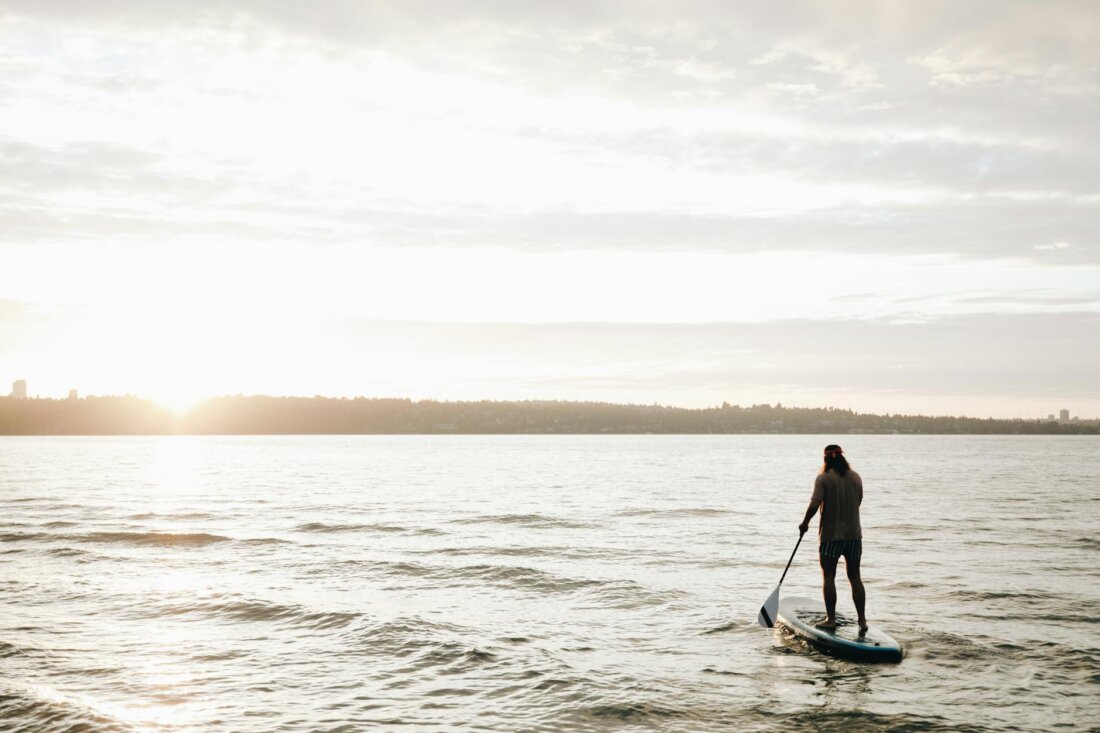
Stand-Up Paddleboarding: The Underestimated Full-Body Workout

6 min read
Everyone thinks stand-up paddling is just leisurely gliding across the lake. True-until you realize after an hour that your abs, shoulders, and legs are burning all at once. SUP is summer’s most underestimated full-body workout, and getting started is far easier than most people think.
What SUP really does to your body
What is stand-up paddling? Stand-up paddling, or SUP for short, is a water sport in which you stand upright on a wide, float-stable board and propel yourself across the water using a long paddle. Sounds relaxing, but every stroke is a full-body workout.
The key factor is the sustained load on your deep muscles. As soon as you’re standing on the board, countless small muscles in your feet, legs and core are constantly compensating for the movement of the water. This happens subconsciously and never stops as long as you stay upright. These deep muscles are often neglected in regular strength training.
Add to that the forward thrust. A clean paddle stroke doesn’t start in the arm; it starts in the core: you plant the blade far forward in the water, pull through the rotation of your hips and upper body, and exit at foot level. Your arms are just along for the ride. Once you grasp this, you can paddle for hours instead of turning back after twenty minutes with burning shoulders. Like open-water swimming, technique determines endurance.
From Kneeling to Steady Stance in Five Steps
The biggest hurdle is mental: standing up for the first time. This sequence works almost every time on the first try-provided the water is calm and the board is wide enough.
Start on your knees
Kneel in the center of the board, roughly over the carry handle. Paddle a few strokes to get a feel for the board’s tilt. The handle marks your balance point.
Hands on the board, feet follow
Lay the paddle across in front of you, place both hands down, and move one foot at a time to where your knees were. Stay in a low squat-don’t stand up yet.
Stand up with your gaze on the horizon
Rise slowly, feet shoulder-width apart and parallel, knees slightly bent. Look ahead toward the shore-not down at your feet. Your gaze steadies your whole body.
Keep paddling immediately
A board in motion is far more stable than one standing still. Start with smooth strokes right away instead of trying to hold your balance motionless. Movement is your ally.
Power your stroke from the hips
Dip the blade well forward, pull through with your core rotation, and lift it out at foot level. Switch sides after a few strokes to stay on course and spare your shoulders.
What You Really Need to Get Started
Here’s the good news for anyone looking to start this summer: you don’t need to buy anything to give it a try. Almost every lake with basic facilities has a rental service, and one or two guided beginner sessions will teach you more than any video. Only when you realise you’re hooked does it make sense to invest in your own gear.
When it comes to your own board, most people opt for an inflatable iSUP. It fits in a backpack, is durable, and perfect for all-round use on lakes and calm rivers. The width matters more than the brand: a board around 80 centimetres wide is far more forgiving for beginners than a narrow race board. A secure leash and a life vest are must-haves, especially if you’re paddling solo. If you plan to make SUP a regular part of your week, pairing it with core strength training is a smart move-because a stable core makes every paddle stroke more efficient.
Why SUP Is the Perfect Move Right Now
Summer is the obvious season, but there’s more to it than that. If you’ve spent the winter training indoors, by June you’re probably craving something that doesn’t feel like a chore. SUP delivers exactly that: you’re outside, on the water, and still working on core stability and endurance-without staring at a stopwatch.
Then there’s the mental side. An hour on calm water, the steady rhythm of your strokes, no traffic, no screens. Many describe SUP as one of the few sports where body and mind unwind at the same time. As a counterbalance to an intense running or strength training plan, it’s pure gold. This summer, give it a proper go-not just for the Instagram shot, but as a real session.
 Cool-down
Click on a question to reveal the answer.
Do I need to know how to swim for SUP?
Is SUP a good workout or just a fun leisure activity?
Inflatable or hard board for beginners?
How often should I get on the water to see progress?
What should I wear?
Outdoor swimming styles: What you need for lakes and seas → Source header image: Pexels / PNW Production (px:9354934)

Editorial Team, IBS Publishing ››
Kitesurfing trackers tested: Fitbit Air vs. Whoop and Apple Watch →
Running in the heat: Your summer training guide →
Bikepacking: Why DACH outdoor athletes are switching to gravel bikes →
Home fitness equipment: What actually lasts →
Translated from the German original using artificial intelligence. The German version is authoritative.