⚡
 Quick Sprint
- ▸Ultra isn’t a leap-it’s a ladder. The ZUT scales distances from 16 kilometers all the way up to the 100-mile crown class: first Grainau, then step by step to the top.
- ▸Weather trumps planning. Heat and thunderstorms slashed the ZUT100 2026 from 164 to 107 kilometers; the 100-mile status vanished. On the mountain, no route is guaranteed.
- ▸Power-hiking isn’t surrender. Even the fastest runners walk the steepest ramps. If you’ve practiced it, you won’t waste seconds on race day.
- ▸The mandatory kit is a blueprint. Whatever UTMB lists, pack for every long mountain tour of your own.
- ▸The mind quits before the legs. With over 5,000 starters, mental prep-not calf strength-separates finishers from dropouts.
What seven distances teach you about your training
What’s remarkable about the Zugspitz Ultratrail isn’t just the longest course-it’s the sheer range. Seven distances raced on the same weekend over the same trails: the 16-kilometre Grainau Trail as the entry point, followed by 28.5, 44, 68 kilometres and all the way up to the 100-mile crown class, the ZUT100. That was the plan. In 2026, heat and thunderstorms forced organisers to make drastic cuts: the ZUT100 shrank from 164 to 107 kilometres, the Ultra and Ehrwald Trails ran 74 kilometres each instead of 106 and 86. If you stand by the route, you see an entire development model laid out at once.
That’s exactly how you should plan your own season. A hundred-mile distance doesn’t begin with a bold calendar entry; it starts with shorter races where you learn to handle technical terrain, tired legs and fuel at high heart rates. The 16-kilometre Grainau route isn’t a consolation prize-it’s the front door. What a truly long distance does to the body is shown in our analysis of the Tahoe 200 Ultra, which plays in an entirely different league.
In the mountains, the clock matters-not the pace
The most common mistake road runners make on their first mountain trail? They watch the pace. The Zugspitz crown distance was designed for 164 kilometres and roughly 8,300 metres of elevation-almost the height of Mount Everest from sea level. Even the weather-shortened 107-kilometre version still had more than 5,000 metres of climbing. On this terrain, pace per kilometre is a meaningless number. It swings between brisk running in the valley and gruelling climbing where a single kilometre can take a quarter-hour.
Experienced trail runners therefore manage by time and effort. They know how long a given climb will take and keep their heart rate in a zone they can sustain for hours. Apply this to your training: plan uphill sessions by duration and vertical metres. One hour of uphill walking at a controlled heart rate teaches you more than chasing a kilometre time that means nothing on the slope anyway.
107 km
Race distance 2026 (planned 164, shortened due to weather)
5,280 m
Vertical metres after weather cut (planned 8,300)
5,000+
Athletes across seven courses
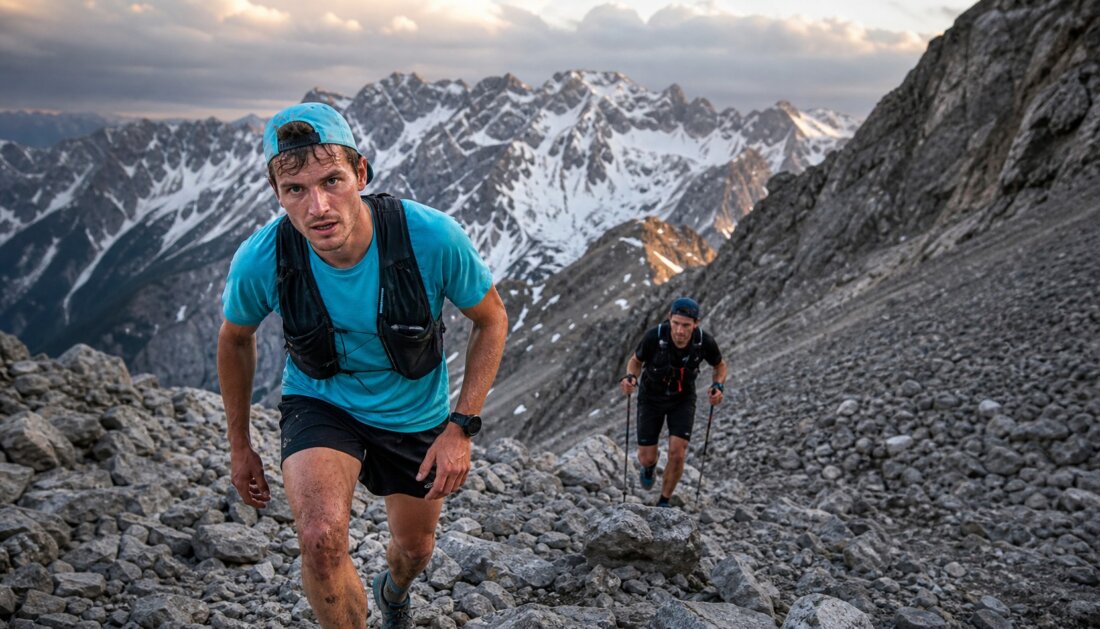
This tiered structure also explains why power-hiking is part of the game. On the steep ramps near the Zugspitze, even elite runners switch to power-hiking because quick, economical walking is more efficient than energy-sapping running. If you see uphill walking as defeat, you’ll burn through glycogen too soon. Practise it deliberately: brisk uphill walking with active arm drive is a skill you’ll never learn on flat ground.
What the mandatory kit list reveals about your planning
UTMB races publish a mandatory kit list, and that list is instructive for every mountain athlete-start number or not. A hooded jacket that’s truly waterproof, backup light, space blanket, whistle, sufficient fluids and fuel for the segments between aid stations. This isn’t organiser pedantry; it’s the lesson of mountain weather collapses when a sunny morning turns to graupel by afternoon.
Use that list as a template for your own long tours. If you’re out alone for four hours in the hills, the same items belong in your running pack even when no one’s checking. Fuel is non-negotiable: on long efforts, energy intake determines whether you stay strong or collapse. Practise eating under load in training, not for the first time on race day.
When the mind gives out before the legs
At the premiere of the hundred-mile distance, the dropout rate was temporarily very high, especially on hot days. Those who dropped out rarely had only empty legs. Most of the time, the mind gives out first: at night, in the relentless rain, on the third climb that feels like the first. This very mechanism-where the brain hits the emergency brake before the muscles are truly spent-has been well studied. We dissected it in detail in our article on Brain Endurance Training.
For you, this means mental preparation is part of your training, not just an afterthought. Break long distances into small sections in your mind, use fixed rituals at aid stations, and consciously get used to discomfort in training-rain, early starts, the moment you’d rather quit. How much this mental battle decides victory or defeat becomes clear every year when you look at races like the Western States 100, where the strongest rarely wins, but the one who makes the fewest mistakes.
Tip: Start by signing up for a nearby trail event and register for the shortest distance that still feels intimidating. A concrete date on the calendar changes your training more than any good intention. You don’t need 164 kilometers to learn the mountain-trail mindset. You just need a first start.
Cool-down
Click on a question to reveal the answer.
I’ve only run on roads so far. What’s a realistic starting distance for trails?
Aim for 15 to 30 kilometres with moderate elevation gain. The leap from road to trail is big enough without doubling the distance right away. For your first mountain trail, allow significantly more time than you would for the same distance on the road-the terrain will slow you down.
How many metres of elevation gain per week should I aim for in training?
It depends on your goal, but a good starting point is simply training uphill regularly. If you live in a flat area, use stairs, bridges or a treadmill with incline. More important than a fixed number is consistency: your body needs to adapt to working hard for long periods on climbs, and that only comes with repetition.
Do I really need trail-running poles?
Not on short, gentle trails. Once the climbs get long and steep, poles save leg power by engaging your arms. If you use them, practise beforehand-handling poles for the first time on race day burns more energy than it saves.
What should go in my trail-running pack?
Follow the UTMB mandatory kit list: waterproof jacket with hood, spare light, emergency blanket, whistle, enough water and food. Even on your own long tours without a race, pack these-mountain weather can turn quickly and help may be far away.
How do I handle heat on the mountain?
Start early, drink consistently and don’t forget electrolytes. Heat is one of the most common reasons runners drop out on long trails. Train in warm conditions so your body adapts instead of facing it for the first time on race day.