






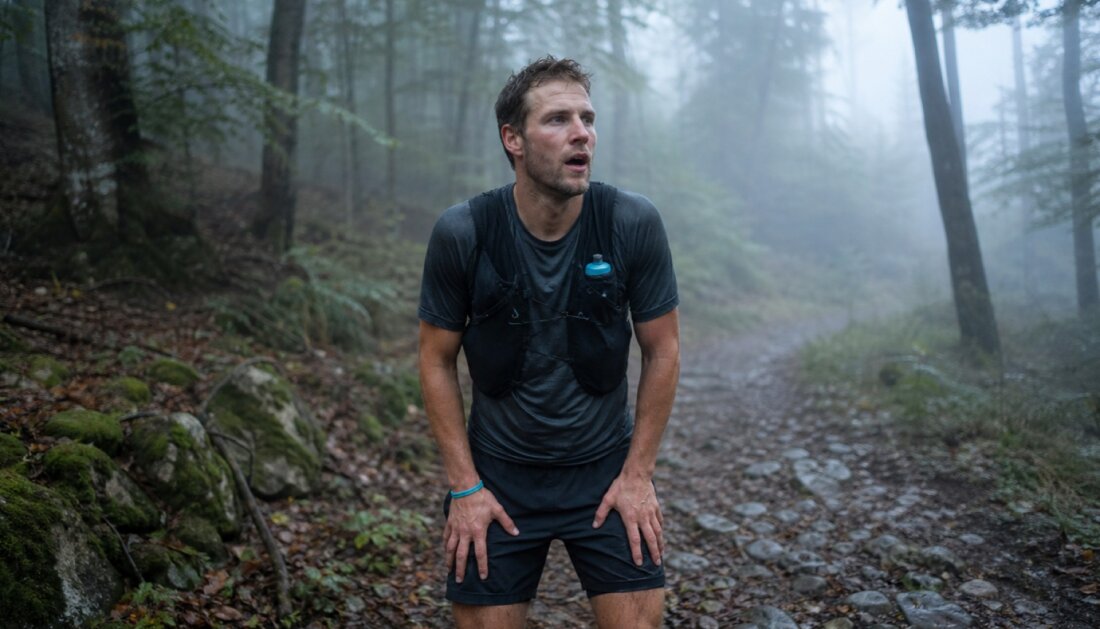
Your Breath Slows You Down Before Your Legs Give Out

5 min read
When you’re gasping for air by the fourth interval repeat, it’s usually your breathing-not your legs-that gives out first. The two are connected; breathing is just the most tangible lever. Freedivers have been working at this threshold for decades. Their tools can be adapted for dry land and integrated into any endurance plan.
 Quick Sprint
- ▸ CO₂ tolerance is trainable. It removes the panic from pure breath pressure.
- ▸ The diving reflex lowers your heart rate measurably, even on land. This helps under load.
- ▸ Static and dynamic apnea tables are two tools with two distinct stimuli.
- ▸ Practice dry first. Never enter water alone. Never hyperventilate before diving.
- ▸ Practice dry first. Never enter water alone. Never hyperventilate before diving.
What is apnea training for endurance? Apnea training involves targeted breathwork with controlled breath holds, often as dry-land exercises. The goal is to improve CO₂ tolerance and maintain calmer breathing under stress. Static and dynamic tables regulate stimulus and recovery. It remains dry-land work and an additional tool for pushing your breathing limits, alongside your running or cycling volume.
Safety Note: Only dry exercises. Never in water without a course and a buddy. Never hyperventilate. Stop immediately if you feel dizzy, tingling, tunnel vision, or pressure in your head. Apnea training is not a substitute for medical advice or running training.
Your Breath Is the Invisible Performance Ceiling
Typical endurance athletes invest in leg strength, lactate threshold, running economy, and power-to-weight ratio. Breathing just hums along in the background, automatic. That’s a mistake. At high intensity, the respiratory muscles themselves become an oxygen bottleneck because they consume oxygen. Shallow, frantic breathing at threshold is simply costly. The moment you feel “out of air” is very often not a cardiovascular ceiling-it’s a CO₂ tolerance limit.
Freedivers have turned this exact limit into a discipline. They measure breath-holds, count diaphragm contractions, and systematically train the moment the body craves air. What looks like an extreme sport is actually a structured training system for the one variable almost every runner and cyclist ignores: how calmly you tolerate rising CO₂ and falling oxygen. You don’t need a wetsuit to benefit.
What Happens in Your Body: Bradycardia and the Dive Reflex
The mammalian dive reflex is no myth. Cold water on the face triggers a reflex cascade via the trigeminal nerve. Heart rate drops. Blood is centralized to protect vital organs. Trained freedivers achieve pulse rates around 40 beats per minute during holds-some even lower.
The reflex isn’t tied to water. Even cold water on the face, on land, triggers a measurable version. For you as an endurance athlete, this means you can train a stronger vagal response. A calmer heart rate at the same external load means lower oxygen demand. Freediving research consistently shows that bradycardia isn’t a fixed trait-it can be trained. Learning to relax into a breath-hold on the couch translates to staying composed during the middle kilometers of a hard interval. That transfer is the whole point.
CO₂ Tolerance Is the Real Lever
The urge to breathe comes from rising CO₂, not falling oxygen. This is the most misunderstood mechanism in all of endurance sports. Your body starts screaming long before oxygen actually runs low. The panic at the end of a hard effort, the gasping, the feeling of “I can’t get air” is overwhelmingly a CO₂ signal. You’re not truly oxygen-deprived-you’ve just exceeded your CO₂ tolerance.
Apnea training targets this exact threshold. Through structured breath-holds with controlled CO₂ buildup, you push back the point where panic sets in. Your body learns: rising CO₂ isn’t an emergency. For you as a runner or cyclist, this means staying composed longer at threshold. The burn becomes information, not a threat. And it’s a lever you can train on a chair.
The Diaphragm Side: Breath Mechanics, Not Mysticism
Most adult desk athletes breathe primarily with accessory muscles in the chest and neck. The diaphragm gets shortchanged. At rest, it doesn’t matter. At threshold, it absolutely does. A weak diaphragm means higher breathing effort, more cardiac output diverted to respiratory muscles, and less for your legs.
Apnea work forces full diaphragm engagement. The holds build pressure control. Recovery breathing trains fast, deep, diaphragm-driven cycles. Freedivers do specific drills for diaphragm flexibility and strength because their sport depends on it. You need the same mechanical control, not their depth. Two weeks of structured diaphragm work often noticeably changes how your breathing feels at tempo pace. The effect is measurable: lower breathing rate at the same speed.
Static vs. Dynamic: Two Tables, Two Stimuli
There are two main formats. CO₂ tables keep the breath-hold length constant and shorten the pause between holds. CO₂ rises across the set. You train tolerance to an increasing signal. O₂ tables do the opposite: fixed pause, growing hold time. You train tolerance to lower oxygen. These are distinct stimuli and belong on separate days.
Then there’s the static vs. dynamic axis. Static apnea means lying still on a mat, measuring a clean physiological response. Dynamic apnea means walking, cycling, or running while holding your breath. That adds load. As a land athlete, start with static and build toward dynamic. Walk first-never jump straight to running with apnea. The most common mistake: people skip the foundation, dive into dynamic work, and interpret the panic as the result. The panic is the signal that you skipped the foundation.
Safety: The Blackout Is Real
Shallow-water blackout is a genuine, documented risk in freediving. It claims the lives of experienced freedivers, not just beginners. The mechanism: hyperventilation before diving expels CO₂. The CO₂ signal that would normally warn you and prompt you to surface arrives too late. You lose consciousness underwater due to low oxygen-without any warning.
The rule is non-negotiable. Never hyperventilate before a breath-hold, never train alone in the water, and never push to the point of blackout-even on dry land. If you feel tingling, tunnel vision, or a warm sense of euphoria, stop immediately. Dry training is low-risk if you halt at the first real contraction or clear urge to breathe. Freediving alone in a pool or open water is the activity that actually kills people. Water work belongs in a course with a certified buddy. Everything in this article works on dry land too.
How to Get Started
- Measure your baseline. Before you begin training, record a clean static apnea session at rest. Lie on your back, relaxed, and breathe calmly for two to three minutes. Then exhale fully and hold. Stop at the first clear urge to breathe-not at panic. This is your reference point.
- Build a CO₂ table. Eight rounds. Hold time remains constant at your maximum minus 30 seconds. Breathing pause starts at two minutes and decreases by 15 seconds each round. Dry, on the couch, one session per week.
- Add an O₂ table after three weeks. Pause remains constant at two minutes. Hold time increases each round. Separate session-never directly after the CO₂ table.
- Diaphragm drills before every run. Three to five minutes of deep belly breathing. Hand on your stomach, chest still. Then start running as usual.
- After six to eight weeks, introduce dynamic apnea while walking. Walk 20 to 30 steps while holding your breath. Then breathe normally and repeat. Never run or cycle.
- Water work only with a course. If you want to train in water, book a beginner’s course with a certified freediving organization. No experiments in the pool.
What You’ll Gain
Apnea training is a systematic tool for the one variable almost every endurance athlete overlooks. Those who train cleanly and cautiously over several weeks can breathe more calmly at the same pace. This only becomes measurable when you honestly log your rhythm and effort-no hero apnea.
More context online: Heart Rate Match · Zone 2 · Brain Endurance · Marathon Build · HYROX.
Cool-down
Click on a question to reveal the answer.
How long does it take to notice benefits from running?
Does the Wim Hof Method deliver the same results?
Is apnea training risky for my circulation?
Can I train apnea while cycling?
Are two sessions per week enough?
Image source: AI-generated (July 2026)