






Fitness Equipment at Home: What Really Lasts

7 Min. Reading Time
My living room had a cross trainer for three months, then a folding home trainer. Both sold. If you have a background in bouldering, trail running, or calisthenics, you’re likely buying home equipment wrong because the recommendations online are optimized for couch potatoes. What remains after three months of setup rotation and in what order you should build.
What My Living Room Gym Setup Really Costs After Three Months
Since January, I’ve been systematically testing home equipment. First, the classic route: a Sportstech elliptical trainer for 449 Euro on sale, an Ultrasport folding home trainer, followed by a TRX set, and then kettlebells. In between, a bouldering board for the door frame, as I thought it would replace two gym visits a week. Spoiler: it doesn’t.
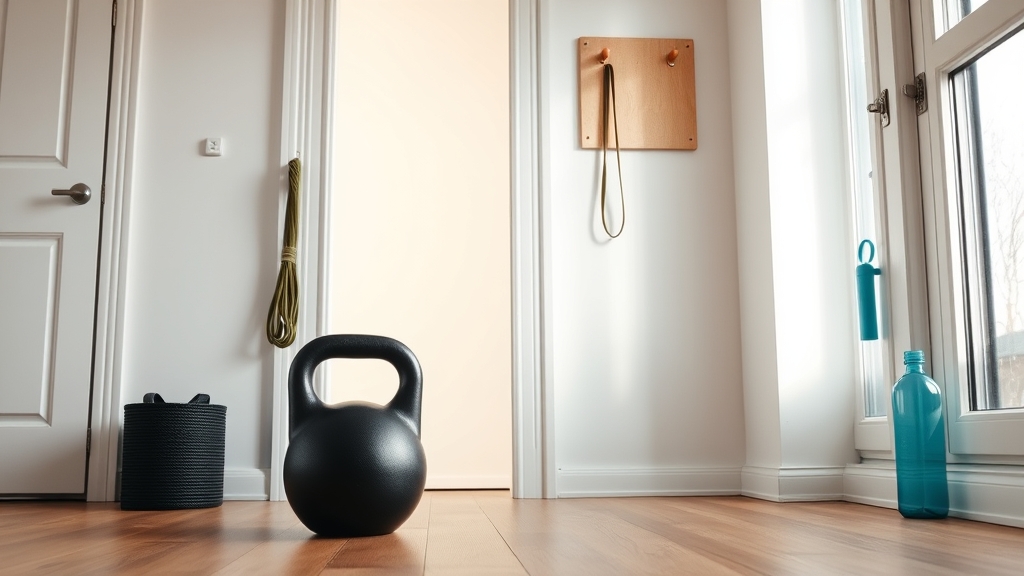
After three months, what remains in rotation: kettlebells, pull-up bar, jump rope, a mobility set consisting of a foam roller plus two mini bands, and a hangboard for the door. Total value: approximately 380 Euro. Space required: half a square meter, as everything can be tucked into a corner. What I got rid of: everything that requires electricity, everything that requires an app, everything that is more of a display than a functional piece.
The point isn’t that large equipment is bad. The point is that they are meant to fill a gap that action sports enthusiasts don’t have. You ride a road bike or run trails. Your cardio gap is zero. What you lack is strength, mobility, perhaps power. For that, you don’t buy cardio equipment that takes up your living space.
The Three Devices Almost Everyone Buys and Quickly Regrets
Three purchases pop up in every Reddit thread and every beginner’s comparison test. And three purchases end up on classified ads after three months. The overlap is no coincidence.
- Weatherproof. If it’s 8 degrees and raining outside, the device still works.
- Low entry barrier. Set up, turn on, start using. No technical hurdle.
- Utilize time windows. Twenty minutes between calls is enough for a session.
- Space hog. An elliptical trainer as a decorative piece ruins the living space you want to enjoy.
- Sub-800 Euro equipment is plastic junk. Racks creak after eight weeks, consoles pixelate, pedals become slippery.
- Double the cardio. You run, ride, paddle, or climb anyway. You don’t need another cardio machine.
Specifically: elliptical trainers in the 400- to 700-Euro range, folding home trainers in the same price class, and vibration plates in any price class. If you really want to indoor cycle and maintain the pace, you buy a smart trainer with your own bike and a Zwift subscription. This is a different game, different price range, different use case.
What Actually Works, in Real Numbers
The numbers above are not from a marketing brochure. This is my actual setup after three months of rotation. What stands out: Cardio is completely missing, and that’s intentional. Who cycles outdoors in the summer and runs trails in the winter has their cardio covered outside. Indoor fills the gap that doesn’t exist outside: Strength, especially in the pull area, and mobility.
Those who boulder or climb add a hangboard. A good set costs between €80 and €150, hangs in ten minutes in a door frame, and requires zero floor space. More effective finger strength per second than in the gym because you isolate specifically, rather than taking breaks between boulder attempts.
The Construction Sequence Over Twelve Weeks
What Does Not Make the Recommendation List
Three categories are excluded, even though they are promoted in every third newsletter. Smart mirror devices (Tonal, Tempo, NordicTrack Vault) cost between 1,500 and 4,000 Euros and are essentially an expensive hardware platform for streaming apps. For outdoor athletes without gym experience, these can be useful as they provide structured sessions. However, for readers with bouldering, trail running, padel, or calisthenics backgrounds, the combination of app subscription and expensive hardware is overkill.
Vibration plates are effective under medical supervision during rehabilitation. In the home gym, they are largely ineffective for training, as studies from the last five years in sports science reviews consistently show. If you want to shake the floors in your rented apartment, you can buy one. If you want to train, this is not the tool.
EMS suits (Electrical Muscle Stimulation) for home use are the most expensive category with the least data benefit for already training athletes. The method has a use case in rehabilitation and for extremely time-crunched hobby athletes who do nothing else. For those already training, twenty minutes with a kettlebell or hangboard yield more results than EMS, at a fraction of the cost.
 Cool-down
Click on a question to reveal the answer.
I live in an apartment. What equipment won’t bother the neighbors?
Are adjustable dumbbells not a universal solution?
Does it make sense to buy used equipment?
Which manufacturers are worth it for kettlebells and hangboards?
At what point does it make sense to switch to a proper gym instead of a home setup?

Redaktion IBS Publishing ››
Mobility Training: 15 Minutes That Will Change Your Workout →
Trail-Running Shoes 2026: The Release Wave from Hoka Mafate X to Salomon S/Lab Pulsar 3 →
72 Hours After the Marathon: What Recovery Research Really Shows →
London Marathon Post-Race Analysis: What Elite Splits and Title Defenders Reveal to the Amateur Runner →
Source Title Image: Pexels / Jan van der Wolf (px:36738339)