






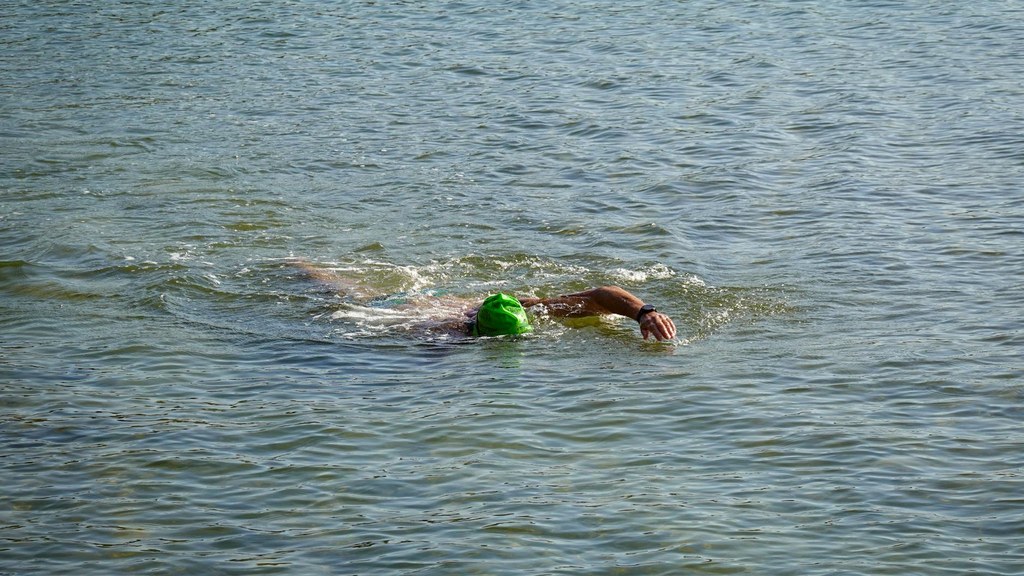
Outdoor Swimming Styles: What You Need at the Lake and Sea
5 Min. Reading Time
You can swim 1,500 metres of freestyle in a indoor pool without stopping. In Lake Starnberg in May you’re done after 200 metres, breathless, disoriented. That’s not a fitness problem. It’s a style problem. What works in a 25‑metre pool collapses in open water because of the wave, the visibility and the cold. Anyone who wants to get out in 2026 – whether it’s the Baltic Sea, a mountain lake, an open‑water race or just a quarry pond – needs a different set of swimming tools than what the swim school teaches.
12.05.2026
Why Your Indoor Pool Style Fails Outdoors
In a pool everything is standardized. Lane 25 or 50 metres, water temperature 27 °C, no wind, no current, no wave, clear view thanks to the blue‑chlorine lines on the bottom. You breathe left, you breathe right, you tap the wall and turn. Your technique is optimized for those conditions.
Then you go to the lake. 14 °C. West wind. 30 cm crest wave. The water looks a dull brown‑green. There is no lane, no wall, no strip on the bottom to orient yourself. Three things happen instantly: your breathing rhythm collapses under the cold shock, water splashes into your face because the wave ignores your breathing phase, and you end up swimming in a direction you never intended.
This isn’t a failure of technique, it’s a style mismatch. The same freestyle pull that moves you efficiently through a lane in a pool becomes a tool without the proper context outdoors. Anyone who wants to swim open water must learn two things: sighting (the visual‑breathing stroke) and switching styles according to conditions. It’s craftsmanship, not talent.
Freestyle in open water: sighting, breathing rhythm, counter‑current
Freestyle remains the standard for distance and pace. But indoor freestyle must be adapted. Three adjustments are critical.
Sighting breath: Every six to eight strokes you lift your head just enough for your eyes to clear the surface. You lock onto your target (buoy, dock, a point on the shore) and submerge again immediately. This is not the same motion as a regular breath. The sighting move is shorter, quicker, and you only breathe on the next normal inhale. If you don’t train it, you keep your head out of the water too long, lose propulsion and constantly correct your line too late.
Bilateral breathing (switching sides every three strokes) is not optional in open water—it’s mandatory. Wind usually comes from one side, as does the wave. If you only breathe right and the wave hits from the right, you’ll swallow water. Anyone who learned to breathe only on one side must retrain bilaterally before the first lake session.
In flowing water a high elbow matters more than in a pool. The early catch right after the entry is the only phase where you truly generate thrust against the current. If you glide shallow there, you’ll drift backward without noticing. A comparative analysis of the efficiency of the four swimming strokes shows why freestyle stays the speed‑stroke outdoors once the technique is sound.
Breaststroke outdoors: when it’s smart and when it costs you
Breaststroke is the beginner’s stroke in the pool, but in open water it suddenly becomes a serious option. The reason: you swim with your head above water, you see your target, you breathe naturally, and you don’t need a sighting trick.
The cost: outdoors breaststroke uses roughly 30 % more energy than in a pool. The kick pushes water wide to the sides. In still indoor water that creates thrust. In waves or light current the kick works partly against the oncoming water, reducing efficiency. You don’t feel more exhausted than in the pool, but you cover only about half the distance per unit of energy.
Breaststroke is smart in three scenarios: during an orientation pause (quick glance, re‑sight, continue), for the first plunge into cold water (you keep breath control), and at a slow pace near the shore (chatting, warming up, cooling down). Breaststroke is not smart for distances over 200 m in open water. Anyone who does a full open‑water lap using breaststroke ends up with half the stroke rate, double the time, and the realization that something went wrong.
Side-Stroke and Backstroke: The Underrated Outdoor Tools
Side-Stroke is the technique nobody learns in a swim lesson but that lifeguards and open‑water veterans love. You lie on your side in the water, one arm pulls underneath while the other sweeps above, the legs perform a scissor‑kick. You breathe continuously because your mouth never goes underwater. You see your target without a sighting trick. Energy consumption is roughly 25 percent lower than freestyle at a comparable pace up to 1 000 metres.
Side‑Stroke answers four outdoor challenges: waves coming from one direction, gear on your back (buoy, tow‑float, swim board), accompanying a weaker swimmer, or simply a long‑distance day when you need to conserve reserves. If you can’t side‑stroke yet, you should learn it before your first long open‑water outing.
Backstroke outdoors is a different story. In the pool it’s a full‑stroke, in open water it’s a tool for a single purpose: a short break without losing speed. You turn onto your back, take a deep breath, relax your shoulders, swim 30 to 60 seconds of easy backstroke and turn again. What you must not do with backstroke outdoors: cover distance. You have no forward view. You risk colliding with buoys, boats, other swimmers, debris. In races, backstroke as the main stroke is disqualified if you miss a buoy course because you didn’t see it.
Four‑Week Outdoor‑Style Drill: The Plan
Week 1: Sighting in the indoor pool. Three sessions. Each session ten 50‑metre freestyle laps with a sighting breath every six strokes. Pretend there’s a buoy at the opposite pool edge and sight it. Sounds absurd—but it builds movement confidence for Day X.
Week 2: Bilateral breathing. If you normally breathe on one side, switch now. Three sessions, 800 to 1 000 metres each, alternating right‑side and left‑side breathing. It feels odd at first. By the second week it becomes normal.
Week 3: First open‑water pace. Calm lake without waves. A wetsuit is mandatory when water temperature is below 18 °C. An experienced companion in a boat or on shore is required. Four 200‑metre sets, alternating freestyle with sighting and side‑stroke. Speed is secondary; movement confidence is the priority.
Week 4: Wave and distance. Seek conditions that aren’t ideal: wind from one direction, light chop, perhaps a spot with current. Three 400‑metre sets. At least one set must include a deliberate style change: 200 metres freestyle, 100 metres breaststroke for a break, 100 metres side‑stroke back to shore. Whoever completes this has the full outdoor‑tool kit. For the jump from indoor pool to open water, this four‑week block is the most honest pathway.
Style Comparison: When Each Works Outdoors
Freestyle outdoors
Strong in: long distances, speed swimming, competition, low waves, clear visibility
Weak in: sighting difficulty, one‑sided breathing technique, dense boat traffic
Breaststroke outdoors
Strong in: orientation, rest, dive phase, short distances, conversational pace
Weak in: choppy water, current, distances over 200 m, prescribed tempos
Side‑stroke outdoors
Strong in: lateral wave action, gear on the back, long distance with reserve, companion swimming
Weak in: maximum speed, competition disciplines that allow only freestyle/breaststroke
Backstroke outdoors
Strong in: short breaks, shoulder relaxation, back‑lying recovery between sets
Weak in: distance, forward visibility, traffic, any open‑water competition situation
An honest answer to the favorite forum question “Which stroke is best outdoors”: none. The question is mis‑framed. Outdoors you need two strokes for sure and a third as a backup. The combination of freestyle plus side‑stroke covers about 90 percent of scenarios. If you also have breaststroke as a rest tool, you’re equipped for almost any condition on a lake, open‑water race, or sea bay. Nothing more is required.
 Cool-down
Click a question to expand the answer.
Do I need a wetsuit for open‑water swimming?
How do I practice sighting when I have no open water?
Is butterfly even an option outdoors?
How quickly can I become ready for open water?
Which stroke is most practical for swimming in the sea?

Source cover image: Pexels / Magda Ehlers (px:13391711)