






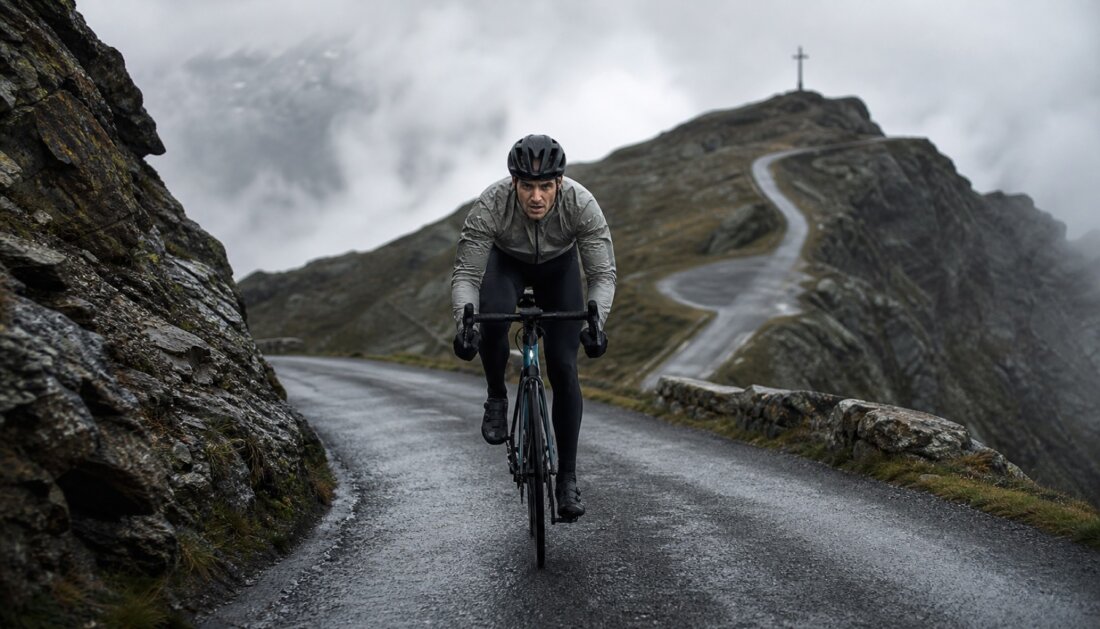
1300 km solo through the Alps from Munich

6 min read
While you’re reading this, someone is pedaling alone somewhere between Munich and the Stelvio Pass. For days on end, without a support car or a team car at the roadside. On 20 June, the riders of the Monaco di Baviera Classic set off at dawn in Munich, facing 1,300 kilometres and 23,550 metres of climbing, with a single deadline in mind: to be back in Munich by 27 June. No service car, no soigneur, no one to swap your inner tube at 2 a.m. It’s this raw self-reliance that gives the race its brutal edge.
 Quick Sprint
- ▸ 1,300 kilometres, 23,550 metres of climbing, start in Munich on 20 June, deadline to return by 27 June.
- ▸ Self-supported means you solve every problem alone. No support vehicle, no team car, no mechanic at the roadside.
- ▸ The route packs in the toughest Alpine passes: Stelvio, Gavia, Mortirolo, Zoncolan, culminating in the Kitzbüheler Horn.
- ▸ Sleep management trumps leg power. A wrong pause can cost hours-or the race itself.
- ▸ The format is growing because it’s honest. No helpers, no excuses-just you, the bike, and the clock.
1,300 kilometres without anyone waiting for you
In a normal stage race, support is everywhere. There’s a bus, a physio on standby, someone handing you a bottle from the team car. At the Monaco di Baviera Classic, none of that exists. Self-supported means no personal crew allowed: no follow car, no private food, no travelling mechanic. If you get a flat at night on a climb, you kneel alone at the roadside and patch it under a headlamp, fingers numb with cold. If you’re hungry, you must know which petrol station within the next 40 kilometres is even open. The organisers call it an Unsupported Challenge, and here it’s not a pose-it’s the rule.
That single rule transforms the race. Speed still matters, but it’s not enough. What becomes decisive is how cleanly you thread your way through the coming hours. When and where do I sleep? Do I eat now, even though I don’t feel hungry, because nothing will be available in two hours? Do I pull on the rain jacket before the downpour, or save those two minutes? A thousand tiny decisions accumulate until they decide whether you gain hours or drop out. It’s strength sport, navigation and self-control on two wheels.
Why more riders are starting without a support crew
Self-supported ultra-cycling has evolved from the fringes of the toughest competitors. Since the Transcontinental boom of recent years, a community has emerged that actively seeks this minimalist approach: one bike, one rider, one route-nothing more. The Monaco di Baviera Classic, listed on the World UltraCycling Association calendar, fits squarely into this movement. To be classified as a finisher, riders must collect points at so-called Explorer-Point sectors along the way-at least 20 of them.
The route gathers some of the biggest names in European mountain cycling. It heads south from Munich, through Austria into the Italian Dolomites, over passes that even professionals approach with respect.
What you can learn from the solo principle
You don’t need to ride 1,300 kilometres to take something away from this race. The self-supported principle works on a smaller scale too. Most of us have been training with an invisible support car in our heads for years: the app that tells us when to take a break, the video that demonstrates the exercise, the group that pulls us along. None of that is wrong. But it robs you of the one skill that matters most in long efforts: learning to feel for yourself what your body needs right now.
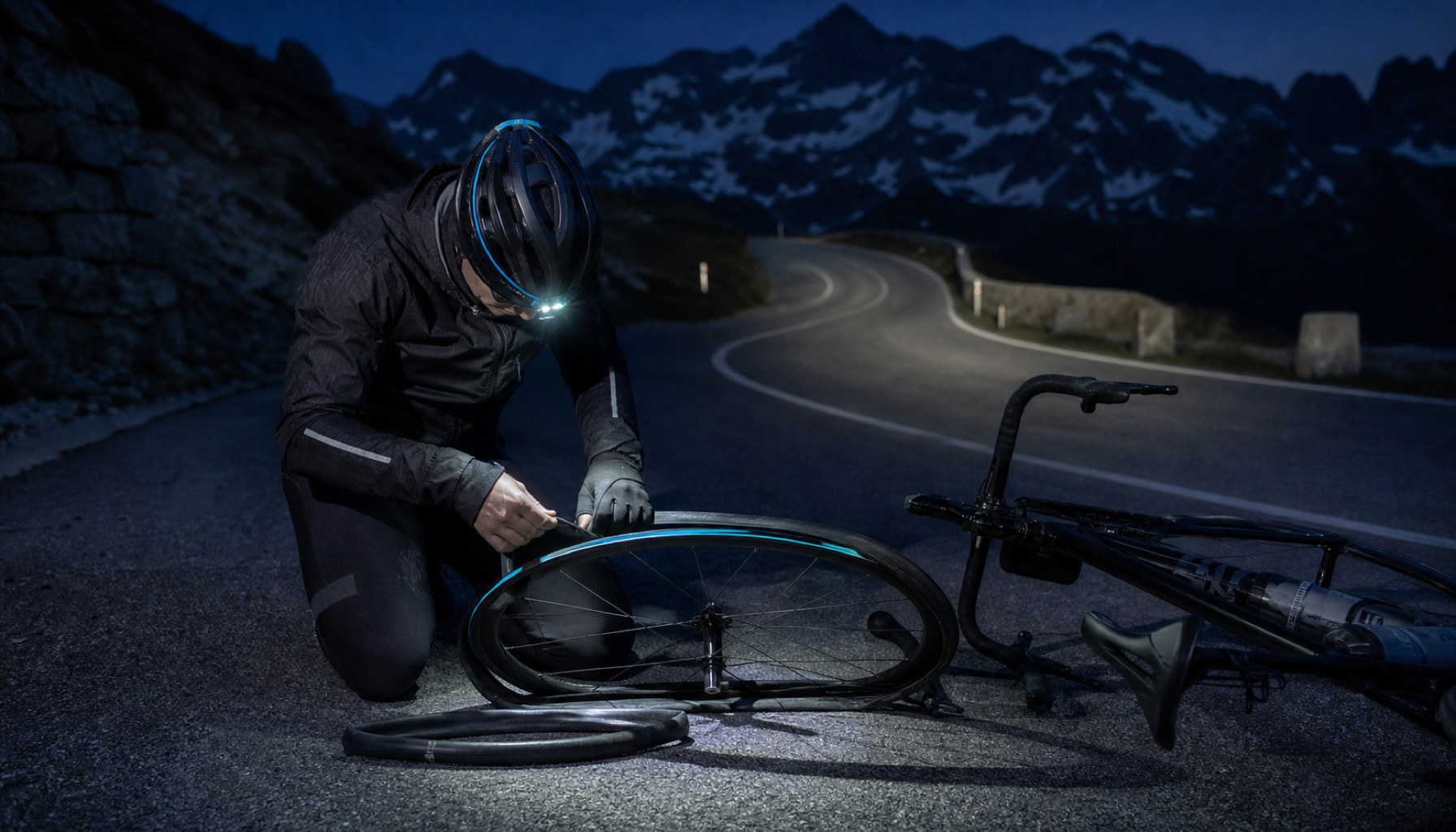
The pros on the course train precisely this. Mental stamina isn’t some soft add-on for them; it’s the toughest discipline of all, and it often fails before the muscles do. Anyone who has ever ridden alone at night on an empty country road-no music, no one else around-knows the moment when only your own thoughts remain, and they can be brutally honest. That’s the moment when those who romanticise the format part ways with those who can actually do it.
The practical takeaway is unglamorous yet remarkably effective. Plan your next long session entirely without aids. No break reminders, no route app holding your hand. You decide when to eat, when to drink, when to turn back. That’s closer to what the riders tackling the Monaco di Baviera Classic are experiencing than any indoor session could ever be. Those who embrace the principle also navigate bikepacking on a gravel bike or a longer endurance block with far more confidence, simply because they’ve learned to trust their own judgment instead of the screen.
Cool-down
Click a question to expand the answer.
What exactly does self-supported mean in an ultracycling race?
How long does the Monaco di Baviera Classic last?
Can an ambitious amateur rider even attempt something like this?
What’s harder: the elevation gain or sleep deprivation?
How can I follow the race live?

Editorial IBS Publishing ››
Bikepacking 2026: From Gravel Bike to Touring Format →
Brain Endurance Training: Why Your Brain Gives Out Before Your Legs →
Critérium du Dauphiné 2026: 5 Endurance Training Lessons →
Tahoe 200 Ultra: What 200 Miles Reveal About Endurance →
Transvulcania 2026: Sinclair Breaks the 11-Year Record →
Image source: Cover and article images AI-generated (June 2026)
Translated from the German original using artificial intelligence. The German version is authoritative.