






Velocity-Based Training: What the Sensor Method Actually Brings to Hobby Athletes

7 Min. Reading Time
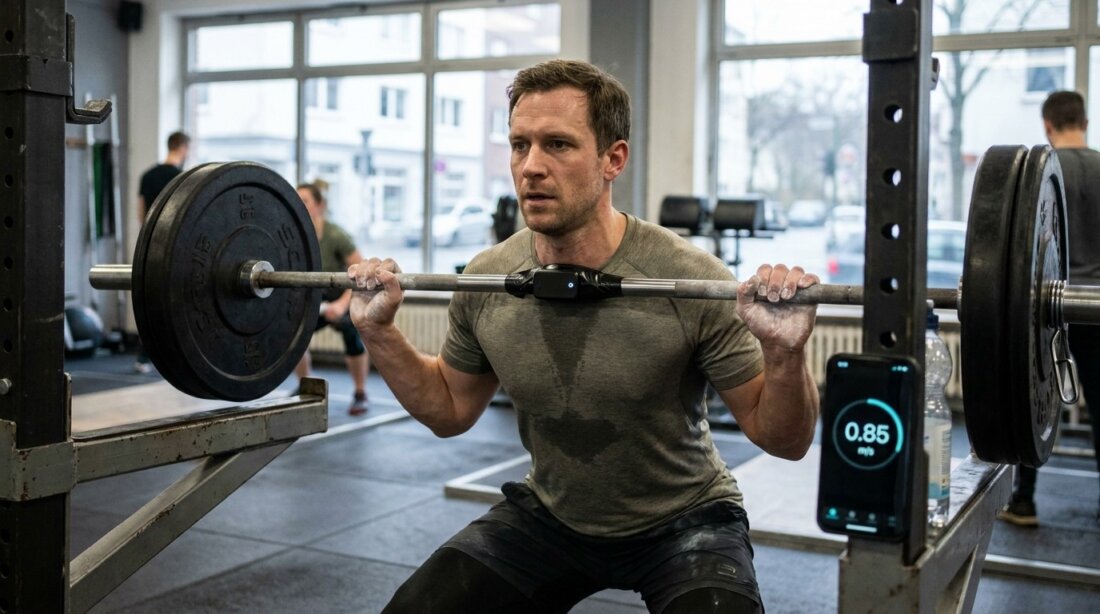
For three weeks, a sensor costing around €250 hung from my barbell. After every repetition, a number lit up on my phone: the speed at which I moved the weight upwards. Velocity-Based Training, or VBT for short, shifts the focus in strength training from the plan on paper to the barbell on that particular day. Instead of fixed percentages of the maximum weight, what matters is how quickly you actually move the load. In the USA, this was long considered professional material; in 2026, the method will arrive for ambitious hobby athletes. The question is simple: Does this number help you with your training, or will the sensor end up next to the fascia roller after two months?
 Quick Sprint
- ▸ VBT controls via tempo, not percentages. A sensor measures how quickly you move the load and tells you in real-time if the weight is right for today.
- ▸ Autoregulation is the actual benefit. On tired days, you go lower; on good days, you go higher. The plan adapts to you, not the other way around.
- ▸ Velocity Loss limits fatigue. If the tempo drops by around 20 percent during the set, it’s time to stop. You train hard without destroying yourself.
- ▸ Useful sensors cost around €200 to €300. Camera apps are cheaper but less accurate. Without precise technology on free weights, none of it works.
- ▸ For beginners, it’s overkill. If you’ve only been training for a year, you’ll get more out of a simple plan than from a m/s number.
What does the sensor on the dumbbell measure?
Velocity-Based Training uses movement speed as the control variable. The idea behind it is simple: every load has its own tempo. You push a light dumbbell quickly upwards, a heavy one moves slowly. There is a clear correlation between load and speed: the closer you are to your maximum weight, the slower the repetition becomes. Sports science has accurately measured this line between weight and speed since the work of González-Badillo and Sánchez-Medina.
The sensor on the bar, an acceleration or position sensor, reads this speed in meters per second. Instead of rigidly lifting 80 percent of your maximum today, you train in a target zone: stay between 0.5 and 0.75 meters per second, then you’re in the strength range. If you get slower in the set, you’re getting tired. This is where VBT becomes interesting because your maximum weight isn’t the same every day. Poor sleep, job stress, three days of inadequate food: last week’s 1RM may be too high today.
| Criterion | Classic (percentage of maximum) | Velocity-Based Training |
|---|---|---|
| Control variable | Fixed percentage of best value | Dumbbell speed in real-time |
| Daily form | Ignored | Directly incorporated |
| Equipment | None | Sensor (around 200 to 300 Euro) |
| Feedback | Feel and number of repetitions | Objective number after each rep |
| Suitable for | Beginners, simple plans | Data-savvy, ambitious athletes |
Anyone who’s ever tried to build their first clean pull-up knows the principle: progress becomes more tangible when you have a measurable variable. VBT provides this variable for the barbell, just in meters per second instead of repetitions.
3 Weeks of Sensor Training: What Changes in Everyday Life?
The first effect happened in the head, not in the muscle. I stopped rationalizing weights. A repetition that feels heavy but goes up at 0.7 meters per second is not at its limit. The sensor takes the drama out of your head and replaces it with a sober number. This is uncomfortable and at the same time liberating, because you no longer have to guess whether you’re lazy or just exhausted today.
The second effect concerns the end of the set. Instead of stubbornly doing five repetitions, you end the set when the tempo drops by a fixed value, often around 20 percent compared to your fastest repetition. This is called Velocity Loss and is the most elegant part of the method. You collect enough hard reps for the stimulus, but stop before the technique falls apart and fatigue lays you flat for the next two days. If you also pay attention to your nutrition for muscle building, you’ll notice the difference in regeneration even more clearly.
What the Sensor Really Brings
- Honest Feedback instead of gut feeling, every rep evaluated individually.
- Autoregulation that respects your daily form.
- Fatigue Control via Velocity Loss, less junk volume.
- Motivation because a rising number is addictive.
Where It Doesn’t Bring Anything
- On Machines, the movement is too guided for clean values.
- With Shaky Technique, then it only measures your chaos.
- For Pure Pump, those training for aesthetics don’t need m/s.
- In the First Training Year, consistency counts more than data.
Things get interesting where VBT comes together with other motion data collection. The same logic that measures the dumbbell here is also behind apps that film and evaluate your technique, such as bouldering with an AI coach. Sensor technology is leaving the profile labs and becoming a training supplement for everyone who wants to take a closer look.
Who benefits from the sensor and who saves the money?
My honest conclusion after three weeks: The sensor is worth it if three things come together. You train regularly with free weights, your technique for squats, bench press, and deadlifts is solid, and you want to work specifically on maximum strength or explosive strength. Then VBT is a real tool because it bridges the gap between training plan and daily form that everyone knows and hardly anyone solves cleanly.

If, on the other hand, you primarily train for aesthetics and well-being, or you’re in your first or second year, then you’re better off investing the €250 in good coaching or simply more time under the bar. The number on the display doesn’t change the fact that strength training is primarily a matter of consistency and clean execution. The sensor sharpens good training. It doesn’t replace missing training. And, by the way: The speed at which you catch your breath again after a set often says more about your condition than any app, which you realize at the latest when you take an honest look at your own regeneration after tough units.
Cool-down
Click a question to expand the answer.
Does Velocity-Based Training Work Without an Expensive Sensor?
Which Exercises Make Sense for VBT?
What Does the Number in Meters per Second Actually Mean?
Is Velocity Loss the Same as Training to Muscle Failure?
Is VBT Worth It for Pure Hobby Athletes?
Bouldering with AI Coach: What Movement-Scoring Apps Can Do in 2026 →

Editorial IBS Publishing ››
Learn the Pull-up: 8‑Week Plan for Your First Pull‑up →
Muscle‑Building Nutrition Plan: What Outdoor Athletes Need to Eat →
Rowing Machine Training: Why the Erg Is the Most Honest Full‑Body Workout →
Cold Plunge: When Ice Bath Helps and When It Hinders →
Image source: Cover and article images AI‑generated (June 2026), C2PA certificate embedded in the image
Translated from the German original using artificial intelligence. The German version is authoritative.