






Regeneration for Endurance Athletes: What Really Matters

6 Min. Reading Time
You get stronger in the hours after your workout. Training creates the stimulus, adaptation happens during rest, eating, and sleeping. Those who ignore this accumulate hard kilometers and still get slower. Five levers determine whether you can build pressure tomorrow or just manage fatigue.
 Short Sprint
- ▸ Sleep is the foundation. No massage gun can save a bad night. Seven to nine hours are the most effective recovery you have.
- ▸ Eat for repair. Protein and enough carbohydrates after training fill the stores and provide building materials.
- ▸ Movement beats stillness. Light rolling or a walk promotes blood circulation more than the sofa.
- ▸ Cold bath is not a miracle cure. Cold immediately after intense strength training can even dampen adaptation.
- ▸ Plan with breaks. Recovery starts with a training plan that actually includes rest days.
What Happens in the 48 Hours After the Workout?
Every intense session leaves traces. You deplete your energy stores, stress fine structures in the muscles, and challenge your nervous system. Progress comes only afterward, when your body repairs, replenishes, and adapts a little beyond its previous level. Training scientists call this supercompensation. For your training, this means: without recovery, the stimulus remains.
Here is where many ambitious hobby athletes fall off track. They stack hard days because more training feels like more progress. Eventually, every session takes place on half-full reserves, and even easy kilometers feel sluggish. Anyone who doesn’t switch off between sessions knows this feeling. How strongly mental fatigue begins is shown by looking at the Brain Endurance Training.
Why 7 to 9 Hours Bring More Than Gadgets
If you improve just one thing in your recovery, start with sleep. During deep sleep, your body releases most of its growth hormone, which controls repair and adaptation. At the same time, the brain sorts out motor patterns you practiced during training. A night with five hours turns a good session into a tired copy.
The target is seven to nine hours, consistently, not just caught up on weekends. Practically, a dark, cool room, a fixed rhythm, and avoiding bright screens before bed help. Those who train hard should aim for the upper end of the range. Sleep is not a lost day-it’s the shift in which your training actually works.
Eat for Repair, Not Just Performance
After an intense session, your body needs two things: refilled energy stores and building materials. Energy comes from carbohydrates, which refill your depleted glycogen stores. The building material comes from protein, which repairs and strengthens the strained muscles. Drinking only water and eating nothing for hours after training wastes part of the adaptation process.
For active endurance and strength athletes, a daily protein intake of about 1.6 grams per kilogram of body weight is often recommended, spread sensibly throughout the day. The exact number depends on volume and goals, but the principle remains: regular, not all at once. What this looks like on the plate is explored in the Nutrition Plan for Muscle Building.
When Light Movement Is Better Than Stillness
A complete couch day may feel deserved, but it doesn’t always get you back the best. Light movement at low intensity pushes fresh blood through the strained muscles, transports metabolic waste away, and keeps joints supple without adding new stress. A relaxed walk, easy cycling, or gentle mobility work often works better than stillness.
The art lies in intensity: active recovery should feel light, almost boring. As soon as you start sweating or become ambitious, it’s no longer recovery-it’s another session. A good example of joint-friendly movement alongside the main sport is shown in the Disc Golf as Recovery Training.
Ice baths, massage guns, compression: What actually works
A lot is sold in the name of recovery: ice baths, massage guns, and compression. Ice baths leave you feeling refreshed and can help you bounce back quickly during tightly scheduled competitions. However, right after intense strength training, evidence suggests that the cold actually blunts the very inflammatory signals your muscles need to grow stronger. If your goal is muscle growth, it’s best not to jump into an ice bath immediately after your session.
Massage guns and compression gear can feel great and temporarily reduce perceived stiffness. But they are no substitute for sleep, nutrition, and smart load management. The honest hierarchy remains: master the basics first, then add the gadgets. Just how objectively training load can be measured is demonstrated by the sensor method behind Velocity-Based Training.
Cool-down
Click on a question to reveal the answer.
How many rest days a week do I need?
Does post-workout stretching actually help with recovery?
Should I train through muscle soreness?
Are ice baths pointless?
How do I know if I’m not recovering enough?

IBS Publishing Editorial Team ››
Brain Endurance Training: Why your mind gives up before your legs →
Muscle Building Nutrition Plan: What outdoor athletes need to eat →
Disc Golf: The perfect recovery workout for surfers →
Rowing Machine Training: Why the erg is the most honest cardio →
Velocity-Based Training: What the sensor method offers amateur athletes →
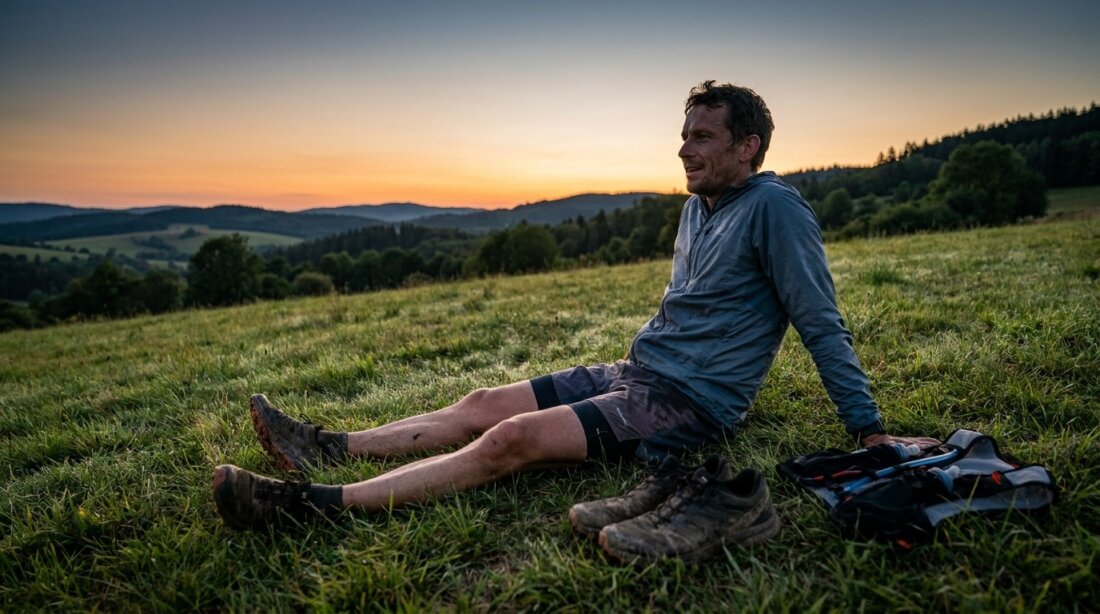
Image source: AI-generated (June 2026)
Translated from the German original using artificial intelligence. The German version is authoritative.