






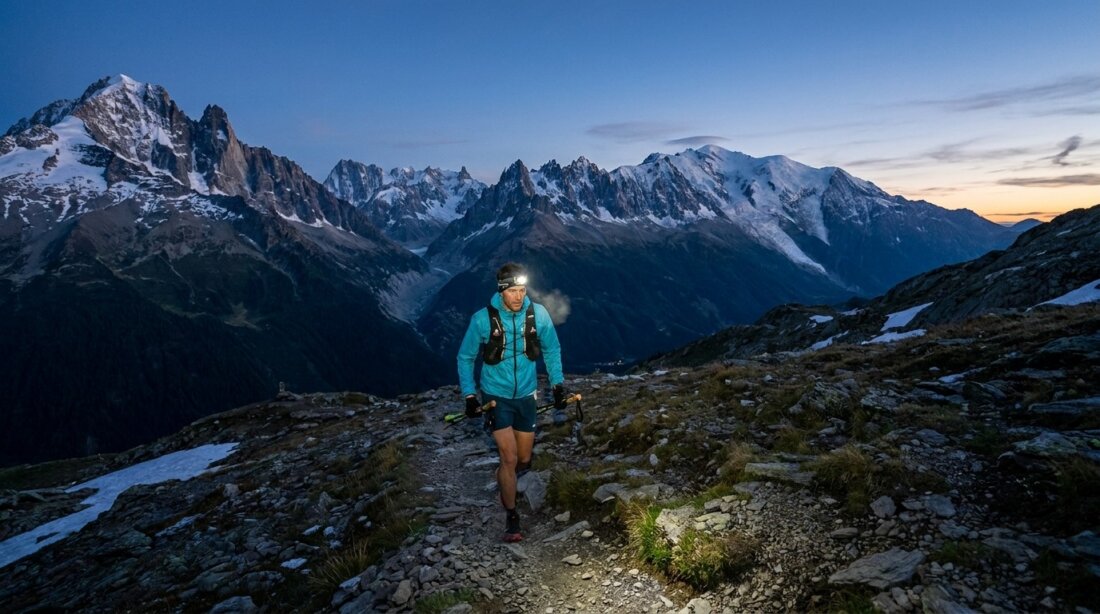
UTMB 2026: The Anatomy of the World’s Hardest Race

8 min read
At 5:45 p.m. on 28 August 2026, around 2,500 runners will set off in Chamonix. Ahead of them lie 171 kilometres, 10,000 metres of elevation gain, and at least one night in the mountains. Tom Evans conquered this race in 2025 in 19 hours and 18 minutes-after dropping out here in the two previous years. He wasn’t leading for long. He simply navigated the descents and the darkness better than the rest. That’s the anatomy of the UTMB: the race isn’t decided at the start, but on the downhills and in the second night.
 Quick Sprint
- ▸171 kilometres, 10,000 metres of elevation, three countries. Start and finish in Chamonix, highest point Grand Col Ferret at 2,537 metres. Time limit: 46 hours 45 minutes.
- ▸Patience beats early surges. The lead group holds back in the opening hours, controlling pace. Those who push too hard early pay for it later with their legs.
- ▸Downhills decide. The eccentric load of descents shreds quadriceps. Muscle-damage marker CK rises 20- to 100-fold.
- ▸Fueling is craftsmanship. 90 to 100 grams of carbohydrates per hour from gels, cola and solid food keep energy deficits in check.
- ▸The night filters. The sub-24-hour elite runs an entire night without sleep. The chasing pack battles two nights against fatigue and fuzzy decisions.
Patience in the first 80 kilometres separates the field
The mass start in Chamonix is loud, tight and fast. Everyone who knows the race warns against exactly that. Before reaching Courmayeur, the major checkpoint in Italy at around 79 kilometres, there are several long climbs and the first technical descents. Anyone who follows the pace of the early leaders here has already lost the second half of the race before it even begins.
Tom Evans took the opposite approach in 2025. He let the early front-runners pull away, tackled the climbs efficiently by alternating between running and brisk walking, and stuck to his own plan. This isn’t caution born of hesitation-it’s a calculated bet on physiology: a body that doesn’t overreach in the opening hours still has reserves after 100 kilometres. Les Contamines at 31 kilometres and Courmayeur are the points where the field visibly begins to stretch out.
Why the descents from Grand Col Ferret break the race
The highest point of the course is at Grand Col Ferret, 2,537 metres above sea level, roughly 108 kilometres from the start. From there, the route winds its way downhill-often technically-over long stretches. And it’s precisely those downhill sections that pack the real punch. Every descent places an eccentric load on the quadriceps, meaning the muscles lengthen under tension. This type of strain tears fine structures in the muscle tissue. The marker enzyme creatine kinase, or CK, can rise 20- to 100-fold above resting levels during an ultra.
The insidious part is the delayed onset. The damage barely hurts in the moment it occurs. It accumulates and strikes in the second half of the race, when every downhill step sets the thighs ablaze and the next climb feels like a wall. That’s why many top-tier runners drop out after Courmayeur or on the Swiss section. It’s rarely just a matter of pace. More often, it’s wrecked legs, stomach issues, or a missed time cut. The muscle damage ultrarunners only feel during recovery explains why the race unravels on the descents rather than on the flats.
Chamonix, mass start
As dusk falls, the field sets off toward Les Houches. The lead group holds back deliberately while the chasing pack presses forward.
Les Contamines, headlamps on
First major aid station, the first night begins. From here, every sip and every gel counts-watch the field stretch out noticeably.
Courmayeur, the field stretches out
Italy’s Life Base with crew access and drop bags. After nearly half the distance, the first setbacks appear-those early descents have already left legs compromised.
Champex-Lac, the strain hits home
After Grand Col Ferret, cumulative muscle damage and energy deficits take their toll. For many, the second night begins here.
Chamonix, back in the valley
Sub-20-hour runners arrive the following afternoon. Everyone else runs against the clock until the 46-hour, 45-minute limit.
Fueling and a sleepless night propel the leaders across the finish line
The decisive figure in the second half of the race isn’t on the clock-it’s on the nutrition plan. Sub-24-hour runners consistently consume 90 to 100 grams of carbohydrates per hour, a mix of gels, cola, and solid food at roughly 15 aid stations. It sounds-and is-like a lot. The stomach must process this volume over twenty hours while the body operates under sustained stress. Many lose the race to a rebellious gut because they never tested this intake under load.
Then there’s sleep-or rather, the lack of it. The leaders run straight through the night and cross the line the following afternoon in daylight. The chasing pack faces two nights on course. The second is the tougher one. Sleep deprivation doesn’t just sour moods; it clouds perception and judgment. After Champex-Lac at 125 km and Trient at 139 km, the focus shifts from pace to clean management of the final hours.
In the end, the numbers speak plainly. In 2025, of 2,492 starters, 1,665 reached the finish line-a finish rate of about 67 percent. The average finisher spent 38 to 40 hours on course. Tom Evans covered the same distance in 19 hours 18 minutes. The gap isn’t down to talent alone, but to the ability not to lose a race downhill and in the dark.
Cool-down
Click on a question to reveal the answer.
What exactly is the UTMB?
How do you even get into the starting field?
Do runners sleep during the race?
Why is downhill running so crucial?
How long does a typical finisher take?

Editorial Team IBS Publishing ››
Western States 100 2026: How Bouillard shattered the course record →What the toughest high-altitude ultra teaches about real recovery →Hydration-vest test over 100 km: Which models actually hold up →Zugspitz Ultratrail 2026: Lessons for your mountain training →Your first marathon: The 16-week plan that really delivers →
Image source: AI-generated (July 2026)