






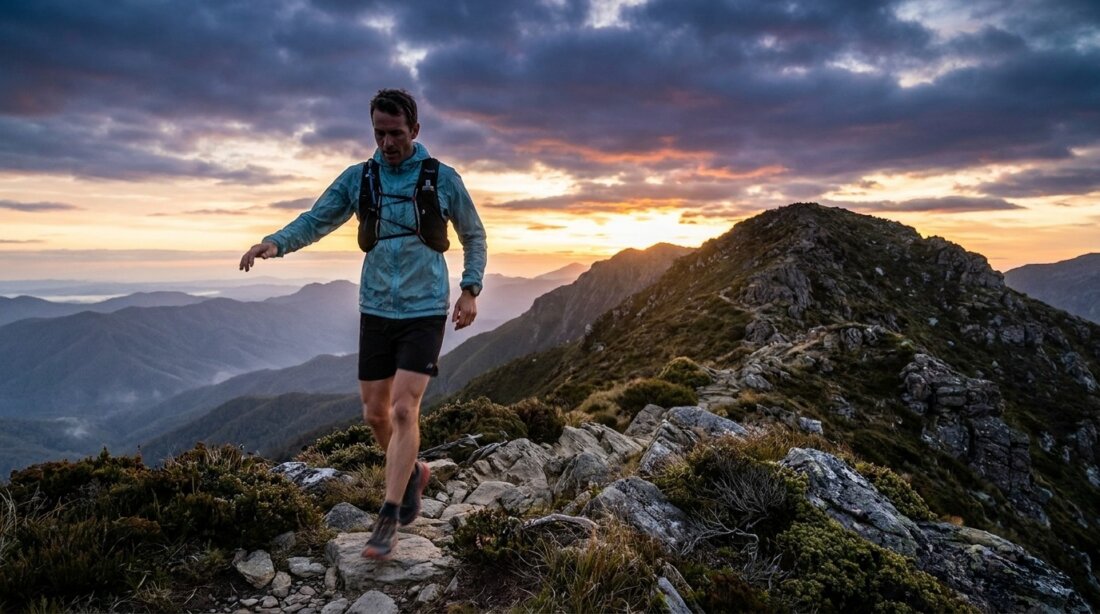
What the Hardest Altitude Ultra Teaches About Recovery

08.07.2026
5 Min. Read
On July 10, Silverton, Colorado sends 147 people on a loop that strikes most of us as absurd: 165 kilometers through the San Juan Mountains, more than 10,000 meters of elevation gain, a 48-hour time limit. The Hardrock 100 isn’t a race in the usual sense, it’s not about speed but about arriving. And that’s exactly what makes it a lesson. Not because you’ll ever run it, but because it shows what altitude and exhaustion do to a body once every buffer is gone.
 Quick Sprint
- ▸The Hardrock 100 kicks off on July 10 in Silverton, 165 kilometers and over 10,000 meters of elevation gain through the San Juan Mountains.
- ▸Altitude is the real opponent, large stretches of the course sit well above 3,000 meters.
- ▸A 48-hour time limit shifts the logic from pace to pacing and recovering on the move.
- ▸Altitude acclimatization takes weeks, you can’t cram it into the final days.
- ▸The principles apply to you too, even if your race is only a tenth as long.
A Race That Flips the Rules
In a 10K or half marathon, everything revolves around pace. At Hardrock, pace is almost beside the point. Anyone who wants to take on 33,000 feet uphill and back down has to master one thing above all: endure without destroying yourself. The fastest finishers need more than a day, most fight their way toward the 48-hour cutoff. It’s a competition in pacing, not sprinting.
In 2026 the field runs clockwise, casually described in the scene as up the walls and down the ramps. That means steeper, shorter climbs and longer, gentler descents. Details like these sound like trivia, but they’re training strategy in its purest form. Anyone who knows what’s coming trains the right muscles and saves their reserves for the sections that matter. And that same forward-looking thinking is something you can steal for any race of your own.
Why altitude changes everything
The Hardrock course runs almost entirely at heights where the air is noticeably thinner. Less oxygen pressure means your heart works harder for the same output, and recovery between climbs takes longer. Nights at altitude also rob you of sleep quality. The body compensates over weeks by producing more red blood cells and adjusting breathing. It’s not a switch you flip right before the start.
Then there’s a factor many underestimate: recovery during the race itself. At Hardrock, there’s no clean split between effort and rest. The body has to heal while it keeps working. Aid stations become mini reset points where runners eat, drink and briefly take the weight off their legs before the next climb. This art of recovering in motion might be the most overlooked skill in endurance sport. Master it, and you can absorb loads that look impossible on paper.
For athletes coming from the lowlands, that’s the hardest lesson. Two weeks of arrival beforehand versus none at all makes a massive difference. Anyone who’s hiked an alpine pass on vacation and felt oddly drained past 2,500 meters has had a taste of it. At Hardrock, that effect is the normal state for two straight days.
What you can take into your own training
You don’t need to run an ultra to benefit from Hardrock logic. Three principles carry over directly.
- Altitude needs lead time. Planning a race or a mountain tour, give your body days to weeks to adapt. An altitude training camp is a luxury, but even arriving early helps.
- Recovery is part of performance. Hardrock runners recover while walking and at aid stations. Translated: build active breaks in deliberately instead of treating recovery as lost time.
- Know the course. Knowing where the hard sections hit lets you ration your energy smarter. That holds for 100 miles just as much as for your next trail half marathon.
The fourth point appears in no training plan, but it’s the most important one: patience with your own body. Altitude and long efforts can’t be outsmarted, only respected. Push too hard too fast and you pay with headaches, bad sleep or, worst case, altitude sickness. Hardrock finishers often look wrecked to the point of caricature in photos, yet they’re excellent managers of their own resources. Treating your own limit as a quantity to work with rather than against is the real takeaway for the everyday life of any ambitious athlete.
The limits of the comparison
Let’s be honest: Hardrock is an extreme that has nothing to do with most athletes’ everyday lives. The participants have years of experience, a lottery draw behind them and a training volume that’s barely feasible alongside a regular job. Try to copy the ultra one to one and you’ll quickly land in overtraining or injury. The value isn’t in the imitation, it’s in the principle behind it. Respect altitude, plan for recovery, know the course. These three ideas cost you nothing and make every mountain race safer. And when you see the first images from Silverton on July 10th, at least you’ll know why these people look so slow yet pull off something superhuman.
Cool-down
Click a question to expand the answer.
At what altitude do I even notice the lack of oxygen?
How long does real altitude adaptation take?
Can I simulate altitude training at home?
Why do the runners walk uphill instead of running?
Western States 100 2026: Bouillard shatters the record →Zugspitz Ultratrail 2026: Lessons for your mountain training →Recovery for endurance athletes: what actually matters →Broken Arrow 23K: Kiriago smashes the course record →Mountain of Hell 2026: The mass start with 1,073 riders →

Editorial Team, IBS Publishing ››
Image source: AI-generated (July 2026)