






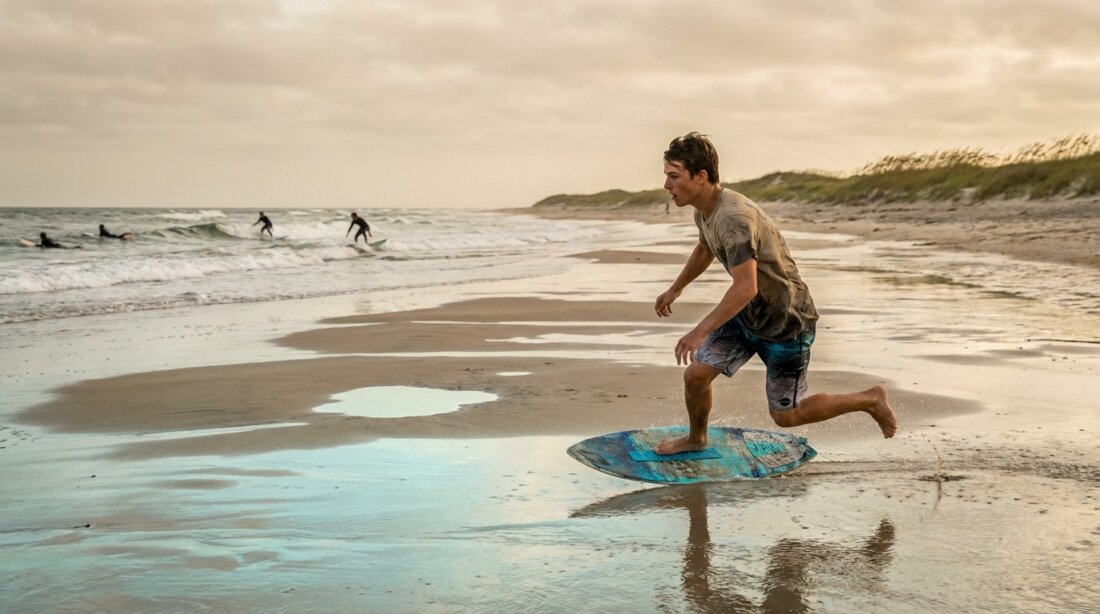
Skimboarding for Beginners: From Beach Fun to Gliding

6 min read
It is the moment right before impact that gets you hooked. You sprint across the wet sand, throw the board in front of you, jump on, and for one second you actually glide. Then one foot is in the water and so is the rest of you. Skimboarding first looks like surfing for the lazy. The impression is misleading. It is its own sport with its own technique, its own scene, and an entry barrier lower than almost anything else on the water. All you need is a board, a flat beach, and the willingness to get wet a few times.
Why Skimboarding Requires More Timing Than Strength
I used to think skimboarding was just what kids do at the beach when they don’t have a surfboard with them. Wrong. The sport splits into two clearly separate worlds, and which one you choose determines your board, your spot, and your learning curve.
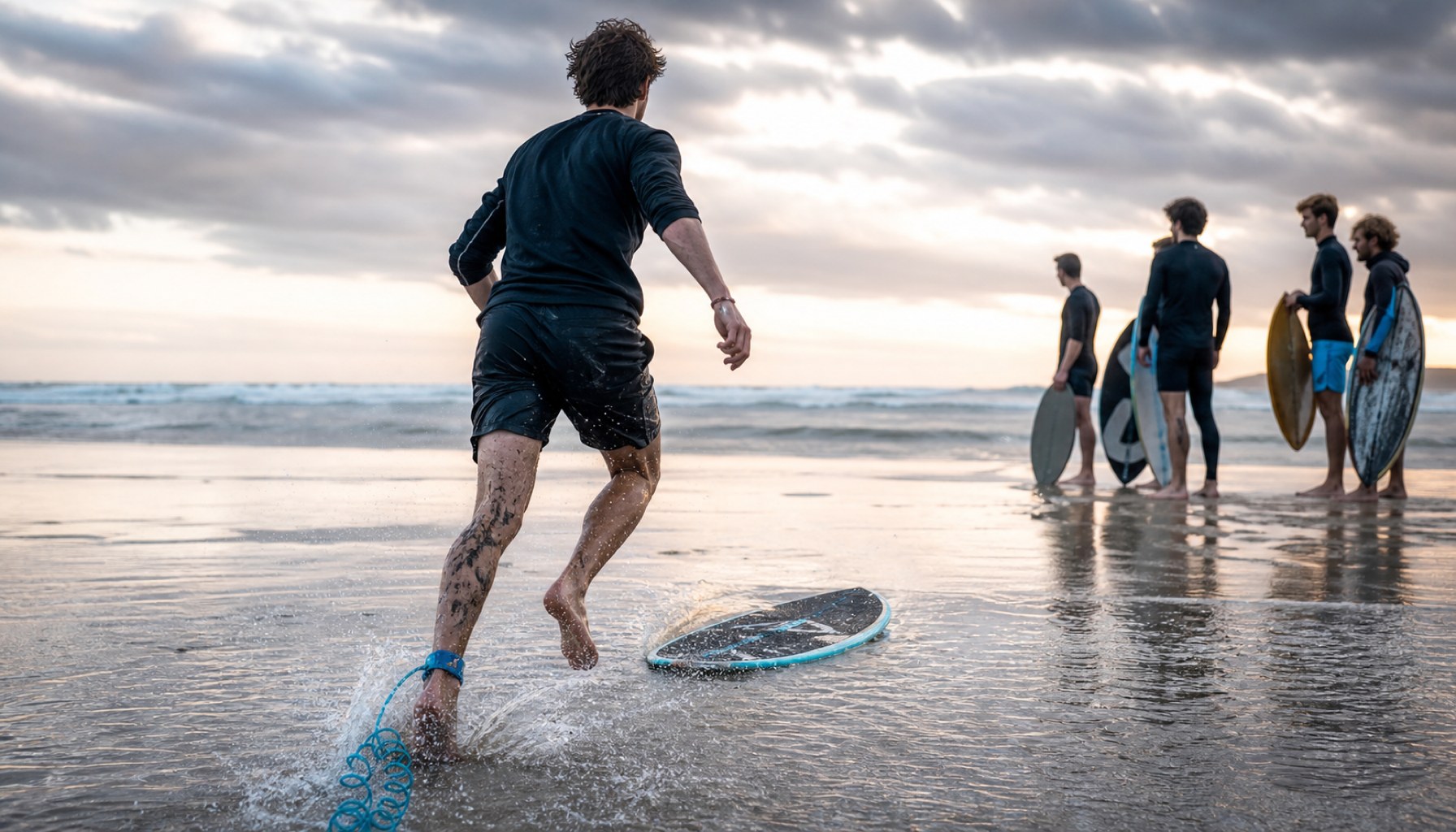
Flatland takes place on mirror-smooth flat water or wet sand. You glide, turn, practice tricks, and when you fall, you fall into just a few centimeters of water. That’s exactly why most people start here: the spot is anywhere the beach tapers out flat, and falling rarely hurts. Wave is the other league. Here you run toward the receding water, hit the shorebreak at the right moment, and ride the wave back toward the beach. Stiffer, longer boards with rocker, more speed, more risk.
The movement itself is always the same: approach, lay the board flat on the water, jump on, glide. What changes is the timing. In Flatland you have time. In Wave, half a second decides whether you catch the wave or disappear in the foam. Anyone who has balanced on a stand-up paddle knows the feeling of an unstable surface, but the dynamics are completely different.
How Skimboarding Came from Laguna to the Rhine
Skimboarding has more history than a first glance suggests. The sport originated in the 1920s in Laguna Beach, California. Lifeguards used flat wooden boards to move quickly along the beach and ride shorebreak that was too small for surfing. Later it developed into its own scene.
This European development is exactly what makes the sport interesting for you. You don’t have to go to California to start. Any gently sloping lake shore, any Baltic Sea beach at low tide, and any riverbank with wet sand works for your first attempts.
That leaves the question of the board. Beginners make the most common mistake here: they buy too expensive and too advanced. A wooden board is inexpensive, heavy, and stable. It lies steady on flat water and forgives when your timing is not yet perfect. A foam board with an EPS core and epoxy is lighter, floats better, and lasts longer, but it is more expensive and almost too lively on flat water. For the first few weeks, wood is the more honest choice. Size depends on your weight: roughly 115 centimeters at around 55 kilos, up to over 130 centimeters beyond 85 kilos. A board that is too small sinks under you; one that is too big feels sluggish.
How to Glide Your First Meters
The first real hurdle is not gliding itself, but the takeoff. The sequence has three phases. Approach: You sprint parallel to the water’s edge, board in both hands. Speed is your friend; without speed there is no gliding. Place the board: You lay the board flat on the water in front of you, not beside you, not on edge. Flat is everything. Step on: You step on while running, front foot first, rear foot immediately after, soft knees, eyes forward.
The foot reflex is crucial. In Flatland you set the front foot first because that helps you maintain balance over the glide distance. In Wave riding you tend to take the rear foot first so you don’t lose speed. Your feet stand roughly shoulder-width apart, rear foot at the tail, front foot about a foot length ahead. Stiff legs are the fastest way into a fall, so stay loose in the knees.
You hardly need protective gear at the beginning. What matters is knowing the ground: no rocks, no sudden drop-offs, no strong current. Flat, clear water where you can see the bottom is the ideal learning spot. Once you glide cleanly after a few sessions and try your first turns, it is worth switching to a foam board. At that point many people are drawn toward the shorebreak, and that is exactly where the sport starts to become addictive. Anyone who wants to get a taste of competition will find several cup events across Europe during the season; the Polish Skimboarding Open in Gdansk is the biggest of them.
 Cool-down
Click a question to expand the answer.
Do I need prior experience in water sports?
Wood or foam for the start?
Where can I skimboard in Germany?
How long does it take until I can glide?

IBS Publishing Editorial ››
Stand-Up Paddling: The Underestimated Full-Body Training →Kitesurfing Tracker Test: Fitbit Air vs. Whoop →Via Ferrata for Beginners: Safely Tackling Your First Via Ferrata →Bouldering for Beginners: Technique Beats Strength →Mountain Bike Trail Technique: Look, Brake, Turns for Beginners →
Image source: Title image and article images AI-generated (May 2026), C2PA certificate embedded in the image