






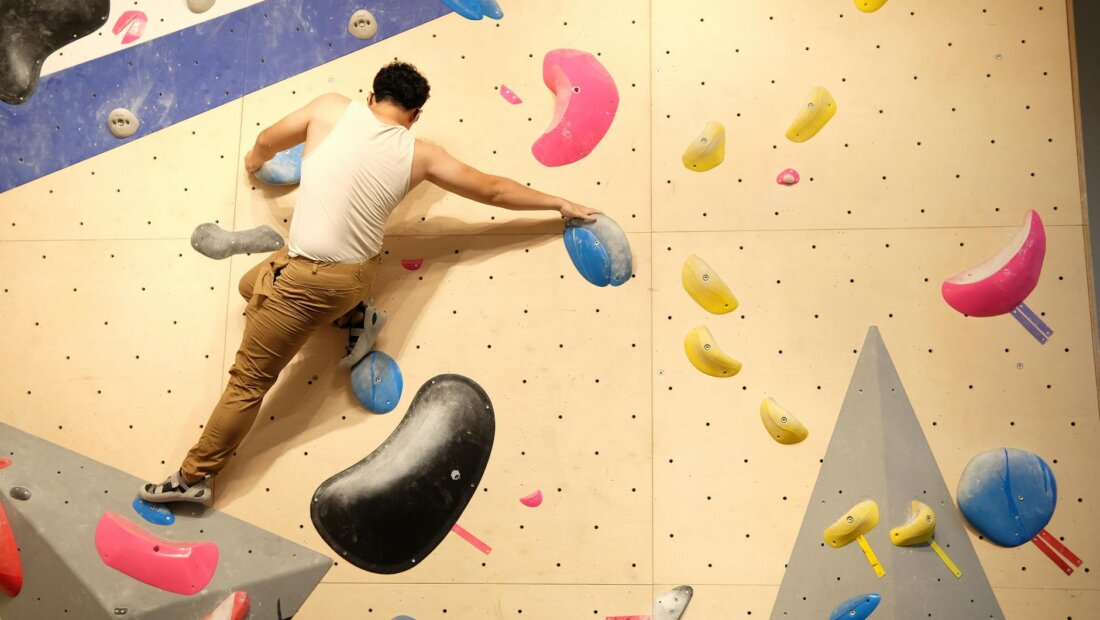
Bouldering for Beginners: Technique Beats Strength

6 min read
Most people approach bouldering the wrong way: they pull themselves up with their arms until their forearms give out, then wonder why they’re spent after an hour. But it’s not strength that determines success on the wall-it’s technique. Master a few basic principles, and suddenly you’ll be climbing routes that once seemed impossible.
Why Technique Almost Always Beats Strength
What is bouldering? Bouldering is climbing without ropes at jump height-usually up to around four meters-over thick crash pads. No harness, no belay partner, just you, short and intense climbing sequences called “boulders,” and the courage to let go. It’s this simplicity that makes the sport so immediate and addictive.
The most common beginner mistake is assuming bouldering is all about strength. At an elite level, it certainly is-but for your first few months, the opposite holds true. Experienced climbers make it look effortless not because they pull harder, but because they shift their weight over their feet and hang with straight arms on the rock. They conserve energy where beginners burn it. The mental game adds another layer, as we explored in our piece on the psychology of tough boulders, but the foundation is movement.
The key lies in your legs. Your leg muscles are far stronger and more enduring than your forearms. Learning to push up with your feet instead of pulling with your hands lets you climb longer, cleaner, and with far more reserve for the crucial moves.
Five Technical Principles for Your First Weeks
These five points aren’t secrets, but they make all the difference between brute force and smooth climbing. Focus on one per session instead of trying to master them all at once.
Precise Footwork
Place your toes deliberately on the foothold, not the midfoot. Then stand still-no readjusting. Clean foot placement gives you stability and lets you reach the next hold with ease.
Keep Your Hips Close to the Wall
The closer your center of gravity is to the wall, the more weight stays on your feet instead of your hands. Rotate your hips in and keep your body near the wall-no sagging backward with a stretched-out stomach.
Straight Arms
Hang with straight, extended arms as often as possible. This uses your skeleton, not your muscles, saving energy. Pulling costs power-only do it when you need to, not as a default position.
Read the Route First
Scan the boulder from the ground: Which holds, in what order, and where’s the tough move? Having a plan means you won’t freeze mid-climb to figure it out-you’ll move fluidly and save energy for the crux.
Descend with Control
Don’t jump from every height. Climb down a few holds and land softly on the balls of your feet, knees slightly bent. This protects your joints and prevents the most common beginner aches and pains.
What Your First Gym Visit Looks Like
You hardly need anything to get started. Every gym offers rental climbing shoes and chalk; just wear comfortable sportswear. Let the staff at the desk know it’s your first time. Many gyms provide a quick orientation, and some even require it, since bouldering without ropes follows different rules than roped climbing.
Routes are color-coded by difficulty. Start at the very bottom, even if it seems easy. The first few sessions aren’t about conquering tough boulders-they’re about developing a feel for footwork and balance. Jumping into something too hard too soon means you’ll default to brute force and pick up bad movement habits. On rest days, a little outdoor activity in the mountains can help improve overall body tension and footing.
Why Now Is the Perfect Time to Start
Bouldering gyms have popped up in nearly every major city in recent years, and summer brings the outdoor version into the mix. If you learn the technique indoors now, you’ll have the foundation to try real rock by late summer-where bouldering takes on a whole new feel.
Then there’s the social side. Bouldering is one of the few sports where complete strangers will give you tips, cheer you on, and brainstorm solutions together. You don’t need a fixed training partner, a team, or a set schedule. You show up when you can, and you’ll almost always find someone stuck on the same problem. That’s what makes starting so easy. Stop talking about it-go this week and give it a try.
 Cool-down
Click on a question to reveal the answer.
Do I need strength to start bouldering?
Is bouldering dangerous?
How often should I go at first?
What does it cost to get started?
Bouldering or rope climbing as a beginner?
Bouldering Psychology: How Hard Moves Rewire Your Brain → Source header image: Pexels / Enil yugto (px:29123281)

Editorial Team, IBS Publishing ››
Via Ferrata Season 2026: Seven Alpine Klettersteigs →
Parkour Basics: Precision Jumps as a Fitness Workout →
SUP as Full-Body Training: More Than Just Gliding →
Home Fitness Equipment: What Actually Sticks →