






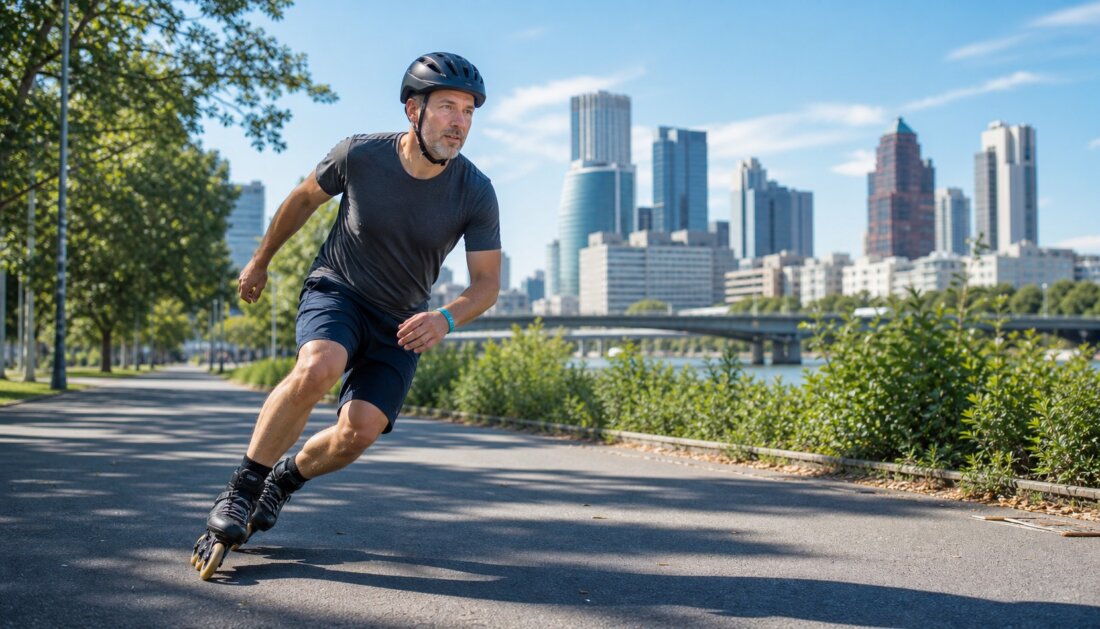
Inline Skating: Calorie Burn and the Best Local Routes

May 23, 2026
7 min read
One hour on inline skates burns between 550 and 1,100 calories, depending on how literally you take the word “hour.” Skating at a moderate pace clocks in at about 7.4 MET according to Harvard Medical School, while pushing hard reaches 12.5 MET—putting it in the same league as fast running. For me, inline skating is the simplest summer cardio option for anyone who calls asphalt home and doesn’t want to trek to the mountains every weekend.
What you really burn per hour
The most reliable source for calorie expenditure is Harvard Medical School. There, sports are measured in MET values—multiples of your basal metabolic rate. Inline skating ranges from 7.4 MET at leisurely pace to 14 MET at maximum effort. For comparison: jogging at 8 km/h is 8 MET, fast swimming is 10 MET, and cycling over 25 km/h reaches 12 MET.
This range is the key point. Inline skating isn’t a single sport with a single intensity; it’s a tool with three gears. The values in the table reflect realistic figures for one hour of pure movement—not one hour in transit, but one hour actually rolling.
A 70-kilogram person at moderate speed burns around 520 calories per hour, matching Harvard’s figure of 260 calories for 30 minutes at 70 kg. Someone weighing 85 kg cruising the Alster twice at 18 km/h clocks roughly 830 calories in an hour—more than a relaxed hour of swimming or two hours of yoga.
How speed, weight, and terrain multiply the burn
Speed is by far the biggest multiplier. Going from 12 to 18 km/h pushes the MET value from roughly 7.4 to 9.8—about a 30 percent calorie boost for what feels like only a little extra effort. Scaling up to 25 km/h lands you in the 12–12.5 MET range, approaching the burn rates of running or road cycling. The catch: sustaining 25 km/h demands clean technique and pro-level inline skates with 100 mm+ wheels, or your ankles will pay the price.
Weight scales linearly. A 90 kg person burns about 50 percent more than a 60 kg person at the same pace. That may sound obvious, yet many calorie calculators still get it wrong. If you’re aiming to lose weight, the early kilos drop off fast—until they’re gone and your calorie burn naturally drops with them. That’s not stagnation; it’s math.
Surface and wind are the hidden multipliers. Rough asphalt forces more effort per push. Headwinds can double the energy cost at the same speed. Hilly routes like Berlin’s Kronprinzessinnenweg or the inclines in Munich’s north end drive up calorie burn without you having to pick up the pace. If calories are your target, seek out hilly terrain deliberately.
Four cities, four real street circuits
The skating infrastructure in German cities is better than its reputation, but it’s spread out. Here are four concrete routes where you can glide safely and without car traffic.
Berlin – Tempelhofer Feld. The outer loop on the former runway circles the field over about six kilometres, smooth, flat, and obstacle-free. Bonus: the standard skate section along the Teltow Canal beside the former Wall Trail can be stretched to eight to ten kilometres. For elevation, the Kronprinzessinnenweg in Grunewald is an asphalted axis of roughly seven kilometres through gently rolling woodland. Berlin residents never lack for options.
Hamburg – Alsteruferring. The outer Alster offers a smooth, roughly eight-kilometre loop. Traffic is limited to 30 km/h, wheel-sports have priority, and the surface is clean. If you need more distance, tack on the Stadtparksee or roll along the Elbe to Blankenese – the final kilometres climb noticeably and show up in your heart rate.
Munich – Isar plus Englischer Garten. The Isar bike path on the eastern bank heading north is the longest continuously asphalted skate option in the city. In the Englischer Garten, the route from the Chinese Tower to Aumeister and back is the classic, car-free and level. Pasing to Allach via Schloss Blutenburg is the insider variant, quiet and alternating between urban and natural scenery.
Cologne – Rheinuferweg. Dual-directional, both left and right banks. The section from Rheinpark over the Mülheimer Bridge and back through the Old Town is the standard city loop, just under ten kilometres. If you stretch the distance, ride the Rhine toward Bonn – flat, fast, perfect for long cruise sessions.
What you need for the first six months
Entry-level inline skates are called fitness skates. Wheels between 80 mm and 90 mm, hardness between 82A and 84A, ABEC-7 bearings. Brands that hit the price-quality sweet spot: K2, Rollerblade, FILA. Price range €120 to €180. Pro models with 100 mm or 110 mm wheels only come into play later, once you’re cruising above 22 km/h regularly. If you’re hunting for your first pair, you’ll find an honest overview in our Inline Skating Beginner’s Guide.
Protection isn’t optional. Helmet, knee pads, elbow pads, wrist guards. Especially the wrist guards. Most people instinctively try to break a fall with their hands – without guards that regularly ends in a broken wrist or ligament damage. Complete sets start at €25 at Decathlon; higher-quality gear from TSG or Bullet Proof runs €50 to €80. Never skip this stuff.
Two handy extras: a headlamp for late autumn training sessions and a merino-blend performance shirt for city tours in shifting temperatures. If you’re mixing in trail activities during summer, also check out our Trail Shoes in the 2026 Release Wave – inline skates and trail shoes share the same outdoor season.
Three training methods, three clear benefits
Long Cruise is the foundation. 45 to 90 minutes at 15 to 18 km/h, steady breathing, no talking-and-breathing struggle. This session builds your aerobic base and refines your technique. Do it two to three times a week and you’ll notice a tangible boost in stamina within eight weeks. Each session burns 400 to 600 calories.
Intervals deliver the punch. Ten-minute warm-up, then six to eight 1-minute sprints at 25 km/h or faster, each followed by two minutes of recovery. Short, brutal, and they push your VO₂ max up fast. Three weeks of intervals can raise your maximum oxygen uptake as effectively as structured strength training for runners.
Technique sets are the most underrated. Spend 30 minutes focusing on single-leg glides, clean push-offs, a stable core, and fluid arm swings. Stick with it for three months and you’ll skate more efficiently, losing about 10 % less energy—same distance, lower cost. It feels slow at first, but it’s the only route to truly fluid skating.
 Cool-down
Click on a question to reveal the answer.
How accurate are the calorie counts in skating apps?
Do I need speed skates to start or will fitness inline skates suffice?
How many sessions per week yield visible results?
Does skating damage knee joints in the long run?
Where can I find organized group rides?

Editorial Team IBS Publishing ››
Inline Skating: Corporate Outdoor Workouts for Peak Fitness →
Blade Night Munich: The Inline Skating Event for Everyone →
Trail-Running Shoes 2026: The New Release Wave →
Strength Training for Runners: Exercises That Boost Running Economy →
Disc Golf in DACH: How the Green Hunt Is Taking Over the Outdoor Scene →
Image source: AI-generated (May 2026), C2PA certificate embedded in image
Translated from the German original using artificial intelligence. The German version is authoritative.