






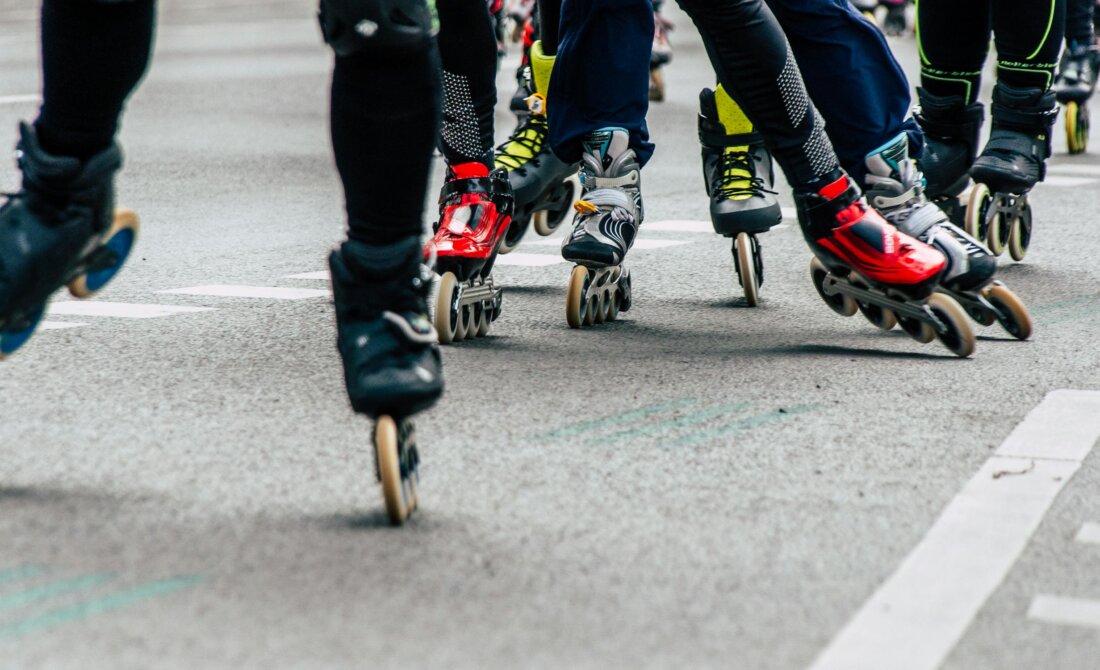
Inline Skating: Undertake an Outdoor Workout for Top

6 min read
Eight wheels under your feet, wind in your face, and your body burning more calories than jogging. Inline skating is back—not as a 90s nostalgia trip, but as a serious fitness workout. Up to 800 calories per hour, easier on your joints than running, and a full-body workout you do in the fresh air. Why this sport was underestimated for so long—and why that’s changing now.
Sources: AOK Magazine, Statista (2024), Rollerblade.com
Why Inline Skating Is Making a Comeback
What is inline skating? Inline skating (also known as rollerblading) involves gliding on shoes fitted with four or five wheels arranged in a single line. Unlike traditional roller skates (quad skates), inline skates feature wheels in a straight configuration, enabling higher speeds and a more natural stride.
In the 90s, inline skating was a massive trend. Then it nearly vanished from city streets. What happened? The technology kept evolving while the sport fell out of fashion. Modern fitness skates now boast better bearings, more comfortable cuffs, and more precise braking systems than anything available in the 90s. Wheels are larger too—80 to 90mm instead of 72mm—delivering a smoother, faster ride.
According to Statista, around 0.87 million people in Germany skate regularly. Numbers have been climbing since 2022, fueled by social media (skating content on TikTok and Instagram), improved infrastructure (smoother bike paths), and a growing appetite for outdoor sports that are actually fun. If Japanese walking feels too tame, inline skating offers the perfect contrast: same routes, triple the speed, five times the calorie burn.
Calorie Burn: Why Skating Beats Jogging
The numbers speak for themselves: inline skating burns between 400 and 800 calories per hour, depending on speed and body weight, according to AOK. In comparison, moderate-paced jogging burns around 400 to 600 calories per hour. Add intervals (30 seconds sprint, 90 seconds easy rolling), and you can reach up to 900 calories.
But the key difference isn’t just about calories. With jogging, each footstrike hits the ground with two to three times your body weight. With skating, you roll—no impact, no shock loading. That makes inline skating significantly gentler on knees, hips, and ankles. For anyone looking for a joint-friendly alternative to rucking for endurance training: skating is the answer.
A 2013 study by the University of Potsdam also found that just a four-week skating program—two sessions of 90 minutes per week—significantly improved balance and jumping power. Balancing on eight wheels activates stabilizing muscle groups that barely come into play during jogging or cycling.
Full-Body Workout on Eight Wheels
Inline skating isn’t just a leg workout. The push-off engages thighs, calves, and glutes. Stabilization comes from the core. And the arm swing works shoulders and upper back. Here’s a breakdown of the muscle groups involved:
Legs and Glutes (Primary Work): The skating stride involves a lateral push-off that challenges adductors and abductors far more than jogging or cycling. Quadriceps and hamstrings work with every stride, while the gluteus maximus stabilizes the hip during the glide phase.
Core (Constant Stabilization): On wheels, you’re constantly balancing. Your core is engaged the whole time—even if you don’t notice it. On uneven terrain or during turns, the demand on trunk stability increases significantly.
Upper Body (Support Role): The arm swing sets the rhythm and adds extra propulsion. During athletic skating, shoulders, triceps, and upper back actively contribute—unlike cycling, where the upper body remains static.
Balance and Proprioception: Your body learns to navigate an unstable surface. This strengthens deep stabilizing muscles and improves coordination between the nervous system and muscles. If you do mobility training, skating is the perfect dynamic complement for balance work.
Gear: Get Started for Under 200 Euros
The basic inline skating setup is a one-time investment with no ongoing costs:
1. Fitness Skates (100 to 200 Euros): Beginners should opt for fitness models with soft boots (easier entry), 80mm wheels, and an integrated heel brake. Proven entry-level brands: Rollerblade Zetrablade, K2 F.I.T., or Fila. Important: Try them on in-store. Skates must fit snugly without pinching. Loose skates mean less control.
2. Protective Gear Set (30 to 60 Euros): Wrist, knee, and elbow pads. Wrist guards are the most crucial, as hand-first falls are the most common injury mechanism. Most manufacturers sell sets of three. Always wear them—even on short rides.
3. Helmet (30 to 60 Euros): A skate helmet protects the back of the head (unlike a standard bike helmet). Bike helmets are better than nothing, but skate helmets sit lower and offer more coverage.
Technique and Braking: The First 30 Minutes
The good news: if you can walk, you can learn to skate. The basics can be mastered in an hour. Here are the three fundamentals:
The basic stance: Knees slightly bent, upper body tilted slightly forward, eyes looking straight ahead. Keep your hands in front of your body, not at your sides. This bent posture lowers your center of gravity and gives you stability. Standing upright means you’ll fall at the first bump.
The skating stride: Don’t step forward like walking. Instead, push off sideways and glide. One foot stays on the ground (the supporting leg), while the other pushes diagonally backward and outward (the kicking leg). Then switch. The motion resembles ice skating. Tip: Practice on a parking lot, not on a bike path. A wide, smooth, level surface is ideal.
Braking: Most fitness skates have a heel brake on the right shoe. To brake: shift your weight onto your left foot, extend your right foot forward, and press down on the heel until the brake pad touches the ground. Sounds simple, but it takes practice. Beginners’ alternatives: roll onto grass or lean against a wall. The T-stop (placing one foot perpendicular) comes later.
One beginner mistake to avoid: never skate downhill before you can brake confidently. Sounds obvious, but it’s the most common cause of falls among newcomers. For your first sessions, choose a flat area—empty parking lot, basketball court, or a wide paved path with no incline.
Inline skating combines everything a great outdoor workout needs: high calorie burn, full-body engagement, low joint impact, and fun. The entry barrier is low, gear is affordable, and the learning curve is steep enough to keep you motivated. Anyone who’s spent an hour on wheels knows: inline skating doesn’t feel like exercise. It feels like freedom. And that’s exactly why it’s making a comeback.
 Cool-Down
Click on a question to reveal the answer.
Is inline skating really better than jogging?
What wheel size is best for beginners?
How fast can beginners skate?
Can I skate on bike paths?
How often should I replace wheels and bearings?
Source header image: Pexels / wal_ 172619 (px:36678658)
Translated from the German original using artificial intelligence. The German version is authoritative.