






XTERRA France: Lessons for Personal Mountain Training
07/09/2026
6 min read
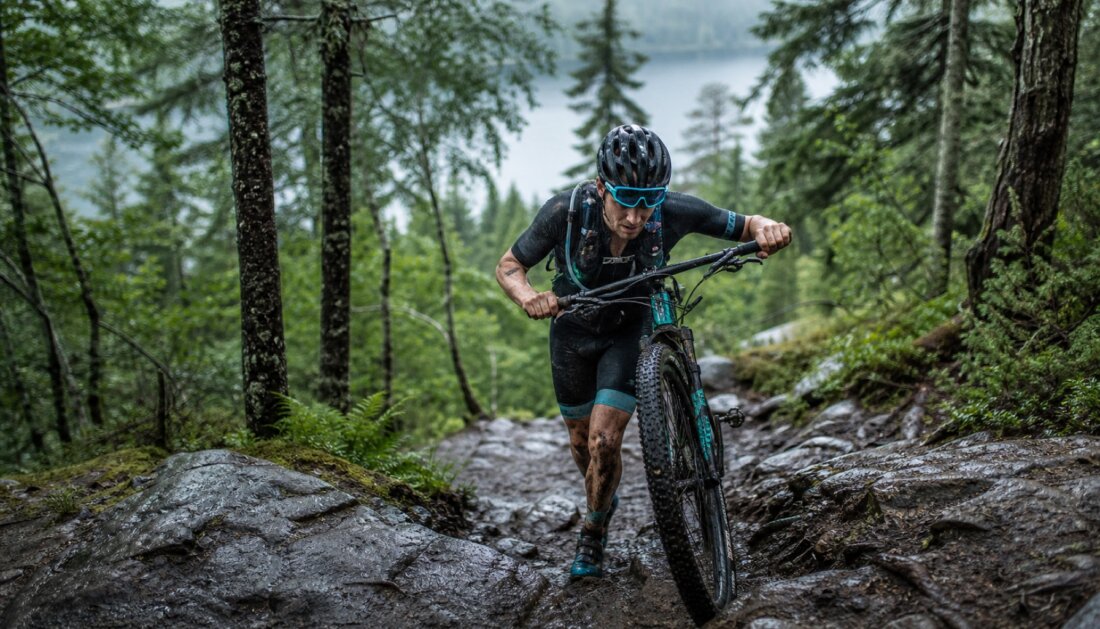
Two thousand athletes, a mountain lake at around eleven degrees, and 40 kilometers of mountain biking through the Vosges: the XTERRA France in Xonrupt-Longemer is no triathlon for bike-path regulars. The 19th edition ran on the first weekend of July. The race shows brutally clearly what your normal training leaves out. Even without a start slot in the off-road triathlon, this course reveals where you lack stability, rhythm, and terrain feel.
 Quick Sprint
- ▸ The XTERRA France combines 1.5 km of swimming in Lac de Longemer, 40 km of mountain biking, and 10 km of trail running. Three surfaces, one afternoon.
- ▸ Technical terrain reshuffles your strength. On roots and loose ground, core stability counts more than raw wattage.
- ▸ The mountain sets the pace. Anyone pacing by the clock instead of the gradient pays for it at the latest during the trail run.
- ▸ Switching between disciplines is a skill in itself. Cold legs after swimming ride differently than rested ones.
- ▸ Five lessons translate directly to flat terrain, even without a mountain lake on your doorstep.
Xonrupt-Longemer sits in the Vosges. XTERRA has been at home there since 2006, now in its 15th year at the same lake. Over 2,000 people show up every year, far more than just pros. The full distance runs 1.5 km swimming, 40 km mountain biking, and 10 km trail running, while the sprint variant roughly halves that to 500 meters, 20, and 5 kilometers. On paper it looks doable. At the lake, on the first climb, and on the trail, that math suddenly plays out differently.
You don’t need to book a start slot for this. What matters is what this terrain reveals about your training.
1. Roots Reshuffle Your Power
On asphalt, cycling is often a wattage game. You pedal, the number climbs, you go faster. Over 40 kilometers of mountain bike trail through the Vosges, that logic breaks down. Between roots, loose gravel and steep ramps, leg power only helps once your core keeps the bike steady beneath you.
Anyone who spends most of their time on the trainer and rarely rides off-road notices this immediately. The thighs push, the upper body is still searching for balance. That’s exactly why an off-road format is an honest test: it shows you whether your strength holds up the moment the terrain turns sideways.
2. The Mountain Sets Your Pace
On flat ground, you can pick a pace and hold it. On a climb, that control ends. An ascent dictates your tempo, no matter what your watch says. Anyone who stubbornly chases a target time overcooks it on the ramps and stands at the final trail run with heavy legs.
The real lesson of this format: pace by effort, not by kilometers. Your body delivers the data, the course provides the context. This mental shift can be trained. Many people miss it simply because their standard loop stays flat.
The Full Distance in Numbers
3. Three Surfaces Challenge One Body
Swimming, cycling, running: three disciplines, three kinds of strain. The real challenge lies in the transitions. After 1.5 kilometers in the cold mountain lake, your legs have poor circulation and feel foreign the moment you get on the bike. After 40 kilometers in the saddle, they need a few minutes on the trail before they cooperate again.
These transitions are a skill in their own right. In triathlon, they’re simply called transitions or brick training. Anyone who only trains individual disciplines can be strong in each one and still lose time in the changeover. Here’s what the timeline of a race day looks like:
4. What You Can Take Back to the Flatlands
You don’t need a mountain lake to benefit from this format. Three things can be practiced almost anywhere. First: deliberately build technical terrain into your training, a forest path with roots is enough. Second: pace by effort, find a hill and learn how your right uphill tempo feels. Third: couple two disciplines back to back, bike then straight into a run, so your body knows the transition.
None of this costs money. It only costs the willingness to leave your comfortable standard loop.
An off-road triathlon doesn’t reward the athlete with the biggest legs, it rewards the one who wastes the least energy on bad terrain.
5. Your Head Decides on the Final Trail Kilometer
The cliché of the mind giving up before the legs actually holds true here. On the last kilometers of a technical trail you’re exhausted, and the terrain forgives no careless step. That’s exactly where the race gets decided. Not over a personal best, but over getting through clean.
That’s why mental training isn’t some esoteric add-on, it’s part of the preparation. Anyone who learns in training to stay technically clean even when exhausted has an edge in competition that no wattage number can deliver. That applies just as much to the XTERRA France as it does to your home loop on a tired Thursday.
Cool-down
Click a question to expand the answer.
What sets an off-road triathlon apart from the classic version?
Do I need mountain experience to train for this?
What is a brick session and why does it help?
Where is the XTERRA France held?
Bildquelle: AI-generiert (Juli 2026)
Image source: AI-generated (July 2026)