






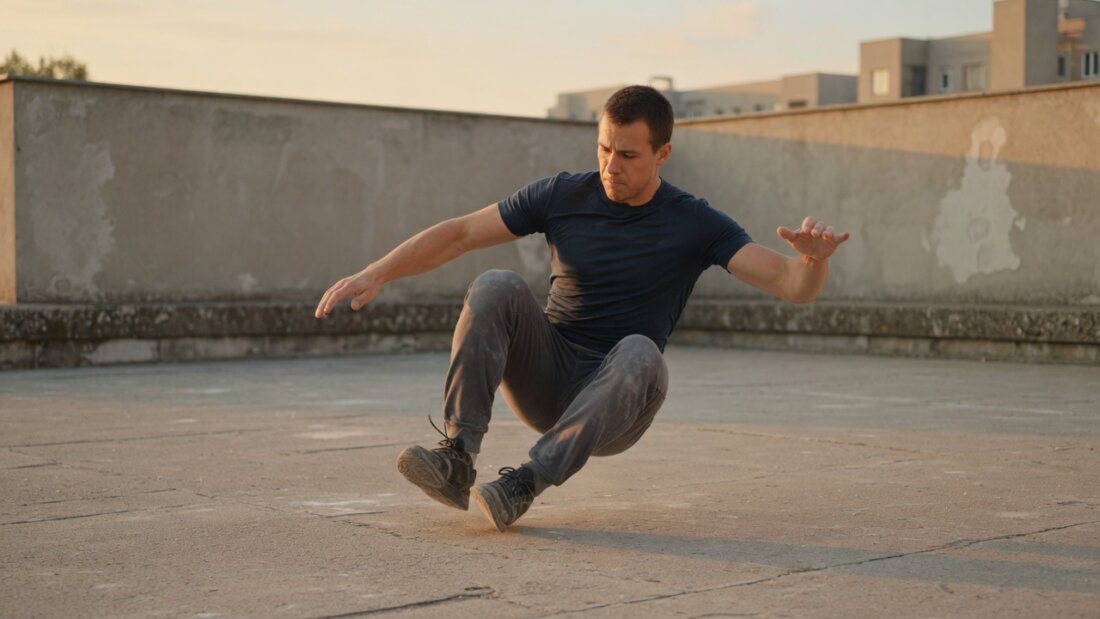
Whoever Practices Parkour Must Be Able to Land

7 min read
You watch the jumps in the videos and think of height, speed, and courage. But the real work begins the moment your feet touch the ground again. Those who can’t do this will sooner or later jump too short or too hard.
 Quick Sprints
- ▸ Land on the ball of your foot with soft knees and as little noise as possible
- ▸ Roll diagonally over the shoulder to distribute force
- ▸ Practice precision jumps to train control instead of maximum distance
- ▸ Always start low and check the surface
The landing nobody films
The landing is the part of parkour that almost no one films. You make contact first with the ball of your foot. The heel follows in a controlled manner. Your knees flex in the direction of movement and absorb the force instead of stopping it abruptly. Your upper body stays slightly forward. The goal is a landing that sounds almost silent. If you stomp or land heel-first, you brake hard. Your joints take the full load.
For your own training, this technique brings direct benefits. In strength training, the box jump suddenly stops being a strain on your knees. You realize the landing is half the exercise. Your eccentric strength improves. When running-especially downhill or during quick stops-you gain natural cushioning. Your ankles and knees become more stable because the small muscles around the joints have to engage. Many runners and strength athletes struggle with exactly this weakness. They jump or run hard and later wonder why they’re overloaded.
The effect goes beyond pure strength. You learn to dose energy. Not every landing needs to be maximal. Sometimes clean and efficient is enough. That spares your joints and energy for later parts of your workout. The movement intelligence you develop influences almost every sport where you have to jump or stop.
The roll saves you when things go wrong
The roll isn’t a stunt. If your landing isn’t perfect or the obstacle is higher than expected, you need a way to redirect the force. Turn your head to the side, let the shoulder lead, and let the energy travel diagonally across your back to the opposite hip. Keep your arm close to your body. You’ll roll over your hip and land on your feet, immediately back in motion. The diagonal is key-rolling flat across your back unnecessarily strains your spine.
This movement gives you a genuine emergency option for other sports. Trip while trail-running, slip while climbing, or fall in football-you’ve got a pattern that distributes impact. Your shoulders and back become more resilient. You also learn not to tense up in uncontrolled situations. It’s a form of body control you won’t get from standard strength training.
The injury-prevention payoff is clear. Many athletes injure hands, wrists, or backs because they instinctively brace incorrectly. The parkour roll teaches you to channel force instead of stopping it. You become less vulnerable in unplanned moments. This isn’t theory-it’s repeatable practice.
Precision is control, not spectacle
A precision jump isn’t about maximum distance. You pick a specific target-a line, a small box, a narrow ledge-and land exactly there. Your feet must hit the spot. Keep your torso steady. The take-off adjusts to the landing, not the other way around. Too much speed or too little control, and you miss. That trains your ability to stay precise under load.
For your training, this means a noticeable boost in movement efficiency. You learn to generate only the force you actually need. In trail-running, it helps you clear roots and rocks. In basketball or other sports with rapid direction changes, your foot placement becomes more secure. In strength training, you suddenly grasp why exact foot positioning is crucial in so many exercises. Precision isn’t a parkour trick-it’s the ability to do exactly what you intend under pressure.
The side benefit is mental. You get used to the idea that a jump only counts if it lands cleanly. That takes pressure off. You’re not jumping to impress. You’re jumping because you know you’ll land cleanly.
Staying on the edge
Balancing on narrow surfaces may sound unspectacular. You stand on a low wall, a curb, or a thin rail. First you stand still. Then you shift your weight. Then you step forward and back. Later you turn without falling. Keep your eyes forward-don’t stare at your feet. It’s boring. It’s also the foundation for everything else.
The carry-over is huge. You train ankle stability and proprioception-qualities many athletes lack and that lead to sprains or knee issues. If you can stand on an edge, you’ll have better control in single-leg gym exercises. If you can walk on an edge, you’ll feel more secure in uneven terrain. The mental side is just as important. You learn to stay calm when the surface is narrow and the stakes are real.
Most athletes underestimate this part. They want to jump straight to the big moves. If you neglect balance, you’ll fall short exactly where precision and stability must come together.
The Safety Vault as a secure entry point
The Safety Vault isn’t a flashy move. It’s the move that gets you safely over an obstacle. You approach, place one hand on the wall or box, swing your outside leg over, and let your inside leg follow in a controlled manner. Keep your center of gravity low. You land on both feet or dismount cleanly. It’s not spectacular. It works even when you’re tired or the surface isn’t perfect.
For your training, this vault gives you one thing above all: the ability to use hands and legs together. Many athletes think only in terms of legs. Once you use your hand as a guide and support, you change how you deal with obstacles. This helps in obstacle course racing, climbing, or clearing fences in the field. You also learn that it’s often better to come over in control than to jump as far as possible.
The Safety Vault is the right starting point because it gives you quick successes without major risk. You build confidence. You see that parkour isn’t about jumping over everything. It’s about choosing the right solution for the situation.
Why you need to start slower than you want
The biggest mistake at the start isn’t lack of strength. It’s lack of patience. You begin low-30 to 50 centimeters. Soft surface. You check the ground every time. You don’t go wild just because friends are watching. You film yourself to hear if you’re landing quietly. You only increase height by 10 to 15 centimeters once the last 20 attempts were clean. Then only by 10 to 15 centimeters.
This slow approach is the real transfer. It teaches you ego control. The athlete who jumps a big gap and gets hurt has gained nothing. The athlete who does the small version perfectly 50 times keeps training. This applies to parkour. It applies to almost every other sport as well. Those who stay healthy long-term are the ones who respect the unglamorous basics.
You also learn that progress isn’t linear. Some days everything flows. Some days it doesn’t. Whoever accepts that and still repeats the basics gets better. Whoever only chases the next level gets injured or stagnates.
How to get started
- Find a soft surface-grass or a soft parking lot. Start with a height of 30 to 50 centimeters.
- Practice only the landing. Jump down, land over the balls of your feet, stay soft, and immediately walk a few steps forward. Repeat this 30 to 50 times.
- Add the roll. From the landing, roll directly into the shoulder diagonal. Stand up immediately and keep moving.
- Mark a small area or line. Jump precisely onto it. Both feet must land exactly on target-no overshooting or undershooting.
- Find a low wall or box. Place one hand and practice the Safety Vault. Swing one leg over, let the other follow in a controlled way.
- Only increase height or complexity once the last 20 attempts were clean and quiet. Check the ground and surroundings every time.
Bottom line
Parkour teaches you one thing above all: the ability to control your body on impact. That skill makes you steadier and more efficient in almost every other sport. The techniques are simple. The discipline to practice them without show and without shortcuts-that’s the hard part.
Cool-down
Click on a question to reveal the answer.
Do I need special shoes?
How long until I see progress?
Can I learn this on my own?
What if I’m scared?

Editorial Team IBS Publishing ››
Learning to kitesurf on the North and Baltic Seas →
Squash goes Olympic: tougher than any cardio →
UTMB 2026: the anatomy of the world’s toughest race →
HYROX Coach qualification: is the certification worth it? →
XTERRA France: lessons for your own mountain training →
Image source: AI-generated (July 2026)