






Whitewater Kayaking: Your First River Without Panic

6 min read
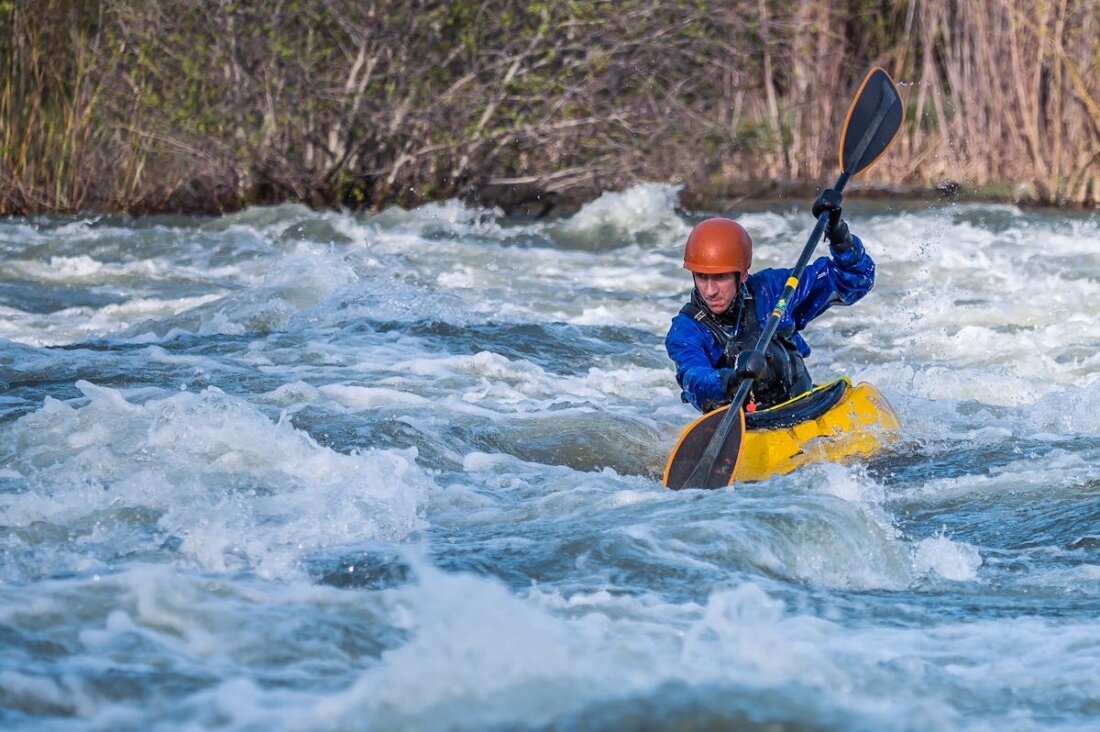
The river beckons. You’re sitting in a boat barely wider than your hips. Ahead: waves, whirlpools, rocks. Your paddle dips, you pull, the kayak turns. A rock to your left, current to your right, straight ahead a wave that floods your cockpit. And somewhere between panic and flow, you realize: this is the most alive you’ve felt in months.
What sets white-water kayaking apart
On the river, you’re at the mercy of the elements. No engine, no sail—just your paddle and your body. The current dictates the pace; you react. That’s the fundamental difference from any other sport: you don’t control your environment, you adapt to it. In real time, without pause.
It’s a mental reset like few others. On the water, there’s no room for emails, deadlines, or everyday worries. Your brain simply doesn’t have the bandwidth. It’s too busy navigating the next wave. If you’ve ever experienced the clarity of freediving, you’ll know exactly what we mean: total presence.
Your first course: What to expect
Day 1 (Flatwater): You’ll learn seating position, paddle strokes (forward, backward, draw, sweep), and how to get in and out of the kayak. The boat will capsize. You’ll fall out. Repeatedly. That’s normal—and why summer is the best time to start.
Day 2 (Eskimo roll + gentle current): The Eskimo roll is the ultimate skill. You’ll deliberately capsize underwater and right the boat with a hip flick. Sounds impossible? It’s pure technique. 90% of beginners nail it by day two.
Day 3 (River, WW I-II): You’ll tackle your first real river. Gentle waves, mild currents, clear lines. Your instructor leads the way. By the end of the day, you’ll know one thing for sure: you’ll be back for more.
Gear: What you need and what the course provides
Provided in the course: Boat, paddle, spray deck, life jacket, helmet. All you need is swimwear and neoprene shoes (or old trainers that can get wet).
Your own gear (if you stick with it): Used boat from 300 Euro, paddle from 80 Euro, wetsuit from 100 Euro, helmet from 50 Euro, life jacket from 80 Euro. Total: from 600 Euro for a complete set.
Tip: Buy your first boat second-hand. Whitewater boats are tough and last forever. eBay Kleinanzeigen and the Facebook group ‘Kanumarkt Deutschland’ are the best places to look. If you just want to test the cold water first, start with a lake kayak.
Best rivers for beginners in Germany
Isar (Bavaria): Lenggries to Bad Tölz is the classic beginner route. WW I-II, crystal-clear water, alpine scenery. The Isar is perfectly tempered in summer and has a forgiving current that lets you learn from mistakes.
Loisach (Bavaria): Slightly more challenging than the Isar, WW II. Ideal for your second or third river day. The gorge near Garmisch is spectacular.
Erft (North Rhine-Westphalia): The insider tip for flatland paddlers. Artificial rapids created by lignite mining. WW I-II, short sections, perfect for practice. And: rideable all year round.
Saalach (Salzburg/Bavaria): For the next step up. WW II-III. An alpine river with more power. Only attempt with solid basic technique.
“In whitewater, there is no tomorrow and no yesterday. There is only this moment, this wave, this paddle stroke. That’s why kayakers are so calm afterwards.”
DKV (German Canoe Association), Whitewater Training Concept
 Cool-Down
Click on a question to reveal the answer.
Do I need to be a strong swimmer?
What is the Eskimo roll?
How dangerous is white-water class I-II?
Can I go white-water kayaking in winter?
How much does a beginner course cost?
Source: Pexels / Brett Sayles