






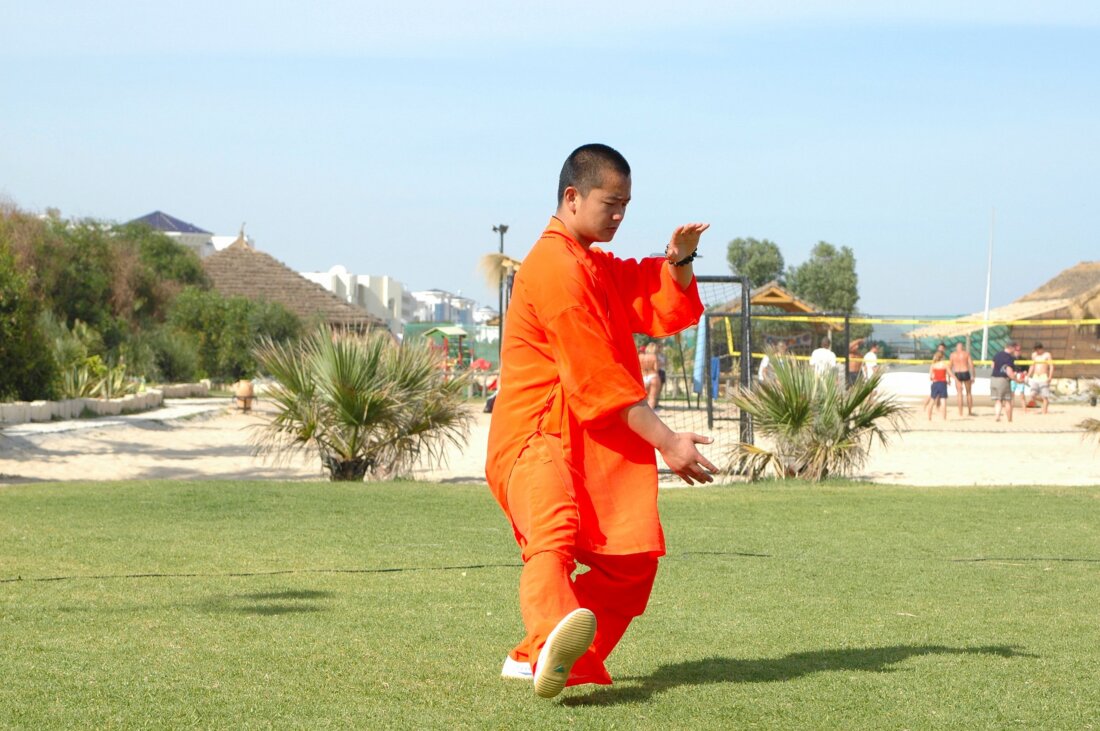
What Wushu Gives Your Trail Training That No Gym Can

6 min read
For three weeks, I practiced a single Wushu stance until my functional training suddenly looked surprisingly smooth. Mabu, the deep horse stance, seems harmless. But after two minutes, your hips, adductors, and core burn in places that air squats and loaded carries barely touch. That’s where it gets interesting for trail runners: flat ground makes training predictable. Wushu introduces angles, rotation, and pressure from positions you actually need outdoors.
 Quick Sprint
- ▸ Wushu is the correct umbrella term for Chinese martial arts, while Kung Fu is the Western collective name. For fitness, Taolu-forms training-is what matters most.
- ▸ The advantage isn’t in calorie burn. It’s in multidirectional ground force, rotation under tension, and control from awkward positions.
- ▸ These are exactly the qualities that make the difference on uneven trails and during rapid direction changes-qualities your gym rarely trains.
- ▸ Treat it as an add-on, not a new system. Three elements as a 20-minute finisher are enough-you don’t need the full form.
- ▸ Stay honest: you won’t build maximal strength here. Your knees demand respect. Noticeable transfer takes four to eight weeks.
How Does Flat Ground Affect Your Trail Experience?
Functional training has a blind spot: many exercises stay too clean. You run straight ahead, push upward, pull toward you. Even powerful tools like the classic rowing machine or heavy carries move along a single axis. A trail rarely follows that rule. The terrain comes at you sideways, the descent pulls you into rotation, and that root hidden under the leaves demands a reaction you didn’t plan for.
This is where Wushu comes in. Before the word scares anyone off: Wushu isn’t some esoteric code-it’s the correct Chinese umbrella term for martial arts. Kung Fu, as we say in the West, literally means “acquired skill” and isn’t a style name. For your training, Taolu is what counts: forms training with stances, kicks, and turns. The full-contact variant Sanda isn’t part of this discussion. We’re talking athleticism, not sparring.
I was surprised by how quickly it clicked. The functional training scene has celebrated Animal Flow in recent years-groundwork with crawls and reaches. Wushu has followed a similar logic for centuries, but with more precision and intensity for the hips, core, and rotational axes. As a workout, it’s specialized. As a supplement, it sharpens exactly the skills the gym and park often miss.
The numbers tell you Wushu isn’t a cardio replacement. A Taolu form lasts one to two minutes and is mostly anaerobic-comparable to a hard interval. If weight loss is your goal, running or cycling is a better bet. But if you want to upgrade your athleticism, you’ll find something here that endurance disciplines don’t deliver.
How Wushu Trains What Your Gym Misses
Form training in Wushu hones three things harder than almost any gym routine. First: ground force from deep stances. The horse stance (Mabu) and bow stance (Gongbu) challenge your legs and glutes isometrically at angles you rarely hit in squats. Second: rotation under tension. Every kick and turn demands your core control load against movement. Third: landing control from awkward positions-the ability to touch down cleanly after a half-turn.
The mobility benefits are best documented. Solid research supports gains in hip and ankle mobility, as well as balance, particularly in Tai Chi and fall prevention. Competition-level Wushu findings should be applied cautiously, but the takeaway for your training remains strong: the first time you hold a Cossack-like stance cleanly, you’ll feel exactly where your body compensates.
Wushu doesn’t train the muscles you see in the mirror. It trains the ones that decide whether you descend cleanly.
Where it falls short deserves equal clarity. You won’t build maximal strength from stances alone-you need load and progression, meaning the fundamentals of strength training and nutrition. Nor does it deliver hypertrophy in the classic sense. Wushu is the supplement for mobility and movement intelligence, not a replacement for the barbell. Confuse the two, and you’ll be disappointed in three months.
Three Wushu Elements to Integrate Into Your Training
You don’t need to learn a full form to reap the benefits. Three decontextualized elements-added to your regular workout as a short finisher-are enough. Schedule one Wushu element per session, not all at once. This keeps it as an add-on, not a second project.
The first is Mabu hold work. Assume a deep horse stance: feet wider than shoulder-width, toes forward, hips sinking toward knee level. Hold for 30 to 60 seconds, three rounds. This builds the isometric ground force that keeps you stable on trails during every load shift. It’s unglamorous-and brutally effective.
The second is the controlled front kick with pause. From standing, lift your leg slowly to full height, hold for one second, then lower. Eight reps per side. This trains core anti-rotation and single-leg stability simultaneously-the exact reactive control needed for quick direction changes. If you track movement quality (e.g., via app-based movement scoring), progress will be clear.
The third is the Gongbu rotation. From a bow stance-front knee bent-rotate your torso slowly toward the lead side and back, keeping your hips steady. Ten reps per side. This develops rotational stability from the right segment, smoothing your descents. Realistic timeframe for noticeable transfer: four to eight weeks with two to three short sessions weekly. Don’t overdo it-just stay consistent.
Cool-down
Click on a question to reveal the answer.
Do I need prior martial arts experience to get started?
Does Wushu replace my strength training?
When will I notice the transfer to my regular sport?
Is the deep horse stance bad for my knees?
How much time will this take per week?

Editorial Team, IBS Publishing ››
Rowing Machine Workouts: Why the Erg is the Most Honest Full-Body Training →
Muscle-Building Nutrition: What Outdoor Athletes Really Need →
Bouldering with an AI Coach: What Movement-Scoring Apps Can Do in 2026 →
1,300 km Solo Through the Alps from Munich →
Image source: Pexels / Alfred Franz (px:31198416)
Translated from the German original using artificial intelligence. The German version is authoritative.