






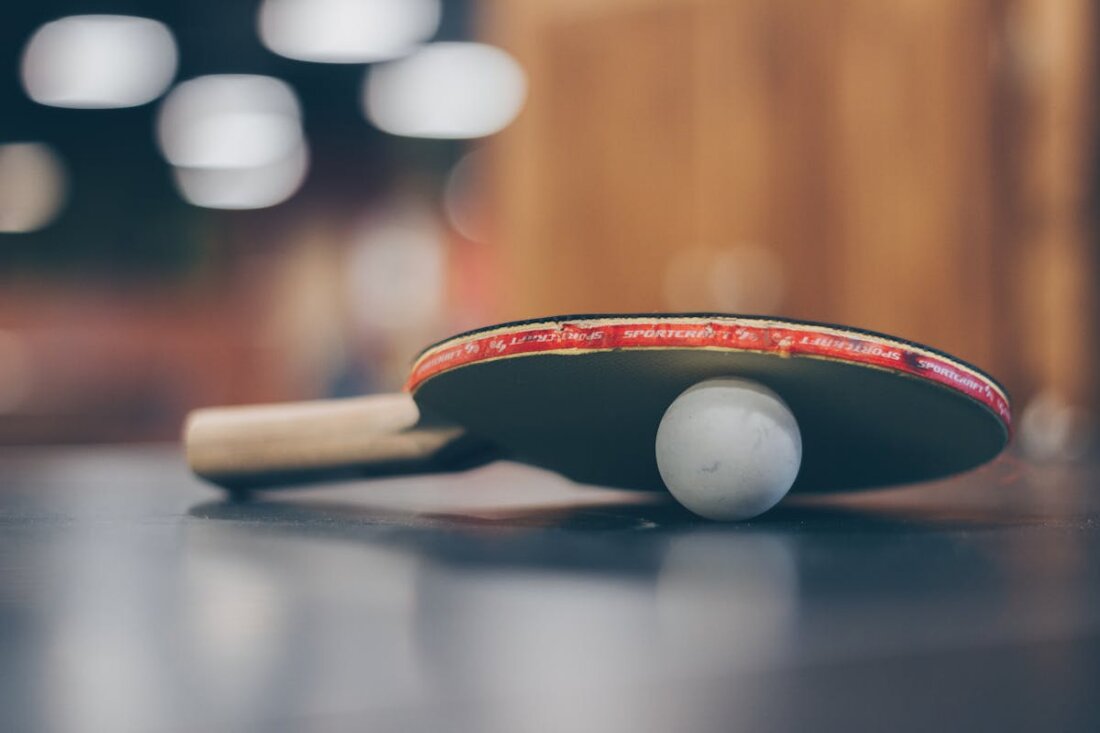
Table Tennis: The Underrated Speed Sport That Trains Your Brain

7 Min. Reading Time
The ball can fly at speeds of up to 170 km/h. Your brain has less than 200 milliseconds to calculate the trajectory, spin, and point of impact. At the same time, you’re planning your return, correcting your position, and analyzing your opponent’s body language. Table tennis is one of the fastest reflex sports in the world. And neuroscientists say: That’s exactly why it’s the best brain training. 350 million people play it worldwide. After reading this, you’ll understand why.
 Short Sprint
- ▸ 350 million players worldwide make table tennis one of the most widely played sports. In Germany, over 550,000 players are organized in clubs
- ▸ High-level brain training: EEG studies show increased theta activity in frontal brain regions during gameplay
- ▸ Dementia prevention proven: Meta-analyses show that table tennis improves cognitive function and balance in neurodegenerative diseases
- ▸ Calorie burn of 250 to 400 per hour during moderate to intense play. Joint-friendly and suitable for all ages
- ▸ Start at 50 Euro: Racket, balls, club membership. Lowest entry barrier of all racket sports
Why Your Brain Loves Table Tennis
Table tennis is what neuroscientists call an open-skill sport. Unlike closed-skill sports like running or cycling, where you can predict the movement, in table tennis every ball is different. Your brain must make real-time decisions without the luxury of thinking.
An EEG study from the University of Bern showed: During table tennis gameplay, theta activity in frontal brain regions significantly increases more than during cycling or cognitive tasks. Theta waves are associated with perception, attention, and processing of environmental stimuli. Simplified: Table tennis forces your brain to work at full throttle.
Even more impressive: A 2024 imaging study showed that regular table tennis players have significantly higher fractional anisotropy (FA) in several nerve pathways compared to non-players. This means: The connections between brain regions are stronger and faster. Table tennis not only trains individual functions but also the networking of your entire brain.
„Table tennis requires players to track the ball’s trajectory in a few milliseconds. This makes it one of the fastest open-skill sports in the world and a unique training for cognitive functions.“
Table Tennis Against Dementia: What Research Reveals
The perhaps most surprising finding: Table tennis is increasingly being studied as a therapeutic tool for neurodegenerative diseases. A systematic review and meta-analysis (2025) investigated whether table tennis can protect the aging brain. The result: Table tennis measurably improves cognitive functions and balance in patients with neurodegenerative diseases.
The mechanism: Open-skill sports like table tennis simultaneously demand motor coordination, visual processing, decision-making, and spatial thinking. This combination activates more brain areas than any closed-skill sport. In Japan, table tennis is already used in rehabilitation programs for Parkinson’s patients.
For you as a healthy player, this means: Every session is active prevention. Not as a medication substitute, but as what scientists call cognitive reserve. The more you challenge your brain, the more resistant it becomes to age-related decline.
Physical Training: More Than You Think
Table tennis has an image problem. Many people consider it a leisure activity with no serious training effects. The data tells a different story. During moderate to intense play, you burn 250 to 400 calories per hour. This is between jogging and swimming.
What’s more: The constant direction changes train agility and explosive legwork. The forehand stroke works the shoulder muscles, forearm, and core. The topspin technique engages the entire posterior chain from the hip to the lat. And it’s all joint-friendly because you never have to land your full body weight like in running or bouldering.
The greatest physical benefit: Reaction time. Professional players react in under 150 milliseconds to the ball. Even hobby players improve their reaction time measurably after a few weeks of regular training. This translates to daily life: faster reactions while driving, better hand-eye coordination, and more precise fine motor skills.
Getting Started: What You Need and Where to Play
Table tennis has the lowest barrier to entry among all racket sports. No expensive equipment, no court booking, no minimum number of players (you need exactly one other person).
Paddle: For your first steps, a ready-to-use recreational paddle for 15 to 30 Euro is sufficient. Once you start playing regularly, it’s worth investing in a paddle with replaceable rubber (wood from 20 Euro, rubber from 15 Euro per piece). The difference is immediately noticeable: more spin, more control, better ball feel.
Where to Play: In Germany, there are over 9,000 table tennis clubs. The DTTB (German Table Tennis Federation) offers a club search on its website. Most clubs offer open training sessions for beginners. Alternatively, you can play at public table tennis tables in parks, workplace sports groups, or leisure centers.
Clothing: Sportswear, sneakers with a light sole (required in most halls). No special table tennis shoes are needed to start.
- ▸ Ready-to-use paddle (15-30 Euro)
- ▸ Light-soled sneakers
- ▸ Balls (40+ mm, 3-star for matches)
- ▸ Table tennis robot (later)
- ▸ Special TT shoes (only for leagues)
- ▸ Personal table (clubs provide)
Three Techniques for Beginners
1. Counterball (Forehand and Backhand). The ball comes to you, you play it flat back. No spin, no effect, just control. This is the foundation. If you can play 20 balls in a row cleanly back and forth, you’ve mastered the basic coordination. Most beginners need three to five sessions for this.
2. Topspin (Forehand). The most important attacking technique. You brush the ball upwards, giving it forward spin and causing it to bounce steeply after the impact. Technically more demanding, but essential for any play above the beginner level. The wrist should be loose, the power comes from hip rotation.
3. Spin Serve. The serve decides whether you attack or defend in table tennis. Even a simple side-topspin serve can put your opponent in trouble if they don’t read the spin. Practice three variations: short underspin (forces a cautious return), long topspin (opens the attack), and side-topspin (unpredictable).
The Social Factor
What sets table tennis apart from most fitness sports: You need an opponent. This makes it a social sport. A comprehensive review in the PMC (2025) highlights that table tennis reduces stress and improves quality of life, partly due to its promotion of social interaction. Regular play appointments create a structure that is often lacking in individual training.
In Germany, over 550,000 players are organized in clubs. This is complemented by company sports groups, university courses, and informal play sessions in parks. Getting started is simple: Most clubs offer open training sessions where you can just drop by and join in. No performance pressure, no commitment.
[/vc_column_text][/vc_column][/vc_row] Cool-down
Click on a question to reveal the answer.
Is table tennis a real sport?
At what age can you start?
How do I find a club near me?
Is a expensive racket worth it for beginners?
Does table tennis really improve reaction time in everyday life?
Source Title Image: Pexels / Josh Sorenson (px:976873)
Translated from the German original using artificial intelligence. The German version is authoritative.