






Fascia Training: Why the Foam Roller Revolution Is More Than Just a Hype
6 min Reading Time
You roll back and forth on a foam roller – and it hurts. Good pain. Afterwards, you feel reborn. But why? Fascia training with a foam roller is one of the few fitness trends backed by solid science. Just 90 to 120 seconds per muscle group yield measurable gains in mobility, less muscle soreness, and faster recovery. Here’s what the research really says.
What Fascia Really Is
Fascia are connective-tissue sheaths that envelop every muscle, organ, and bone in your body. Imagine a three-dimensional web linking everything together. When this network sticks or hardens at one spot, you feel it elsewhere: neck tension may stem from adhesions in the upper back; limited hip mobility may originate from stiff tissue on the thigh.
Foam rolling is a form of self-myofascial release (SMR). You use your own body weight to apply pressure to fascial tissue. This pressure stimulates Golgi tendon organs, triggering relaxation in both muscle fibers and fascia. Simultaneously, blood flow to the tissue increases – accelerating repair and reducing edema.
“Self-myofascial release using a foam roller yields significant improvements in joint range of motion, reduces delayed-onset muscle soreness, and preserves muscle strength and jump height. The optimal dose is 90 to 120 seconds per muscle group.”
What the Research Confirms (and What It Doesn’t)
The evidence base is stronger than for most fitness trends. A 2019 meta-analysis published in the Journal of Sports Medicine synthesizes the findings: foam rolling improves mobility, reduces muscle soreness, and maintains performance. Effects are moderate – but consistent.
Specifically: joint mobility improves most markedly in the hip and shoulder. Benefits appear after just a single session (acute effect) and intensify with regular practice over weeks (chronic effect). A 2025 systematic review confirms these chronic benefits: modest but meaningful gains in strength, maximal voluntary contraction, jump height, and dynamic balance.
What foam rolling is not: a replacement for active mobility training. Research shows combining foam rolling with dynamic stretching delivers the best outcomes. Foam rolling alone boosts mobility. Mobility training alone enhances control within that mobility. Together, they’re unbeatable.
The 6 Most Important Foam Roller Exercises
1. IT Band (outer thigh). Lie on your side with the roller under your outer thigh. Roll slowly from knee to hip – 90 seconds per side. Pause for 10 seconds on tender spots. This area is almost always tight in runners.
2. Quadriceps (front of thigh). Lie face-down with the roller under your thighs. Roll from knee to hip flexor. Especially effective after squats or kettlebell goblet squats.
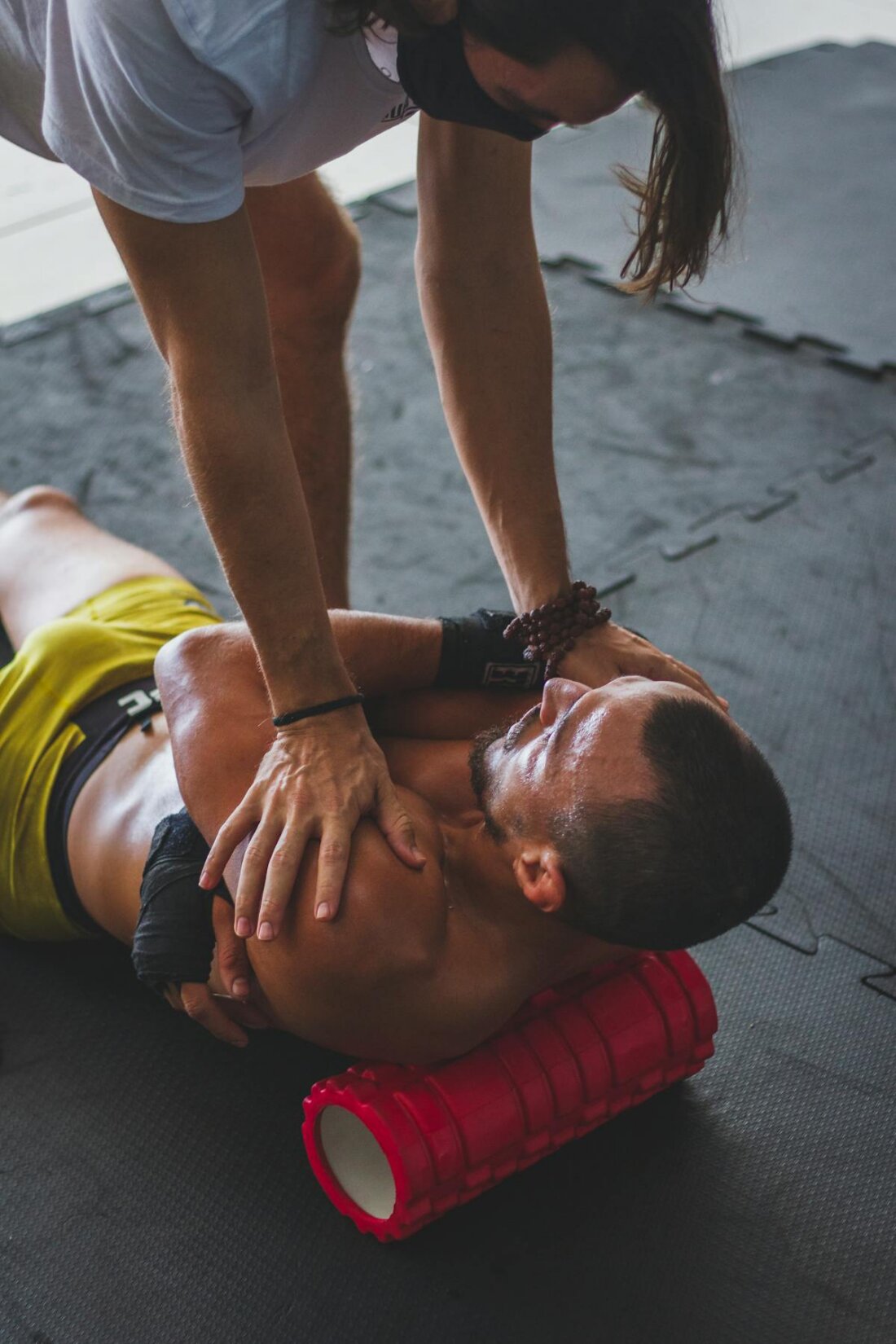
3. Upper Back (thoracic spine). Lie on your back with the roller placed horizontally beneath your shoulder blades. Cross your arms over your chest. Roll from shoulder blade to mid-back. Ideal for counteracting desk posture and the classic rounded back.
4. Glutes (piriformis). Sit on the roller with one leg crossed over the other, knee bent. Shift your weight to one side. Hold for 90 seconds per side. Eases sciatica-like symptoms caused by a tight piriformis.
5. Calves. Sit with the roller under your calves. Cross one leg over the other for added pressure. Roll from Achilles tendon to popliteal fossa (back of knee). Crucial for runners and anyone who stands for long periods.
6. Latissimus Dorsi (side of back). Lie on your side with the roller under your armpit. Roll from lower scapula to armpit. Often overlooked – but vital for shoulder health and overhead mobility.
Choosing the Right Roller: Soft, Firm, or Vibrating?
Three categories – with one clear recommendation for beginners:
Smooth Standard Rollers (soft to medium): Made from EPP foam, €15-€25. Perfect for beginners. Delivers comfortable, even pressure – no risk of localized overload. If you’ve never rolled before, start here.
Textured Rollers (medium to firm): Featuring bumps, grooves, or ridges. €25-€50. Texture enables more precise pressure-point work. Best for advanced users who plateau after three to four weeks with a smooth roller.
Vibration Rollers: €80-€150. Recent studies show added benefits: superior pain reduction, lower subjective fatigue, and greater improvements in hip and knee mobility compared to standard rollers. Worthwhile if you roll regularly and have the budget.
- ▸ Standard roller, 30-45 cm (EPP foam)
- ▸ Lacrosse ball for trigger points
- ▸ Yoga mat as base layer
- ▸ Massage gun (different mechanism)
- ▸ Fascia cream (no scientific evidence)
- ▸ Extra-firm PVC roller (too aggressive)
Your 10-Minute Routine
This routine fits seamlessly before or after any workout – or as a stand-alone session on recovery days.
Pre-Workout (5 minutes): IT band – 60 seconds per side. Quadriceps – 60 seconds. Upper back – 60 seconds. Goal: boost mobility without sacrificing strength.
Post-Workout (5 minutes): All six exercises, 45-60 seconds each. Pause longer on tender spots. Goal: reduce DOMS and accelerate recovery.
Three times per week delivers noticeable results. Daily is better – but not essential. Consistency matters more than frequency: ten minutes three times weekly beats thirty minutes once a month.
 Cool-down
Click any question to reveal its answer.
Is foam rolling before training beneficial?
How long should I roll each muscle group?
Can foam rolling reduce cellulite?
Foam roller or massage gun?
Are vibration rollers worth it?
Header Image Source: Pexels / Bruno Bueno (px:5485463)