






Bouldering 2026: The Complete Guide to Germany’s No. 1 Trend Sport

6 Min. Read
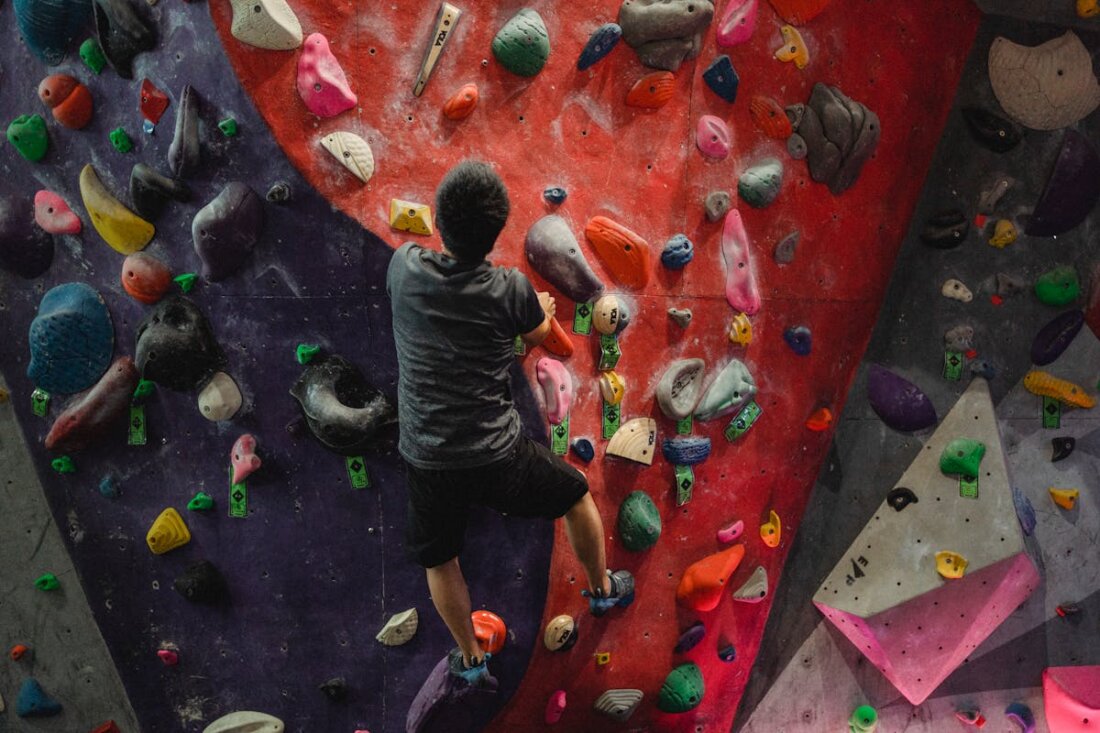
You stand before a four-meter-high wall filled with colorful holds. Your hands are dusted with chalk, the mats beneath you slightly springy. You grab the first hold, set your foot, and pull yourself up. Three moves later, you’re stuck. Your mind calculates, your body experiments. And it’s exactly this moment, this interplay of mind and body, that makes millions of people addicted to bouldering.
Why Bouldering is Exploding
566 climbing and bouldering gyms operate in Germany. Thirty years ago, there were 20. The boom has several drivers: the Olympics since Paris 2024, Instagram-worthy gyms with cafes and coworking spaces, and a generation seeking fitness without monotonous equipment. Bouldering is Social Media in 3D. You solve problems with your body, celebrate successes in real-time, and do it in a community that cheers you on instead of ignoring you.
The DAV reports 1.64 million members, a historic record. The proportion of women is 44.2 percent and has been growing stronger than the male proportion for years. Bouldering is the first climbing sport that truly appeals equally to both genders.
The decisive difference from other trend sports: The entry barrier is absurdly low. No prior knowledge, no expensive equipment, no course registration. You go to a gym, rent shoes, and climb. You’re in within ten minutes.
Your First Day at the Bouldering Gym
What you need: Sports clothing that allows freedom of movement. Nothing more. You can rent climbing shoes at the counter (3-4 Euro), chalk is usually available too (your own bag: from 5 Euro). A session costs between 10 and 14 Euro, depending on the city and gym. Ten-visit passes or monthly passes significantly reduce the price.
How bouldering works: Each boulder is a route on the wall, marked by holds of one color. You start at the bottom with both hands on the starting holds and try to reach the top hold. The difficulty grades range from 1 (ladder) to 8+ (pro). As a beginner, you start at 1-3 and will be surprised how quickly you progress.
The unwritten rules: Don’t stand underneath someone who is climbing. Don’t step on the mats with street shoes. Only give tips when asked. And: Failure is normal. Most boulders are not solved on the first try. That’s precisely the appeal.
Bouldering as Therapy: What Science Says
Friedrich-Alexander University Erlangen-Nürnberg has been conducting the largest clinical study to date on therapeutic bouldering for years. The result: Bouldering-psychotherapy works just as effectively as cognitive behavioral therapy for depression. The study with 156 patients was published in the journal BMC Psychiatry and is methodologically top-notch (randomized, controlled, blinded evaluation).
Another study with 133 patients showed: Bouldering beats pure physical training in treating depression. Not only did mood improve, but also anxiety, body image, and self-esteem.
Why this works: Bouldering combines physical exertion with problem-solving, self-efficacy, and social interaction. When you succeed on a boulder you’ve failed on ten times, it changes your self-image. No treadmill in the world can do that.
“Bouldering psychotherapy is not inferior to cognitive behavioural therapy in the group treatment of depression.”
Luttenberger et al. (2021), BMC Psychiatry, Friedrich-Alexander-Universität Erlangen-Nürnberg
Technique for Beginners: The Five Basics
1. Feet before hands. Beginners pull themselves up with their arms. Advanced climbers push up with their legs. Your leg muscles are stronger than your forearms. Use them. Imagine you’re climbing a ladder, not a pole.
2. Straight arms. Every second with bent arms costs strength. Hang on straight arms, it saves your forearms and conserves energy for the tough spots. When reading the route to rest: arms straight.
3. Hips close to the wall. The closer your center of gravity is to the wall, the less strength you need. Turn your hips to the wall, don’t climb frontally. In overhangs: body tension from foot to fingertip.
4. Plan ahead. Read the boulder before you start. Where are the holds? Which hand goes where? Where do you place your foot? The best climbers solve 80 percent of the problem on the ground.
5. Fall consciously. You will fall. That’s normal and safe, the mats are thick. Important: Don’t fall with straight arms or onto single joints. Let yourself roll down with slightly bent knees.
Equipment: What you really need
Climbing shoes (from 60 Euro): Your first personal investment after a few sessions. Rental shoes are hygienically questionable and rarely fit optimally. Beginner shoes are comfortable, have a slight pre-tension, and fit snugly without causing pain. Brands like La Sportiva Tarantula, Scarpa Origin, or Simond Rock are solid first shoes.
For technical comparisons in sports equipment, it’s always worth looking at current tests. In climbing, fit trumps brand.
Chalk (5-10 Euro): Magnesia powder or liquid chalk for dry hands. Liquid chalk is preferred in many halls because it produces less dust. A chalk bag or chalk box is essential.
What you DON’T need: No rope (bouldering is rope-free), no harness, no helmet. No training plan to start with. No special clothing. Bouldering is the ultimate low-budget sport.
From Indoor Boulderer to Outdoor Rock
Spring is the perfect time to start: You begin indoors, build technique and strength, and switch to real rock in the summer. Germany has first-class bouldering areas. The Franconian Switzerland is the mecca for climbers in southern Germany. The Elbe Sandstone Mountains offer unique sandstone formations. The Black Forest and the Palatinate have compact areas for day trips.
Outdoor bouldering is a different world: Rough rock instead of smooth plastic holds, nature instead of neon, crash pad instead of gym mat. But the basic technique is identical. If you climb a 5 indoors, you’ll have fun outdoors. Additionally, regular endurance training helps for longer outdoor sessions.
Important: Never go outdoor alone. Always with experienced climbers or a DAV group. A crash pad (fall mat) is mandatory. And: Respect nature. Observe climbing bans, do not modify holds, leave no trash.
Training and Progression: How to improve
In the first few weeks, you’ll automatically make progress. Your body learns the movement patterns, your grip strength increases, your eye recognizes solutions faster. After 2-3 months, progress slows down. Then you need structure.
2-3 times a week is ideal. More is counterproductive at first, tendons and fingers need regeneration. A good rhythm for beginners: Boulder on Monday, boulder on Wednesday, outdoor training or compensatory sport on Friday. Weekend: easy session or break.
Antagonist training: Climbing trains pulling muscles. The counterpart (pushing) is neglected. Bench presses and shoulder presses as compensation prevent muscular imbalances. 15 minutes after the session is enough.
If you want to climb stronger after 6 months, invest in a hangboard (from 30 Euro). Structured finger training is the most effective way to increase grip strength. But: Never in the first six months. Your tendons are not ready yet. Patience is as important in sports nutrition and regeneration as in training itself.
 Cool-down
Click on a question to reveal the answer.
Do I need prior experience to start bouldering?
Is bouldering dangerous?
How much does bouldering cost per month?
Can I go bouldering alone?
Does bouldering really help with depression?
Image Source: Pexels / Allan Mas