






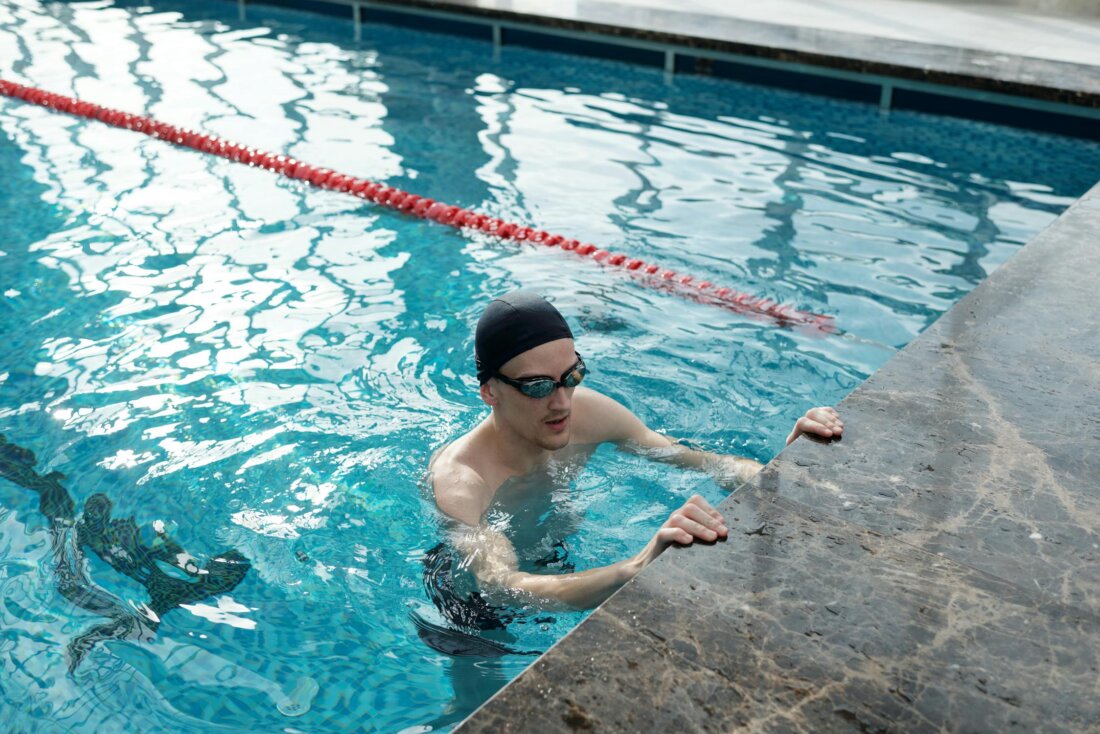
Swim Better in 2026: Technique Over Power

6 min Reading Time
Most people can swim. Few swim well. You crawl 50 meters, gasp for air, and wonder how pros sustain it for hours. The answer isn’t fitness – it’s technique. Swimming efficiently doesn’t mean going faster; it means using less energy to cover the same distance. And you can learn it. Starting this February, at your local pool, three times a week, one hour per session. Afterward, you won’t just swim – you’ll glide.
Why most swimmers fight the water instead of moving with it
Watch lap swimmers at your local pool. Most make three critical errors: lifting their heads too high when breathing, letting their legs drop, and taking far too many arm strokes per lap. The result? They plow through the water like a ship with its handbrake on.
In water, drag is your biggest enemy – not lack of strength or endurance – but the simple fact that your body isn’t lying flat enough. Every centimeter your hips or legs sink increases your cross-sectional area underwater. And more surface area means exponentially more resistance.
Elite swimmers cover 25 meters of freestyle in just 12 to 14 strokes. Most recreational swimmers need 20 to 25. That gap isn’t about arm power – it’s about body position, the glide phase after each stroke, and torso rotation.
The three adjustments that change everything
1. Lower your head – look at the pool floor.
The instinctive reaction underwater is to lift your head. But as soon as your head rises, your legs sink. Your gaze should be directed straight down at the pool floor – not forward. It feels unnatural at first, but it aligns your body horizontally. Your occiput – the back of your head – should just barely break the water’s surface.
2. Rotate your torso – not just your arms.
Freestyle isn’t an arm sport. It’s a rotation sport. With every stroke, your torso rotates 45 to 60 degrees. Power comes from your core musculature – not your shoulders. Imagine reaching for something on a high shelf: you don’t just extend your arm – you pivot your entire upper body. That’s exactly what happens in efficient freestyle.
3. Glide after hand entry.
Most recreational swimmers begin their next stroke the instant their hand enters the water. Pros let the hand fully extend and glide for a moment. This glide phase harnesses momentum from the previous stroke – and reduces the number of strokes needed per lap. Fewer strokes mean less energy expended at the same speed.

“In swimming, you win not by working harder – but by creating less resistance.”
The 4-week plan for better freestyle
Three sessions per week, each 45 to 60 minutes long. Each week has a specific focus.
Week 1: Body position and breathing pattern.
Drill: 4 × 25 meters using only your legs – arms extended forward, face submerged. Turn your head to the side to breathe every 5 seconds. Goal: feel what a flat, horizontal body position feels like. Main set: 10 × 50 meters easy, focusing strictly on head position. Count your strokes per 25 meters – and record them.
Week 2: Rotation and catch.
Drill: 4 × 25 meters swimming on your side – one arm extended forward, the other resting at your side – with torso rotation timed to every third kick. Main set: 8 × 75 meters, emphasizing torso rotation. Feel how power originates from your hips – not your shoulders. If you experience shoulder pain after training, you’re rotating too little.
Week 3: Glide phase and efficiency.
Drill: 4 × 25 meters “catch-up” drill – both hands meet in front before initiating the next stroke. This enforces a deliberate glide phase. Main set: 6 × 100 meters, aiming to reduce your stroke count by two per 25 meters compared to Week 1. Those curious about freediving gain double here: breath control and movement efficiency transfer directly.
Week 4: Integration.
Main set: 4 × 200 meters with 30 seconds rest. Combine all technical points: head down, torso rotation, glide phase. Compare your stroke count to Week 1. If you’ve cut three or more strokes per 25 meters, your technique has measurably improved.
Equipment: What you actually need
Swim goggles (from €15): Non-negotiable. Without goggles, proper head positioning is impossible – you’ll instinctively lift your head to see. Anti-fog coating and UV protection are standard. Clear lenses suffice for indoor pool training.
Swim cap (from €5): Not just for long hair. A silicone cap reduces drag around your head – and keeps your goggles securely in place. Often mandatory at public pools.
Pull buoy (from €10): A flotation device squeezed between your thighs. It lifts your legs and forces focus onto your arm stroke. Ideal for refining body position without worrying about leg work. Athletes aiming to improve aerobic base endurance use the pull buoy as a tempo sensor.
Paddles and fins: Only useful starting Week 3 or 4. Paddles enlarge your hand surface area – exposing flaws in your catch technique. Fins support body position and increase speed. Both are training aids – not shortcuts. Using them too early masks weaknesses instead of correcting them.
Why swimming is the most underestimated workout
Swimming is the only full-body cardio workout with zero joint stress. No running, no jumping, no impact. Your shoulders, core, back, and legs all engage simultaneously – while water supports your body weight. For runners, swimming is the perfect recovery workout on non-running days. For strength athletes, it builds often-neglected endurance – without compromising recovery for the next lifting session.
And it delivers an effect no other sport offers: silence. Underwater, you hear only your breath and the rush around your ears. No podcast, no playlist, no notifications. Forty-five minutes of lap swimming equals 45 minutes of moving meditation. In a world that never quiets down, that may be the most valuable training benefit of all. Anyone who’s felt the stillness after stepping out of an ice bath knows exactly what I mean.
 Cool-down
Click on a question to reveal its answer.
How often should I swim per week?
I get breathless immediately while freestyling. What am I doing wrong?
Do I need formal swimming lessons as an adult?
Is swimming effective for weight loss?
Header Image Source: Pexels / ShotPot
Translated from the German original using artificial intelligence. The German version is authoritative.