






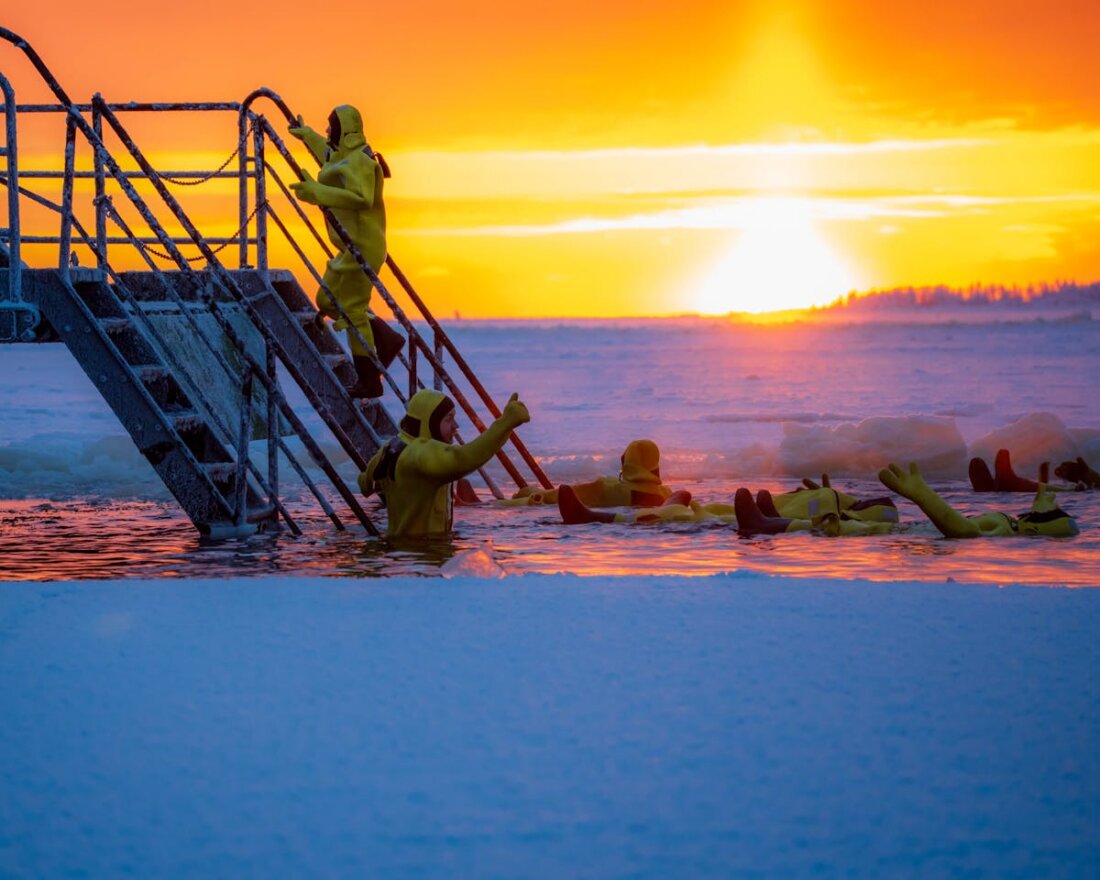
Ice Bathing 2026: What Science *Really* Knows About Cold-Water Immersion

6 min Reading Time
Your alarm rings at 6:30 a.m. You pull on your swimsuit and bathrobe, walk down to the lake – and step into the water. 4°C. Your body screams. Your mind says: get out. You stay. For 90 seconds. Afterward, the rest of the day feels like cheating – because everything suddenly seems easier than that. Welcome to the world of ice bathing. But which parts are physiology – and which are Instagram myths?
What Happens Inside Your Body: The First 90 Seconds
Seconds 1-15: Cold shock. Your sympathetic nervous system fires on all cylinders. Norepinephrine surges, heart rate spikes, blood pressure rises. Your body interprets the cold as a threat and mobilizes energy. Breathing accelerates uncontrollably – the moment most people give up.
Seconds 15-60: Your body begins adapting. Breathing normalizes. Dopamine levels rise steadily. A Finnish study by Tiina Mäkinen found plasma dopamine concentrations increased by 530 percent at 14°C water temperature. Unlike other stimuli, dopamine is released more slowly – but remains elevated longer. That explains the “afterglow”: a calm, energized mood lasting for hours.
From second 60 onward: Brown adipose tissue (BAT) activates. Unlike white fat (storage fat), brown fat burns calories to generate heat. Metabolism can increase by up to 250 percent. Sounds like a fat-burning miracle. It’s not. The effect is short-lived, and calorie burn per session is modest. However: regular cold exposure trains brown fat and improves thermoregulation over time.
What’s Proven – and What’s Not: An Honest Assessment
Proven: Dopamine surge (replicated across multiple studies), norepinephrine release, short-term metabolic increase, activation of brown fat, improved subjective mood post-immersion, reduced muscle soreness after exercise.
Partially proven: The Dutch cold-shower study (3,018 participants, published in PLOS ONE) reported 29 percent fewer sick days. Caveat: This was based on self-reported data – not employer-verified absences. And the benefit appeared independent of duration: just 30 seconds sufficed.
Not proven: That ice bathing directly strengthens the immune system. That it prevents depression. That it reduces inflammation. A 2025 meta-analysis even found inflammatory markers rise immediately after cold immersion – only declining after 12 hours. While stress levels drop, immune effects remain unclear. Anyone claiming ice bathing makes you “immune to colds” hasn’t read the literature.
“The positive effects on mood and energy are well documented. Claims about immune enhancement go far beyond what current data support.”
Medizin-transparent.at, independent evidence review (Cochrane-affiliated)
The Wim Hof Method: Hero or Hype?
No article on ice bathing is complete without Wim Hof. The Dutchman holds 26 world records in cold disciplines and transformed ice bathing from a niche practice into a global phenomenon. His method combines specific breathing techniques, progressive cold exposure, and meditation.
Science gives him partial credit: A study at Radboud University (Netherlands) showed Wim Hof practitioners could consciously influence their sympathetic nervous system and immune response. Anti-inflammatory mediators were 200 percent higher; pro-inflammatory ones up to 50 percent lower than in the control group.
The catch? The study couldn’t isolate whether the breathing technique – or the cold exposure – drove the effect. And the sample size was small. Wim Hof is an extraordinary athlete. But his claims (“never get sick again”) vastly exceed what science has yet confirmed. If you’re just getting back into sport, treat ice bathing as a supplement – not a substitute – for solid training.
Starting Safely: The 4-Week Plan
Week 1: Cold showers. End your warm shower with 30 seconds of cold water – every day. This trains your cold-shock reflex and breath control. Sounds harmless – but for most, it’s already a challenge.
Week 2: Longer cold exposure. Shower cold for 60 seconds. Breathe deliberately: inhale slowly through the nose, exhale slowly. Avoid hyperventilation. Your body adapts faster than you think.
Week 3: First outdoor test. Try a cold stream, lake, or sea. Never alone. Check water temperature (bring a thermometer). Below 10°C? Beginners should limit immersion to 1-2 minutes. Have warm clothes and a hot drink ready. Don’t jump straight into a hot shower afterward – let your body warm itself.
Week 4: Build routine. Aim for 2-3 cold exposures weekly – alternating between cold showers and outdoor bathing. Listen to your body: numbness in hands and feet is normal; chest pain or dizziness means stop immediately.
Ice Bathing for Athletes: Recovery Tool – or Myth?
Almost every professional locker room features an ice tub. The idea: cold water after training reduces inflammation and speeds recovery. Science says: partly true. Cold-water immersion after intense exercise consistently reduces perceived muscle soreness and subjective fatigue – replicated across multiple studies.
But: if your goal is muscle growth, ice bathing may backfire. Its anti-inflammatory effect also dampens the very adaptation signals that trigger muscle hypertrophy. Use it after competition or high-intensity sessions – not after strength training if you aim to get stronger. For the right balance between intensity and recovery, periodization matters far more than cold water.
Evidence linking ice bathing to measurable performance gains remains sparse. What is proven: you’ll feel better and more recovered afterward. Whether objective recovery accelerates is still open. Sometimes, that subjective feeling is enough.
Gear and Locations: What You Actually Need
To start: A shower with a cold setting. That’s it. No gear. No cost. Cold showers are the fastest way to learn your body’s physiological response.
Outdoor ice bathing: Neoprene gloves and socks (from €15) protect extremities. A water thermometer. A warm hat (heat loss from the head is significant). A bathrobe or thick towel for afterward. A thermos with hot tea. And – crucially – a training partner who watches your back.
Home ice tubs: Inflatable cold plunge tubs (€100-€300) or dedicated cold plunge pools (from €1,500). Overkill for beginners. A cold mountain stream or local lake works just as well. Those who prefer outdoor training will find suitable waters in most regions.
 Cool-down
Click any question to reveal the answer.
How cold does the water need to be?
How long should I stay in cold water?
Is cold showering as effective as full-body ice bathing?
Can ice bathing help with weight loss?
Who should not ice bathe?
Header Image Source: Pexels / Markku Soini