






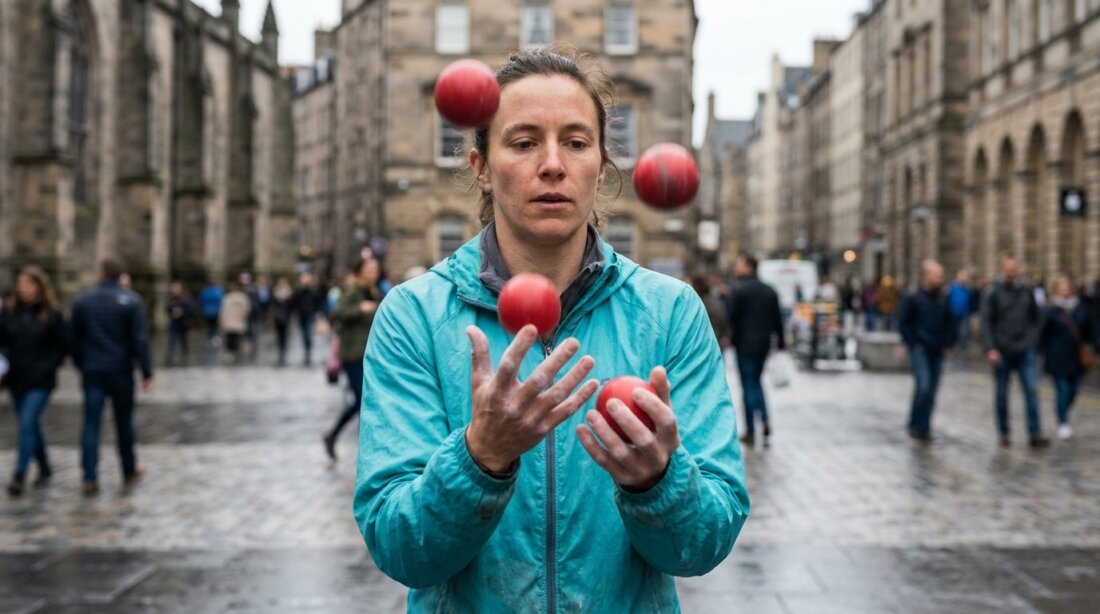
Juggling as a Workout: What Three Balls Can Do for You

03.07.2026
6 min read
Three months, three balls, sixty seconds straight: after exactly this regimen, researchers in Regensburg and Jena found more gray matter in the brains of their test subjects. Juggling may look simple, but it demands remarkable effort from your shoulders, core, focus, timing, and patience. You need no gym, no prior experience, and no excuses. You’ll be terrible at first. That’s precisely the point.
 Quick Sprint
- ▸ Your brain gets in on the act. Three months of juggling practice measurably enlarge the areas responsible for motion vision-verified via MRI in ordinary adults.
- ▸ Full-body without the burn. Roughly 300 to 400 calories an hour, plus constant work for shoulders, arms, upper back, and core.
- ▸ The real payoff is transferable. Hand-eye coordination, reaction time, and balance improve-and those gains spill over into every other sport you play.
- ▸ It’s no miracle cure. The brain boost shrinks again once you stop-just like a muscle. And it doesn’t replace cardio.
- ▸ Getting started costs almost nothing. Three balls-or three rolled-up socks-and ten minutes a day are all you need for your first cascade.
How to Master the Three-Ball Cascade
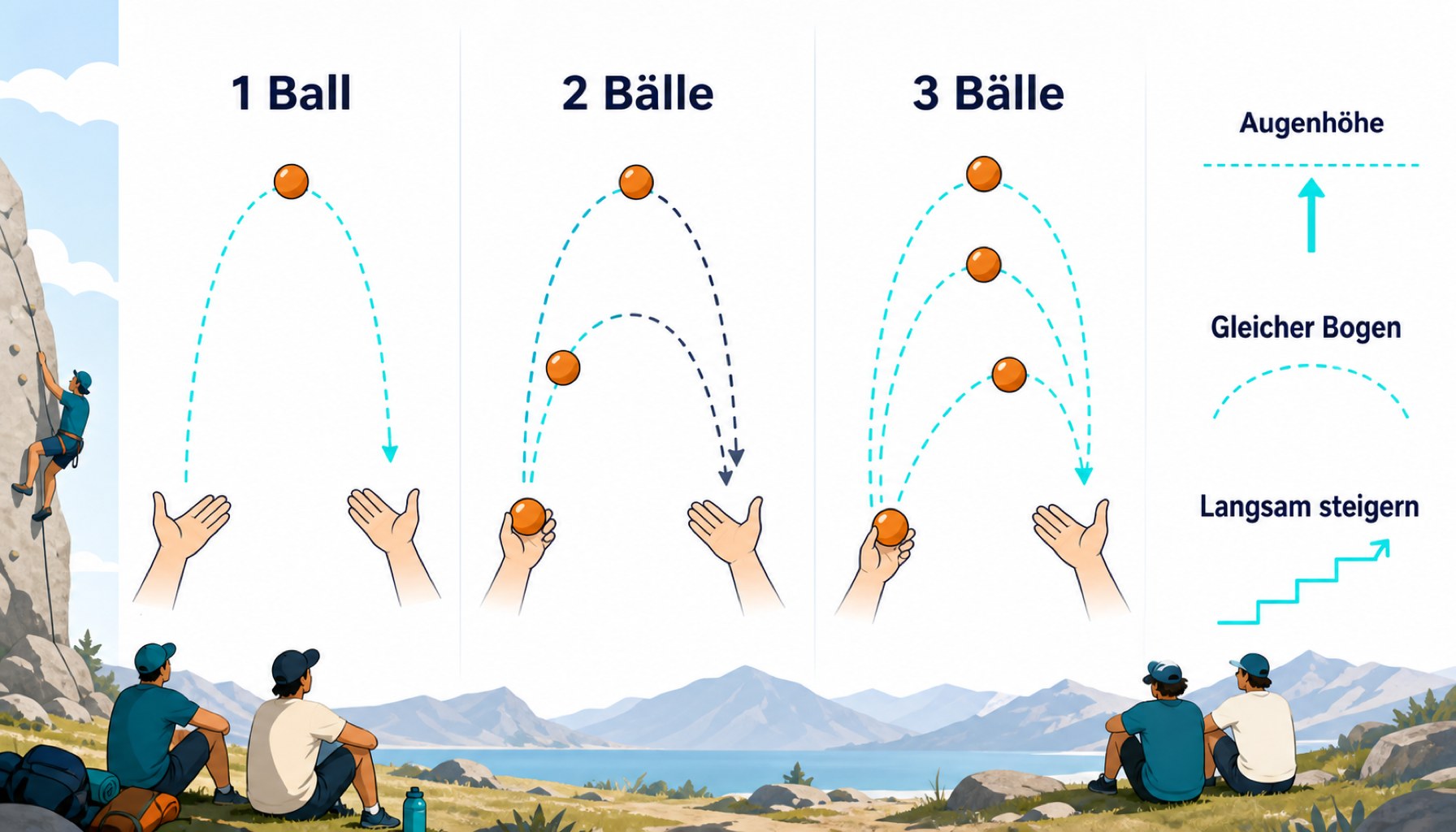
Don’t start with three balls. If you grab three and toss them straight away, you’ll create chaos and quit after five minutes. Break the pattern into stages and stick with each one until it feels natural.
That’s exactly the mistake I made. Three balls, big gesture, everything gone. It wasn’t until I used a single ball that throwing became a pattern.
Expect two to three weeks until your first clean cascade if you practice ten minutes daily. Some nail it in three days; others need a month. Both are normal. The difference usually isn’t talent-it’s the calm in your throws.
What happens in your body and mind?
Juggling may look like it’s all in the hands, but it’s full-body work. Your shoulders, upper arms, upper back and core keep the throws steady-so you’ll feel warm even while standing in one spot.
The real magic happens upstairs. In the much-cited study from Regensburg and Jena, healthy adults spent three months mastering the three-ball cascade. MRI scans showed measurable growth in the grey matter of brain regions responsible for motion vision. For the first time, it was proven that an adult brain can reshape its structure through training-not just rewire its connections.
One telling detail from the same research: after a three-month break, some of the grey-matter gains shrank back. That’s not bad news-it’s honest. Your brain treats skill like a muscle: use it and it grows; leave it idle and it recedes.
Is it worth it for you?
It depends on what you’re after. Juggling isn’t a cardio substitute and won’t make you faster over ten kilometres. Yet few other workouts deliver so much else in such a small package.
- + Engages full body and mind in one move
- + Do it anywhere-indoors or out
- + Needs only three balls and nothing else
- + Instant, measurable progress that keeps you motivated
- − Early days can feel frustrating
- − Doesn’t replace endurance or strength training
- − Needs a bit of ceiling clearance
- − Benefits fade without regular practice
Who benefits most: anyone who already plays a sport that mixes hand–eye coordination. Climbers, boulderers, ball-sport athletes and fast-reacting trail runners feel the crossover most clearly. Balance and reaction time are trainable skills-and three balls offer a cheap path to both.
10 minutes fit into your week
You don’t need a training plan. You need a fixed moment. Ten minutes are enough if they’re daily. Two hours on Sunday won’t beat a little every day, because motor learning needs repetition over time, not volume in a single session.
It helps to attach the habit to something you already do. Place balls beside the coffee machine and juggle while the water heats. Or use it as an active break between two focus blocks-your mind will feel clearer afterward. Five minutes in the morning, five in the evening, and every good intention that never happens finally gets a chance.
Once the cascade clicks, things get really interesting. Higher throws, under the leg, two balls in one hand. The pattern never stops getting harder. That’s exactly what keeps your brain engaged.
Cool-down
Click on a question to reveal the answer.
How long will it take me to juggle three balls?
Which balls should I use?
Does juggling really make you smarter?
Is juggling a real workout or just play?
Am I too uncoordinated to juggle?

Editorial IBS Publishing ››
What Wushu brings to your trail training that no gym ever will →
Recovery for endurance athletes: what really counts →
Innsbruck Climbing World Cup: 3 lessons for your wall →
Your first marathon: the 16-week plan that carries you →
Image source: cover and article images AI-generated (July 2026)
Translated from the German original using artificial intelligence. The German version is authoritative.