






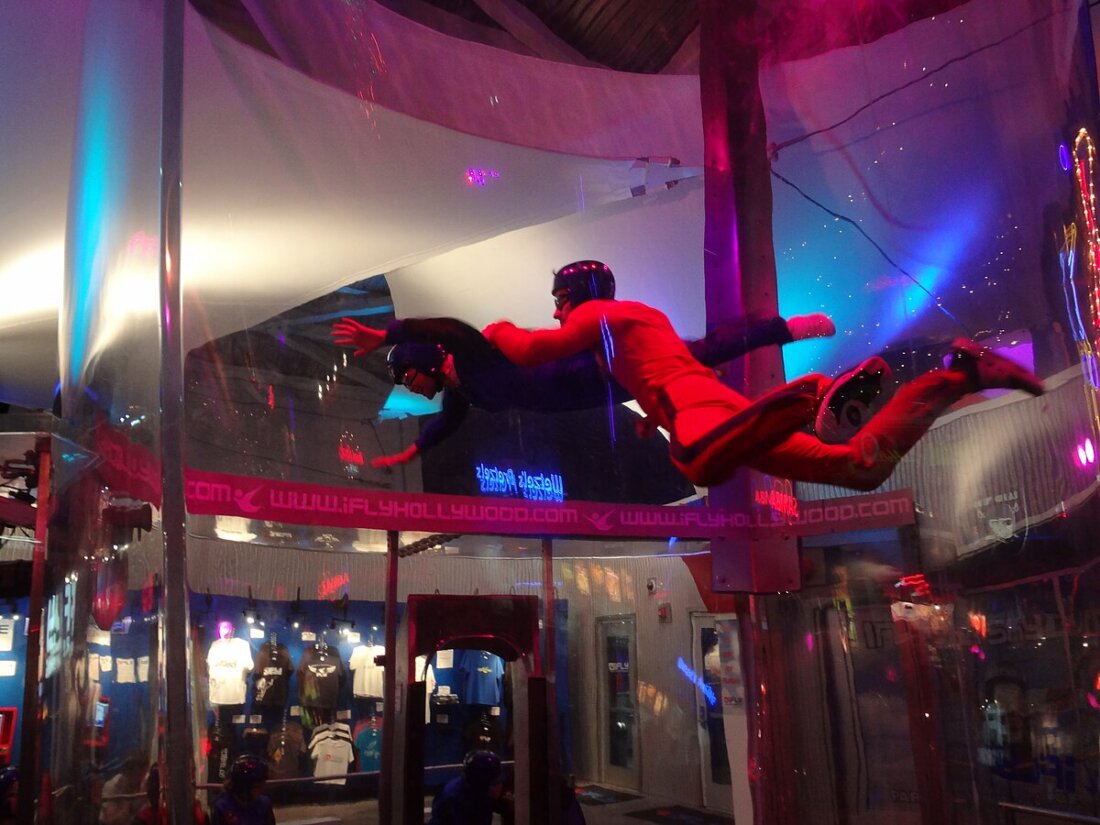
From Wind Tunnel to Sky: How Indoor Skydiving Changed My Freefall
2 min read
Between my first tandem jump in September 2023 and today, I’ve logged 47 hours in the tunnel and 28 real jumps. The tunnel has completely transformed my skydiving—and I’m convinced every serious parachutist should use indoor skydiving as part of their training.
The turning point
After my tandem jump I signed up for the AFF course (Accelerated Freefall). But sixty seconds of free-fall per jump at €250 a pop delivers precious little practice time for a lot of money. A friend recommended FlyStation Munich as a supplement. After three sessions there I’d banked more controlled flight time than in my first five real jumps combined.
What the tunnel teaches
In the tunnel you learn to: maintain stable belly position (the foundation of everything else), execute horizontal-axis turns, move forward and backward, and—once you’re advanced—sit-fly and head-down. Body position and aerodynamics are identical to real free-fall; the only difference is the wind comes straight up instead of slightly up-and-forward.
Transferring skills to the sky
My first solo jump after twenty hours in the tunnel was a revelation. My belly position stayed rock-solid, I could steer deliberately, and I even had mental bandwidth left to enjoy the view instead of panicking about my posture. My AFF instructor said it was the calmest first solo he’d ever supervised.
My training schedule
I now visit the tunnel twice a month (ten minutes each session) and jump every four to six weeks. Tunnel sessions focus on technique—drilling new body positions, ironing out weaknesses—while real jumps are pure enjoyment and confirmation that what I’ve learned in the tunnel holds up in the air.
Frequently asked questions
How much tunnel time should I rack up before my first solo?
There’s no hard rule, but ten to twenty minutes of tunnel time before the AFF course makes a dramatic difference—roughly five to ten sessions. Body control and muscle memory transfer almost seamlessly into real free-fall.
Is tunnel training expensive?
At about €30–40 per minute of flight time it doesn’t look cheap. Yet compared with real skydiving (€250 for sixty seconds of free-fall), the tunnel gives you four to five times the flight time per euro—and lets you practice with laser focus.
Does indoor skydiving feel the same as real parachuting?
Body position and aerodynamics are identical. The main differences: air flow in the sky is slightly turbulent (not the laminar stream of the tunnel), you contend with shifting air density, and the psychological factors are worlds apart. Still, muscle memory and body awareness transfer almost perfectly.
Header image source: Wikimedia Commons / iFLY Hollywood (CC BY 2.0)
Translated from the German original using artificial intelligence. The German version is authoritative.
More on the topic: Outdoor yoga: your guide to your first park session | Marathon for beginners: from couch to starting blocks in 16 weeks | Barefoot running: what science really says about natural running