






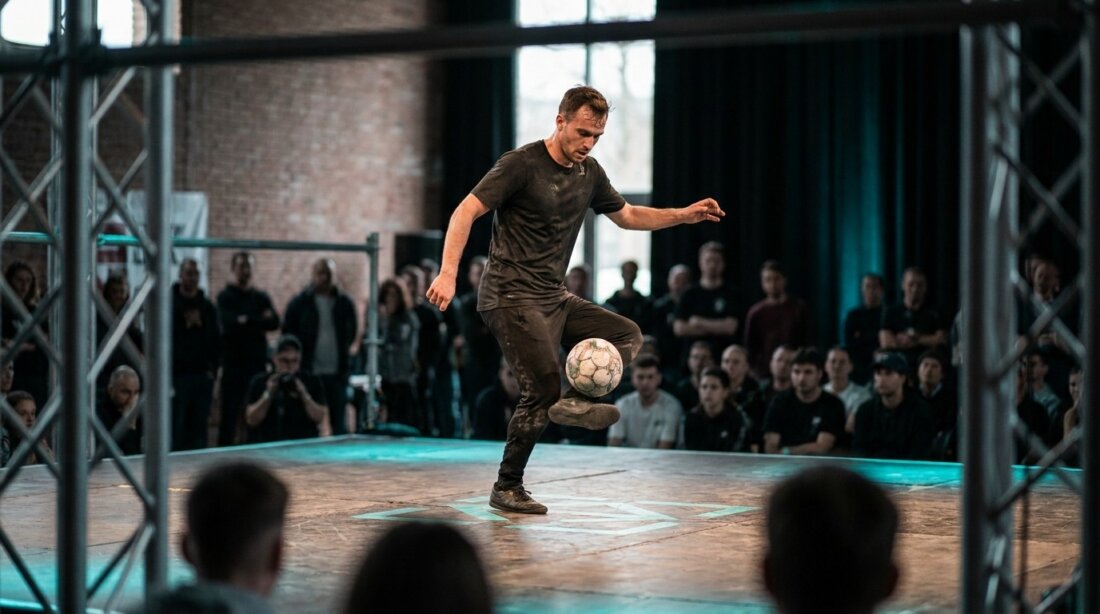
Freestyle Football: Your Timing Still Has Room for Improvement

07.07.2026
7 min read
Seven months ago, Jesse Marlet stood on stage in Sopot. For three minutes, the ball rolled so cleanly across foot, head and shoulder that 2,500 spectators fell silent. The Dutchman claimed his second consecutive world title and remained unbeaten throughout the tournament. Freestyle football is no sideshow. It is ball control as a sport in its own right.
 Quick Sprint
- ▸ The foot does what the hand does in juggling. Only less polite: freestyle football uses foot, head, shoulder and floor.
- ▸ Five trick families structure the scene. Lowers, Uppers, Sitdowns, Ground Moves and Blocking each train a different muscle chain.
- ▸ Entry requires three skills, no equipment. Sit, sole stop and Around The World are enough for your first combo.
- ▸ The global elite battles every three minutes. The WFFA ranking uses an Elo system like chess, not crowd approval.
- ▸ Transfer matters more than show. Footwork, reaction time and balance feed into every other sport you play.
What happens when the foot takes over?
Anyone who can already juggle three balls knows this moment: after a few weeks, the cascade feels natural. And then? Freestyle football starts right there. The ball rests on the foot, clings briefly to the nape, taps the shoulder, or stays seated between shin and instep. Suddenly, it’s not just the hand at work anymore-it’s the entire chain from ankle to torso.
Ball artistry is the German umbrella term for both disciplines, though the scene draws a clear line between them. A YouTube search for “freestyle football” lands you with people balancing a ball on their instep for twenty seconds without touching the ground. It feels closer to Wushu than juggling: body tension, balance, and the patience for a thousand failed attempts until a trick clicks.
I underestimated it. I assumed that if I could juggle, I could keep a ball on my foot. Wrong. The hand gives you feedback through every finger. The instep gives almost none until you learn what to watch for. My first Around The World looked like a kick against an invisible pylon.
How five trick families organize your training
The World Freestyle Football Association splits the sport into five families. Lowers are footwork on the ground: crossovers, Around-The-World variants, quick touches. Uppers belong to head, neck, and shoulders-the ball stays aloft. Sitdowns happen seated, usually with bent legs. Ground Moves fill the gap: the freestyler stands while the ball rolls or dances on the floor. Blocking suspends the ball with foot, leg, or torso without floor or hand contact. In competition, battles last three minutes and run as head-to-head duels. Judges score technique, creativity, and flow.
For your training, that means you steer which chain has to fire. Lowers demand ankle and calf control. Uppers bring neck stability and peripheral awareness into play. Juggling trains hand-eye coordination above all. That’s exactly why the two disciplines complement each other cleanly.
| Criterion | Juggling | Freestyle Football |
|---|---|---|
| Body Area | Hands, forearms, gaze | Foot, head, shoulder, torso |
| Entry Barrier | Low, patterns noticeable in days | Moderate, first trick takes weeks |
| Training Space | Any room with 2 m ceiling height | Flat ground, slightly more room |
| Competition Scene | Sparsely organized | WFFA world ranking, battle format |
Start with 3 skills: Sit, Sole Stop, Around The World
Almost everyone’s first attempt looks the same: ball in the air, leg around it, ball away-often straight into the neighbor’s yard. Good freestylers break the trick into smaller chunks before they put it all together. These three skills build on one another.
- Sit: the ball while seated. Sit on the ground, knees bent, balance the ball on your shin. Hold for ten seconds before you even think about moving. It trains core tension without you ever calling it core training.
- Sole Stop: the ball lands exactly where you want. Toss the ball up, cushion it with the sole of your foot so it doesn’t rebound. This is the foundation for every ground-move combo-and the point where most beginners quit because the ball keeps bouncing away. Stick with ten clean stops in a row before you move on.
- Around The World: your first real trick. Ball on the instep, toss it up, swing the same leg all the way around the ball, then catch it. The motion rarely clicks before day ten to fourteen of short daily sessions. Once it clicks, you’ve got the basis for ninety percent of the lower-body tricks that follow.
- ▸ A standard size-5 football is plenty to start
- ▸ A flat, even surface-indoors or out
- ▸ Ten minutes a day, daily beats one long session
- ▸ A special low-bounce freestyle ball for starters
- ▸ Freestyle shoes with flat soles
- ▸ A coach-led training program
Sopot, December: 2,500 people hold their breath
Jesse Marlet from the Netherlands won his second consecutive world championship in December 2025 in Sopot, Poland, sweeping the entire slate: national title, Super Ball World Open, and world championship in the same year-without losing a single battle. More than 2,500 spectators watched the final, the largest crowd the format has ever drawn. Isabel Wilkins from Great Britain claimed the women’s title.
What separates the world’s best freestyle footballers from hobby players isn’t usually the sheer number of tricks. It’s the transitions between them: shifting from Lowers to Uppers to Sitdowns without the ball ever touching the ground unless it’s supposed to. Those very transitions are a more realistic training goal for you than the next jaw-dropping single trick.
I watched the final on replay and only noticed after the third replay that I’d been holding my breath the whole time. I wasn’t even there in person. That says more about the format than any attendance figure ever could.
How freestyle football sharpens your timing
Freestyle football won’t replace endurance runs or strength training, but it fills a gap that classic athletic drills often miss: reactive footwork under constantly shifting conditions. Anyone who’s ever climbed or tested indoor wind tunnels knows the principle: your body learns fastest when the task stays fresh and never turns into mindless repetition.
The carry-over is concrete. Foot feel aids passing in team sports, balance for climbing or skating, reaction time anywhere you have to respond to a rapidly changing cue. The catch: without regular practice, the benefit fades just like juggling skills. Ten focused minutes a day beats one long session on the weekend.
Cool-down
Click on a question to reveal the answer.
Do I need a special ball for freestyle football?
How long does it take to land my first Around The World?
Is it useful as pure coordination training, even without competitive ambitions?
Can I train juggling and freestyle football at the same time?

Editorial IBS Publishing ››
Juggling as a workout: what three balls can do for you →
What Wushu brings to your trail training that no gym ever could →
Indoor skydiving: how wind-tunnel sports will become a fitness trend in 2026 →
Innsbruck Climbing World Cup: 3 lessons for your wall →
Hook-first 2026: songs for the first 15 seconds IBB →
Image source: AI-generated (July 2026)
Translated from the German original using artificial intelligence. The German version is authoritative.