






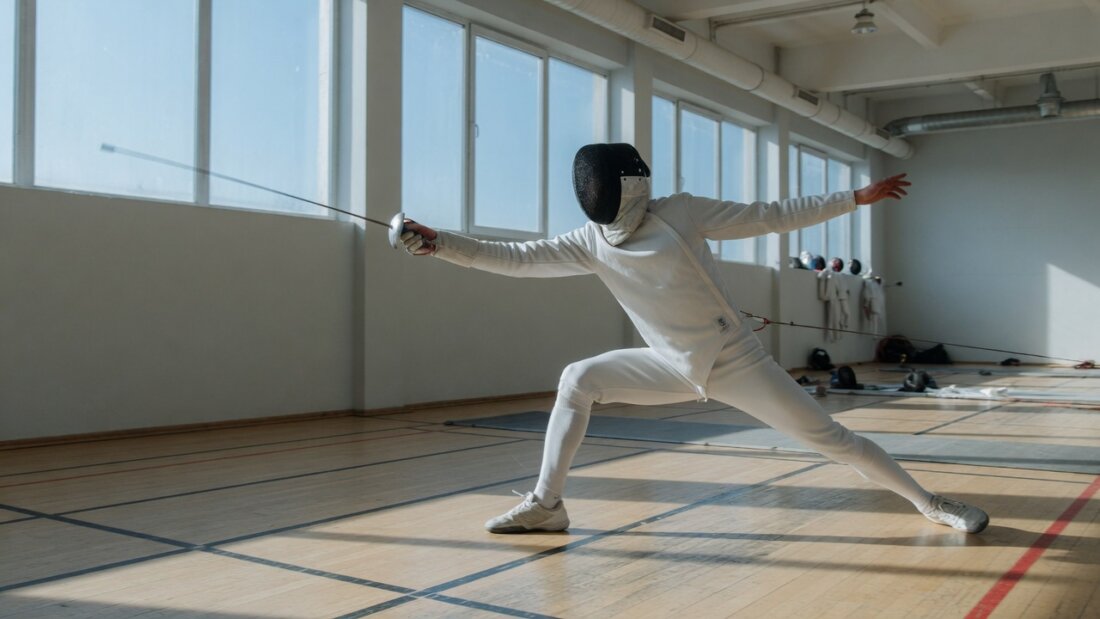
Fencing teaches you to brake when it really matters

6 Min. read
When a fencer attacks, everything unfolds in under a second: gauging distance, making a decision, an explosive lunge, the hit, and the recovery. What might seem like an elite sport is actually one of the most intensive schools for footwork, reaction speed, and eccentric loading you’ll find. The question isn’t whether you should join a fencing club. The question is which mechanics you can adopt to react faster and brake more solidly.
 Quick Sprint
- ▸ Fencing trains eccentric leg strength and reaction speed at a level few other sports can match.
- ▸ The lunge is an explosive forward movement with hard braking-exactly what runners and ball sport athletes often neglect.
- ▸ You don’t need to pick up an épée. Three to four transferable exercises are enough to noticeably complement your training.
- ▸ Knee and hip stability benefit directly, because fencing footwork is dominated by single-leg and lateral movements.
Why fencing is more than just poking with a stick
Fencing is one of the oldest Olympic sports, yet also one of the most finely calibrated movement schools out there. An attack in foil or épée often lasts just fractions of a second. In that time, the fencer decides on distance, timing, direction of attack, and their own balance after the strike. All of this happens in an asymmetric stance under constant tension.
You don’t need to become a fencer to reap the benefits. The sport forces its athletes to remain stable in extreme positions, absorb abrupt directional changes, and process stimuli in milliseconds. It’s precisely these skills that stagnate in many recreational athletes. You might train your strength endurance or basic stamina. But when did you last specifically work on your ability to stay upright during a single-leg forward landing? Fencers do this a hundred times over per training session.
The En Guard Stance: Your Foundation for Everything That Follows
Before a fencer attacks, they stand in the en guard stance. Feet roughly shoulder-width apart, front foot pointing forward, rear foot at a 90-degree angle to it. Knees bent, center of gravity low, back upright. This position is not a rigid stand. It is a preloaded spring. The most fundamental movements from here are the step forward and the step backward. Both look unspectacular, but they require constant full-body tension because the center of gravity must neither wobble nor tilt.
For you, this means: The en guard stance is an isometric holding position that simultaneously challenges your foot and calf muscles, your quadriceps, and your hip stabilizers. If you test it, you will find that 60 seconds in a proper fencing stance are more demanding than many standard exercises in the gym. The rear foot reveals a biomechanical detail that many runners lack: the ability to actively hold the foot in external rotation engages the hip external rotators and the gluteus medius muscle. Precisely the muscles that protect your knee joint from collapsing inward.
The Lunge: Explosive Forward, Hard Braking
The lunge, as it is called in fencing, is the sport’s most striking movement. The front foot pushes explosively forward, the rear foot fully extends the knee, the arm extends to strike. Then comes the difficult part: the body must decelerate. The entire forward energy must be absorbed by the front leg, within a fraction of a second.
This phase is eccentric leg strength in its purest form. Your muscle lengthens under load when it is actually supposed to brake. Precisely this load is missing for runners and team sport athletes if they never train eccentrically. During sudden stops or changes of direction, they then lack the capacity to protect their joints. The lunge trains exactly that: rapid forward acceleration followed by a hard single-leg landing. Your front knee must remain stable under forward pressure. Your hip must not drop. Your ankle must cushion the landing without collapsing.
Reactive Agility and the Game of Distance
Fencing is a sport where you constantly switch between action and reaction. The opponent makes a move, you react. You start an attack, the opponent parries, you must immediately switch gears. This reaction chain does not run consciously. It runs via automated movement patterns that are hardwired during training.
Distance management is the key here. A fencer knows their attack distance down to the centimeter. They know when they can strike and when they are vulnerable. You can acquire this body awareness without ever holding a blade in your hand. Partner drills with a ball, where you react to a signal and adjust the distance while running, train exactly that. You learn to dynamically estimate distances and adapt your speed to an external stimulus.
Flèche and Ballestra: When the First Step Decides
The flèche is an attack where the fencer throws a dynamic step forward from the stance, almost like a jump. The ballestra combines a small hop with an immediate lunge. Both are based on an explosive first step from a standing position. For runners, this is an unfamiliar movement pattern. For team sport athletes, it is everyday routine. Tennis, basketball, soccer demand first steps from a stand that must be instantly explosive.
Fencing technique teaches you how to bring your center of gravity forward while actively using the sole of your rear foot to push off. This is not pure calf strength. It is coordination between the foot arch, calf muscles, hamstrings, and hip extensors. When this drive is executed cleanly, every sprint, every start from the blocks, and every change of direction benefits. The strength of fencing training lies in this combination of reaction, single-leg stability, and eccentric load. You do not have to adopt all elements. Two or three mechanics are enough to close a noticeable gap.
How to approach it
- Hold the stance as a Warm-up. Get into the fencing stance: front foot forward, rear foot at a 90-degree angle, knees bent. Hold the position for 45 seconds per side. Then switch sides. This activates your hip stabilizers and calf muscles in a way that helps you before sprints or jump training.
- Lunge with a landing stop. Take a wide lunge forward, but don’t land softly and fluidly. Land hard, stop immediately, and hold the position for two seconds. This trains eccentric braking power. Three sets of six repetitions per leg are enough to start.
- Reaction drill with a partner. Stand three meters opposite a partner. Your partner holds a ball at chest height. They drop it without warning. You start from a standing position and must catch the ball before its second contact with the ground. This trains your initial acceleration, distance perception, and reaction all at once.
- Lateral step sequences. From the stance, take three quick steps to the left, then three to the right. Keep your center of gravity low. This trains lateral movement, which many runners completely neglect. Two sets of ten switches per side.
- Single-leg landing from a jump. Jump slightly forward and land on one leg. Hold the position stable for two seconds. The front knee must not drift inward. This exercise is the most direct transfer of the lunge into your strength training.
Conclusion
Fencing is one of the most efficient schools for footwork, reaction, and eccentric load that you can incorporate into your training without any equipment. You don’t need to touch a blade to benefit from the mechanics. If you test the stance, practice the lunge with a landing stop, and do a reaction drill once a week, within a few weeks you will feel your body learning to brake harder and with greater stability. That’s exactly what separates a fast athlete from one who stays fast even under pressure.
Cool-down
Click a question to reveal the answer.
Do I really need to join a fencing club to benefit from this?
What are the injury risks of the lunge?
How often should I include these exercises?
Does this offer benefits for endurance athletes too?

Chief Digital Officer, Evernine ››
Learning to kitesurf on the North and Baltic Seas →
Squash goes Olympic: harder than any cardio →
UTMB 2026: The anatomy of the world’s toughest run →
HYROX Coach Qualification: Is the certification worth it? →
XTERRA France: Lessons for your own mountain training →
Image source: AI-generated (July 2026)