






Pickleball: Der US-Boom der gerade Deutschland erreicht

6 Min. read
In the U.S., pickleball is already the fastest-growing sport. Forty-eight million Americans play it. In Germany, the craze is still in its infancy—but the numbers are exploding: over 176 courts, more than 60 clubs, and a community that grows larger every month. If you’re looking for a sport you can learn in 10 minutes yet remains tactically rich enough to last for years, you’re in the right place.
Sources: trendsport.info (2026), German Pickleball Association
What Is Pickleball?
What is pickleball? Pickleball is a paddle sport that blends elements of tennis, badminton, and table tennis. It’s played with a solid paddle (no strings) and a perforated plastic ball on a court roughly the size of a badminton court. The sport was invented in 1965 on Bainbridge Island near Seattle and is now the fastest-growing sport in North America.
What makes pickleball special: The learning curve is incredibly gentle. The basic rules take just 10 minutes to grasp, and within half an hour you can play your first match. At the same time, the game offers enough tactical depth to challenge advanced players — especially in doubles, the most common format. The pace is slower than tennis but faster than badminton. Rallies last longer, points are more exciting, and the physical demand is moderate enough for all age groups.
In Germany, the scene is growing rapidly. The German Pickleball Association now counts over 60 member clubs. According to trendsport.info, there are already more than 176 courts across the country. And with the open-play format — where anyone can just drop in — the entry barrier is lower than in almost any other sport.
The Rules: Ready to Play in 10 Minutes
Pickleball has five core rules you need to know:
1. The Court: 13.41 metres long and 6.10 metres wide. The net stands 86 centimetres high at the centre. For comparison: a tennis court is almost twice the size. The compact court means less ground to cover and more reaction time.
2. The Serve: Underhand, diagonally into the opponent’s court. The ball must be struck below hip level. No power serves like in tennis—here, it’s all about placement and spin.
3. The Two-Bounce Rule: After the serve, the ball must bounce once on each side before volleys are allowed. This stops the server from charging the net and ending the point with a volley. Smart move: this rule automatically extends rallies.
4. The Kitchen (Non-Volley Zone): The 2.13-metre zone right in front of the net is called the Kitchen. You can’t hit the ball out of the air (volley) while standing in this zone. You *can* step in—but only if the ball has bounced first. The Kitchen is the tactical heart of pickleball, forcing finesse over power.
5. Scoring: Played to 11 points, with a minimum two-point lead. Only the serving team can score. In doubles, each team gets two serves before the serve switches sides.
Pickleball vs. Padel vs. Tennis: The Honest Comparison
Three racquet sports, three totally different experiences. If you’ve already tried padel or tennis, you might be wondering: what sets pickleball apart?
Court and Setup: Tennis demands the largest space (23.77 x 8.23 m). Padel is played on a 20 x 10 m court with glass walls that become part of the game. Pickleball only needs 13.41 x 6.10 m—and no special infrastructure. You can fit four pickleball courts on a single tennis court. That’s why the number of courts is growing so fast.
Barrier to Entry: Pickleball is the easiest to pick up. The rules are simpler, the court smaller, the balls slower. Tennis has the steepest learning curve: serve, technique, and stamina take months to master. Padel sits in the middle, benefiting from those glass walls that keep the ball in play.
Costs: Pickleball is the most budget-friendly. A solid paddle costs €30 to €80, and a set of balls is under €10. Padel rackets run from €60 to €200, while tennis rackets start at €80 and go up to €300—plus regular restringing costs. Court hire? Pickleball courts are often free (clubs, open play), while padel can cost €20 to €40 per hour.
Who It’s For: Pickleball for those who want to jump in fast, families, and mixed-age groups. Padel for tactical players who love dynamic, wall-involved action. Tennis for endurance athletes who value tradition and one-on-one competition.
Gear: What You Need and What It Costs
The barrier to entry for gear is minimal:
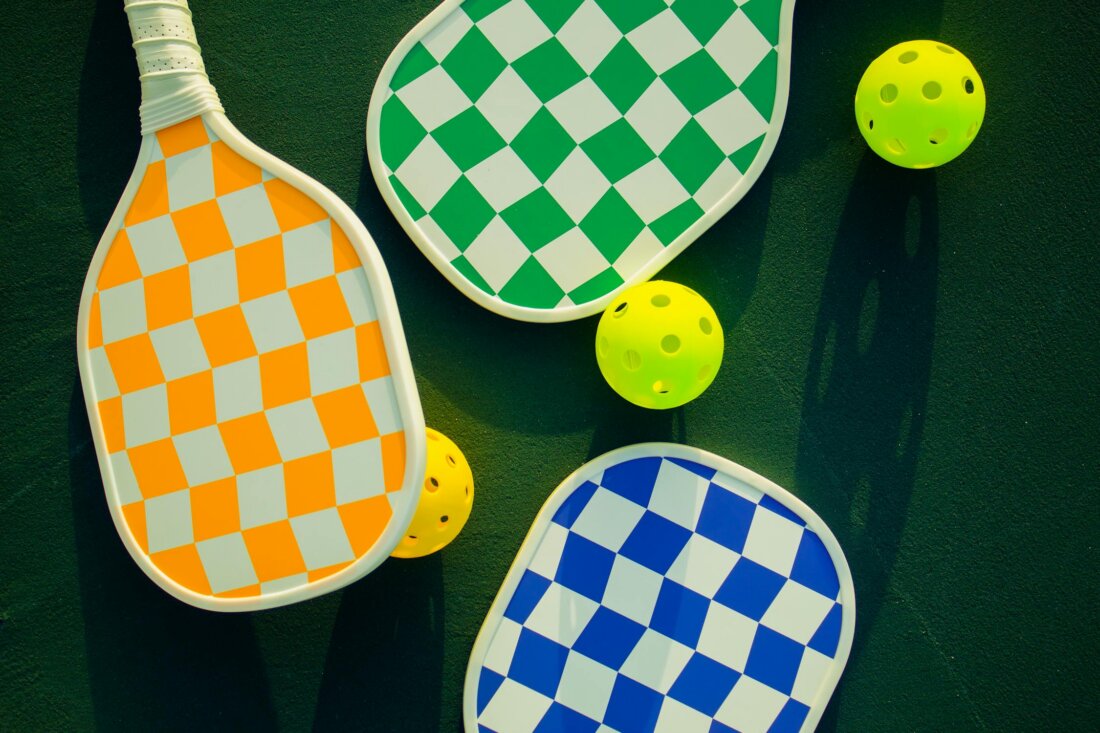
Paddle (€30 to €150): The paddle is flat, no strings, and made from composite materials (carbon, fibreglass, wood). Entry-level models start at €30 and are more than enough. Advanced players invest in carbon paddles for better spin potential. Trusted brands: Selkirk, Joola, Head, Franklin.
Balls (€8 to €15 for 6): Perforated plastic balls, similar to a Wiffle ball. Outdoor balls have smaller holes and are heavier (for wind resistance), while indoor balls have larger holes and fly slower.
Shoes: Indoor sports shoes or tennis shoes work best. Avoid running shoes—the sole needs to support lateral movements. If you already own shoes for badminton, handball, or tennis, those will do the job.
Here’s how you get started with pickleball in Germany
Step 1: Find a court. The best overview is offered by trendsport.info, which features an interactive map of all 176+ pickleball courts across Germany. Alternatively, the website Pickleballfans.de lists clubs and playing locations by city.
Step 2: Attend an Open Play session. Open play is the heart of the pickleball community. Simply show up at the scheduled time—the teams are mixed on-site, and you play with rotating partners. No club membership required, no registration, no commitment. Most open play sessions are free or cost a maximum of 5 euros.
Step 3: Play your first matches. In doubles (the most common format), you’ll step onto the court with a partner. More experienced players will explain the rules in under two minutes. You’ll grasp the concept after just three rallies. Within 30 minutes, you’ll be playing your first real match. This isn’t a marketing claim—it’s the reality of pickleball.
Step 4: Join the community. Pickleball thrives on community spirit. In many cities, WhatsApp groups and Facebook communities organize impromptu sessions. In Berlin, Munich, Hamburg, and Cologne, there are multiple weekly meetups. If you enjoy Pump Track as a community sport, you’ll love the pickleball scene.
Pickleball is a rare phenomenon in sports: a game that takes minutes to learn but never gets boring. Its combination of low cost, minimal space requirements, and an open, welcoming community makes it the perfect entry point for anyone looking to try something new. Germany’s pickleball boom is still ahead. Those who start now will be part of the first wave.
 Cool-Down
Click on a question to reveal the answer.
Is Pickleball a good workout?
Can I play Pickleball alone?
What is the Kitchen, and why is it so important?
Do I need tennis experience to play Pickleball?
Will Pickleball become an Olympic sport?
Source of header image: Pexels / Lindsey Flynn (px:19642658)