






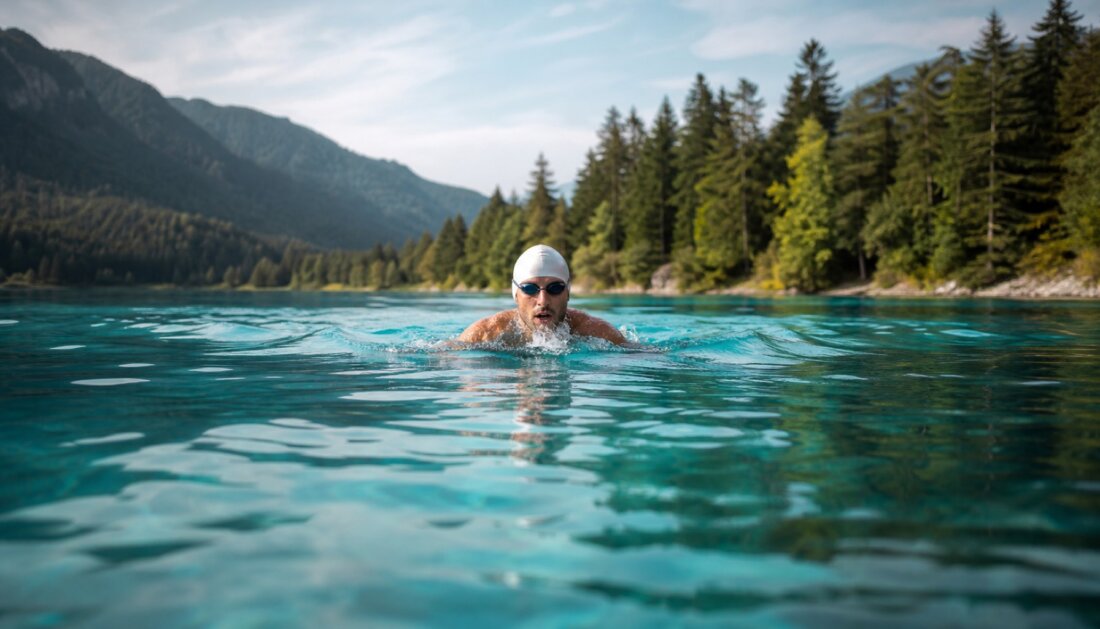
Front Crawl, Breaststroke, Backstroke: Which Swimming Technique for Which Body of Water

6 min read
Freestyle may be the fastest stroke in the pool, but breaststroke feels relaxed. That equation holds true in a 25-metre pool. Once you step into open water where you can no longer see the bottom, everything changes. It took me three summers to realise that the best outdoor technique isn’t the fastest one—it’s the one that keeps your head above water.
Why pool logic doesn’t work in open water
In a swimming pool, everything is predictable. A line on the bottom shows you the way, the wall appears after 25 or 50 metres, and the water is a steady 27 °C. You can focus entirely on your technique because the environment asks no questions.
In open water, all of that disappears. There’s no line, no wall, and often no clear view of what’s below. Add waves, currents, wind, and a temperature that throws your breathing off in the first few minutes, and suddenly swimming isn’t just about propulsion—it’s about navigation and safety too.
This is where the real test begins: which technique actually suits you. A stroke that delivers personal bests in the pool can slow you down in the open water if half your energy goes into staying on course. Once you grasp that, swimming outside feels far more relaxed. For more on preparing for the season, check out our overview of the current open-water season.
Freestyle: the fastest pace, the steepest price
Freestyle is the most efficient technique when pure speed is the goal. Your body stays flat, water resistance drops, and thrust remains steady. For triathlons and long crossings, there’s rarely another way to go.
The catch? Orientation. Freestyle keeps your gaze downward, not forward. In open water that means you have to lift your head regularly to check your line. Pros call this “sighting.”
What is sighting? Sighting is the open-water swimmer’s way of staying on track. Every few strokes you briefly raise your eyes above the surface, lock onto a fixed point onshore or a buoy, then drop your head right back down. This keeps you on course without derailing your rhythm.
You perform this quick check every 6 to 10 strokes. It costs rhythm—and a few percentage points of speed.
I once swam my first open-water kilometre without sighting and was genuinely shocked by how far off course I drifted. By the end I’d covered roughly 200 metres extra. Freestyle in open water is worth it—but only if you practise the head-lift in the pool first, until it no longer feels like a break in motion.
Breaststroke: the underestimated head-up all-rounder
Breaststroke has a bad reputation in the swimming scene. It’s seen as slow and something you should leave behind once you’re in the pool. Out in open water, that perception flips.
The biggest advantage is simple yet crucial: with breaststroke, you can keep your head above water the whole time. You see where you’re going, you spot boats, you spot other swimmers. You don’t have to break your rhythm just to take a look. In choppy conditions, poor visibility, or an unfamiliar lake, that’s a real safety boost.
Breaststroke is slower than front crawl—that’s a fact. But for long, steady stretches where arriving matters more than speed, it’s the honest choice. Many recreational swimmers front-crawl the first hundred metres, then switch to breaststroke as soon as they realize that losing track of direction saps more energy than speed gains. For gear that makes the transition easier, check out our guide to swimming styles for outdoor use.
“Anyone swimming in open water should never go alone, check the water temperature beforehand, and when in doubt, choose the technique that gives the best overview.”
Paraphrased from DLRG safety advice for open-water swimming
Backstroke and technique switching: when a change saves you
Backstroke is rarely planned for open-water swims, yet it has one clear purpose. It’s your recovery stroke. When your neck tightens from front crawl, when you’re gasping for air, or when you just need a quick breather, flip onto your back. Your face is free, your breathing steadies, your pulse drops.
The catch: on your back you can’t see where you’re going. As a go-to technique in a lake, it’s a non-starter. But as a 30-second reset between tough sections, it’s pure gold. I now use it deliberately instead of just treading water when I need a break.
That’s where technique switching comes in. This isn’t about the competitive medley, but the simple ability to call up several clean strokes on demand. You start with front crawl, switch to breaststroke in rough water, flip to backstroke to catch your breath, then go back. Whoever masters this stays flexible outdoors and handles far more situations than someone locked into a single technique.
Which technique suits which body of water
The calm lake is the simplest terrain. Visibility is usually good, waves are minimal, and distances are manageable. This is where you can practice freestyle and train your sighting without much risk. The lake is your training ground.
The ocean is a different league. Waves, saltwater, currents, and tides demand your full attention. Freestyle works, but only if you’ve mastered sighting and understand the conditions. When in doubt, breaststroke is the smarter choice at sea—you’ll see the waves coming.
The river is the special case. Currents change everything. Swimming against the current is exhausting, even pointless. Here, technique matters less than knowing where you can safely enter and exit. Breaststroke with constant forward glances is the baseline; freestyle is the exception. And no matter the body of water: below roughly 16 °C, technique takes a backseat. Warmth and a quick exit plan become the priority.
| Body of water | Recommended technique | Why |
|---|---|---|
| Calm lake | Freestyle for practice | Good visibility, minimal waves, short distances. The ideal spot to learn sighting. |
| Ocean | Breaststroke; freestyle only with solid sighting | Waves and currents demand situational awareness. Head-up beats speed. |
| River | Breaststroke with forward glances | Currents rule. Knowing safe entry and exit points trumps technique. |
| Cold water (rule of thumb: below 16 °C) | Gentle breaststroke, short stays | Warmth and a rapid exit matter more than efficiency. |
 Cool-down
Click on a question to reveal the answer.
Which technique is best for open-water beginners?
How often should I look up while front-crawling in a lake?
Does backstroke even make sense in open water?
Does cold water change your stroke choice?
Image source: AI-generated (May 2026), C2PA certificate embedded in image