






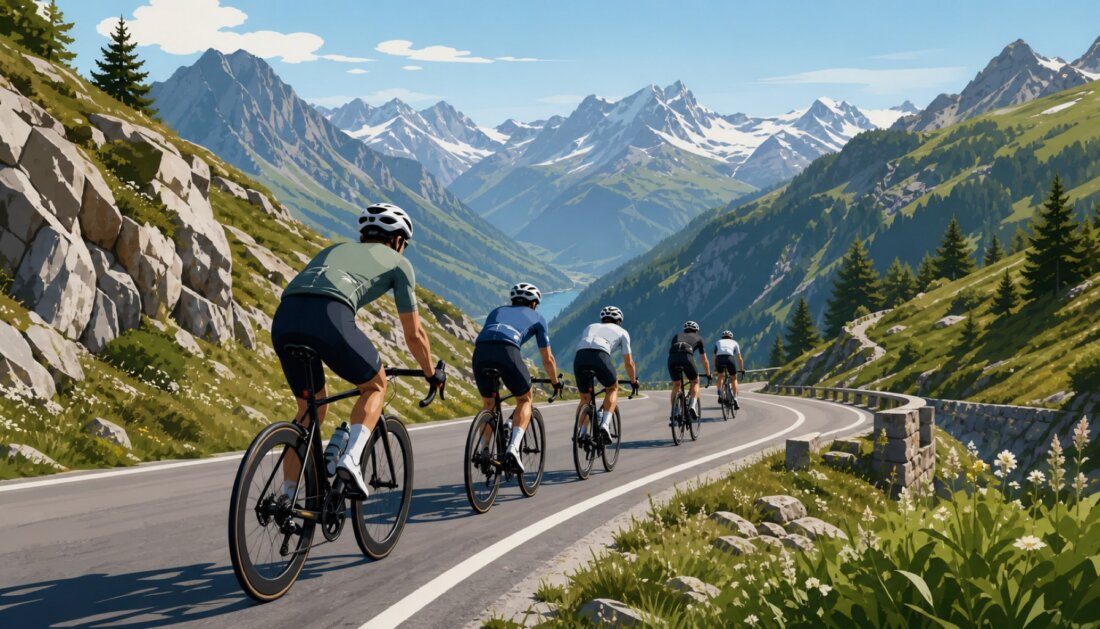
Critérium du Dauphiné 2026: 5 Training Lessons for Endurance

AUTHOR:
Sonja Höslmeier

6 min. read
On Sunday, 7 June, the peloton rolls out from Vizille – the very field that will decide the Tour de France four weeks later. Since 2025 the race is officially called the Tour Auvergne-Rhône-Alpes, yet everyone still calls it the Critérium du Dauphiné, and everyone means the same thing: the dress rehearsal. Eight days in which pros like 19-year-old Paul Seixas, ahead of his first Tour start, test whether their form is where it needs to be. What makes it fascinating is not who wins. It’s how these athletes approach a race they don’t actually need to win. That’s exactly where you can steal five lessons for yourself, whether your season goal is a gravel marathon, a triathlon, or your first Alpine crossing.
 Quick Sprint
- ▸ The dress rehearsal is a diagnosis, not a showdown. Pros test their form three to four weeks before their A-race rather than guessing on the big day.
- ▸ Holding pace beats making pace. The team time trial rewards steady watts, not one hero attack.
- ▸ Back-to-back days train recovery. Eight hard days in a row reveal whether your recuperation keeps pace with your workload.
- ▸ Equipment gets tested beforehand, never on race day. If it doesn’t fit at the Dauphiné, it’s gone before the Tour.
- ▸ Mountains are the most honest fitness test. One long climb tells you more about where you stand than any flat-road interval.
1. Plan your own dress rehearsal three weeks out
No pro rides into the Tour blind. The Dauphiné falls just under four weeks before the Grand Départ on July 4, and that’s entirely by design. The race is a test run under real conditions, early enough to make corrections afterwards.
For you, that means building a genuine stress test three to four weeks before your season goal. A race-pace block, a dress-rehearsal ride, a short distance at target intensity. You want to know where you stand while you can still do something about it. Anyone who only finds out on race day doesn’t have a plan – they have a hope. For a clean way to pin down your base pace beforehand, the Zone 2 approach with FatMax and VT1 data has you covered.
2. Practice holding pace, not making pace
Teams ride a team time trial at the Dauphiné because the 2026 Tour opens with exactly that format in Barcelona. In a time trial, the winner isn’t the rider with the most explosive acceleration – it’s the group that distributes its effort most evenly.
That’s the unglamorous truth behind almost every endurance goal. The first climb in a gravel marathon feels great, you push hard, and 40 kilometres later you pay for it. Pacing is a skill, not a gut feeling. Train it deliberately: a fixed wattage or fixed pace over a set distance, even if it feels too easy at first. The discipline to do that gets ingrained through structured interval training designed to sharpen exactly this kind of tempo control.
3. Stack two hard days back to back
One stage is tough. Eight in a row is a different sport entirely. Stage racing doesn’t test your peak performance on a single day – it tests how quickly your body is ready to go again by the next morning.
You can replicate that effect on a smaller scale. Deliberately build a weekend around two demanding sessions: long on Saturday, intense on Sunday. You’ll learn two things. First, whether your recovery keeps pace with your workload. Second, how fatigue settles into your technique – because that’s exactly when mistakes happen. For an honest look at how much of that recovery actually runs through sleep, and what wearables can realistically tell you about it, see our deep dive on sleep, recovery and HRV tracking.
4. Test Your Gear When the Stakes Are Low
What the pros try out at the Dauphiné – saddle, tyres, nutrition, position – is already locked in by the Tour. Nobody switches to something untested at the most important race of the year. The tune-up race is the place for experiments, not the main event.
Sounds obvious. Gets ignored constantly. New shoes on race day, a gel you’ve never tried, a saddle position you’ve only been riding since Tuesday. Anything you use for the first time on race day is a risk you’re voluntarily building in. Your dress rehearsal is your gear check too. Whatever pinches, chafes or upsets your stomach gets cut now.
5. Let the Mountains Tell You the Truth
The Dauphiné is notorious for its mountain stages, and that’s no accident. A long climb is the most honest test there is. On the flat you can hide in a group, draft your way through, and fake it. On the mountain, you’re alone with your form.
Build at least one long ascent into your preparation – something that genuinely challenges you. Not a hill you knock out standing on the pedals, but a ramp where you grind at threshold for twenty minutes or more. What the mountain tells you about your current shape is incorruptible. And honestly: if that doesn’t appeal to you right now, you’ve got the wrong article open.
Dress Rehearsal vs. Race Day, Side by Side
The difference between a test run and a race lies not in pace but in intention. This table makes it concrete.
| Aspect | Dress Rehearsal | A-Race |
|---|---|---|
| Goal | Check form, identify weaknesses | Deliver your best result |
| Gear | Testing new things is fine | Proven kit only |
| Handling mistakes | A lesson for next time | Costly, hard to recover from |
| Mindset | Relaxed, curious | Focused, all chips on the table |
When the field rolls out of Vizille on June 7th, don’t just watch the finishing times. Watch how calmly these athletes handle a race they’re using as a tool. That mindset is yours to borrow, free of charge, no professional power meter required.
Cool-down
Click on a question to expand the answer.
I don’t ride a road bike at all. Is any of this actually useful for me?
How hard should my own dress rehearsal be?
Three to four weeks out – isn’t that too early?
Where can I actually follow the Dauphiné?
Why does the race have a different name now?
Zone 2 personalised: What FatMax and VT1 data can teach your training plan →

Editorial IBS Publishing ››
Interval training for runners: Get faster without running more kilometres →
Sleep and recovery: How wearables and AI can genuinely optimise your training →
Comrades Marathon 2026: What German-speaking runners need to know →
Running in the heat: The training guide for summer →
Image source: Cover image and article images AI-generated (June 2026), C2PA certificate embedded in image