






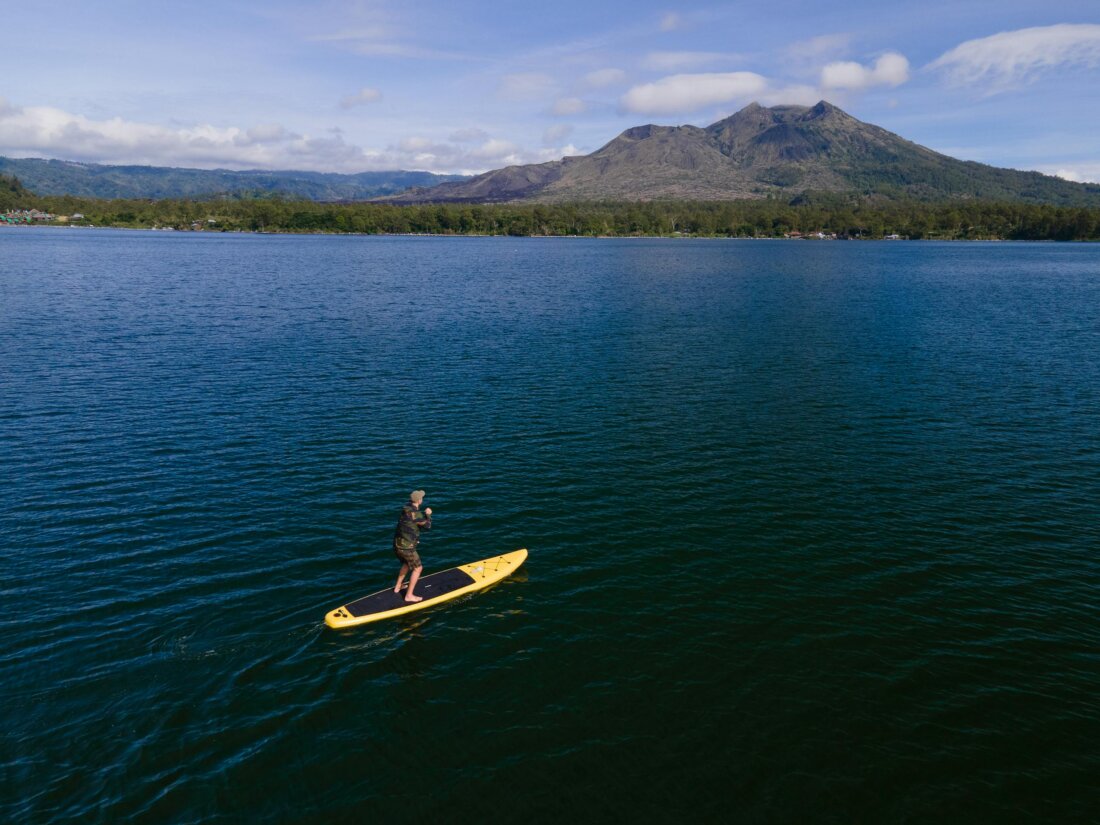
SUP 2026: Why Stand-Up Paddleboarding is Booming This Spring

6 Min. Read
Over 5 million people step onto a SUP board each year. The market is growing by 10 percent annually. And the best part: You need neither prior experience nor a specific fitness level. Stand-Up Paddleboarding is the most accessible watersport in the world – and simultaneously one of the most effective full-body workouts you can do outdoors.
Why SUP Is Taking Over
Stand-Up Paddleboarding has quietly become a phenomenon. No viral TikTok moment, no celebrity endorsement, no Netflix documentary. Instead: millions of people finding a tranquil lake and never wanting to leave. The global SUP market is set to grow to 16.35 billion euros by 2035, driven by a simple truth: SUP is the most accessible watersport in the world.
You don’t need waves (like surfing), wind (like sailing), or a team (like rowing). You need a board, a paddle, and access to water. Germany has thousands of lakes, rivers, and canals perfect for SUP. And with inflatable boards taking over the market, all your gear fits into a backpack.
What SUP Does to Your Body
SUP looks relaxing. It is—until you try it. A study in BMC Sports Science, Medicine and Rehabilitation systematically examined the physiological effects of SUP. The results:
Cardiovascular: Just 30-45 minutes of moderate paddling elevates your heart rate to a level that induces cardiovascular adaptations. Regular paddlers showed measurable increases in VO2max—the gold standard for aerobic fitness.
Core Strength: Every paddle stroke requires stabilization from deep core muscles. You’re standing on an unstable surface that moves—your body must constantly compensate. After a few weeks of regular paddling, core muscle endurance improves measurably.
Balance: SUP is the ultimate balance training. Better than a Bosu ball, better than a wobble board. Because the instability is real—not simulated. Your balance is challenged in every session, and the carryover to other sports is enormous.
Source: Business Research Insights, SUP Market Report 2026

Which Board Is Right for You?
The most important decision for beginners: inflatable (iSUP) or hardboard? Short answer: inflatable. Long answer:
Inflatable Boards (iSUP): Fit rolled up in a backpack, weigh 8-12 kilos, cost from 300 euros for good beginner models. Quality has improved massively in recent years—high-quality iSUPs are rigid enough for touring and light waves. Ideal if you don’t have a roof rack or want to transport the board in your car.
Hardboards: Stiffer, faster, better glide. But: more expensive (from 800 euros), need a transport solution, more sensitive to impacts. Makes sense if you paddle regularly and want performance.
Board Size: Rule of thumb: 30 cm longer than your height, at least 81 cm (32 inches) wide for stability. Beginners benefit from wider boards—speed comes later, stability comes first.
Your First Day on the Board
You’ve got a board, a paddle, and a calm lake. Here’s how to get started:
- Knees first: Start on your knees in the center of the board. Take a few paddle strokes. Feel how the board responds.
- Stand up slowly: Hands on the rail, one foot forward, then the other. Stand shoulder-width apart, knees slightly bent, eyes looking forward (not down!).
- Switch paddle sides: Change sides every 3–4 strokes, otherwise you’ll paddle in circles.
- Falling is normal: Everyone falls in. Seriously, everyone. Take it with humor. The water is warm enough (from May onwards in most German lakes).
Most people are standing steadily after 15–30 minutes. By your third session, you’ll be paddling without thinking. That’s when the real fun begins: longer tours, river trips, SUP yoga, or simply drifting on the board with a book.
BMC Sports Science, Medicine and Rehabilitation, paraphrased
Why SUP Is Addictive
Most water sports have a steep learning curve. Surfing takes months. Sailing requires a course. Wild swimming demands courage. SUP just needs a lake and 30 minutes. And then something happens that’s hard to describe: you’re standing on the water. Alone. Silence. Your gaze stretches across the lake. Your body is working, but your mind is free.
Studies confirm what paddlers intuitively know: SUP has measurable effects on anxiety, sleep quality, and stress levels. The combination of nature, movement, balance training, and contact with water is neurologically powerful—researchers call this the Blue Space Effect. Being near water reduces cortisol more effectively than forests or parks.
Then there’s the community aspect. SUP groups are booming in every German city with access to water. After-work paddles, full-moon tours, SUP yoga classes. This sport combines fitness with social connection in a way gyms simply can’t match.
Conclusion
SUP is the sport for anyone who wants to be outdoors without going to extremes. For those seeking a workout that doesn’t feel like work. For anyone who needs a quiet lake and a board to clear their mind. The season is starting now. The lakes are waiting. And you need less than you think to get started.
 Cool-down
Click on a question to reveal the answer.
What does a good beginner SUP cost?
Can I SUP on rivers too?
How fit do I need to be for SUP?
When does the season start in Germany?
Do I need a course?
Title image source: Pexels / Mikhail Nilov (px:6965085)