






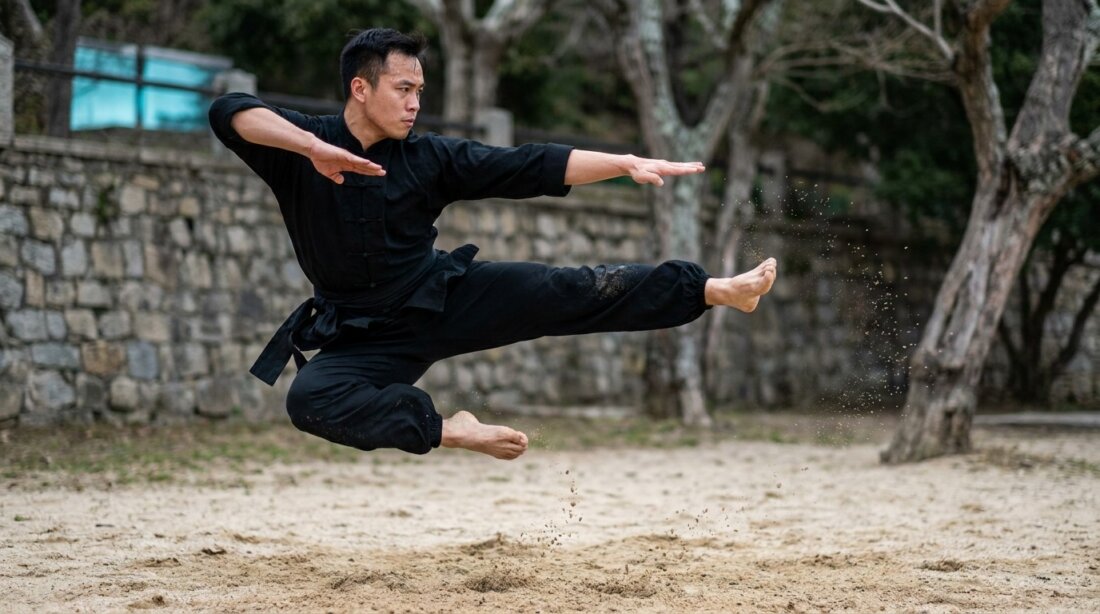
Wushu in Check: What the Martial Art Adds to Training

4 Min. Read
Jumps that look like dance, kicks that look like combat, and body control that rivals artistic gymnastics. Wushu is far more than the martial art it’s so often reduced to. In Dakar, it makes its debut as a medal sport at the 2026 Youth Olympic Games – and at the same time, more and more people are discovering it as a seriously demanding full-body workout. Anyone who has ever watched a Taolu form immediately understands why.
 Quick Sprint
- ▸ Wushu has two sides: the acrobatic forms (Taolu) and full-contact fighting (Sanda).
- ▸ As a training discipline, it builds strength, flexibility, coordination, and balance all at once.
- ▸ Elite athletes train like gymnasts or dancers, not like traditional martial artists.
- ▸ At the Youth Games in Dakar, Wushu is a medal sport for the first time in 2026.
What Sets Wushu Apart from Other Martial Arts
The term Wushu refers to the modern, athletically structured form of Chinese martial arts. Put simply: everything Wushu can be called Kung Fu in the broad sense, but not every Kung Fu is the highly organized, competition-oriented Wushu you see today in training halls and at international tournaments. The difference lies in ambition. Wushu combines traditional technique with modern sports science, placing exceptional emphasis on flexibility, acrobatics, and dynamic movement.
At its core are two disciplines. Taolu, the forms, is the visible, almost dance-like side: fixed sequences of jumps, kicks, strikes, and spins, judged on difficulty, precision, and expression. Watching it, you might think of gymnastics rather than fighting. Sanda, on the other hand, is free combat – a full-contact system of punches, kicks, throws, and grappling techniques that trains real-world application in an actual duel.
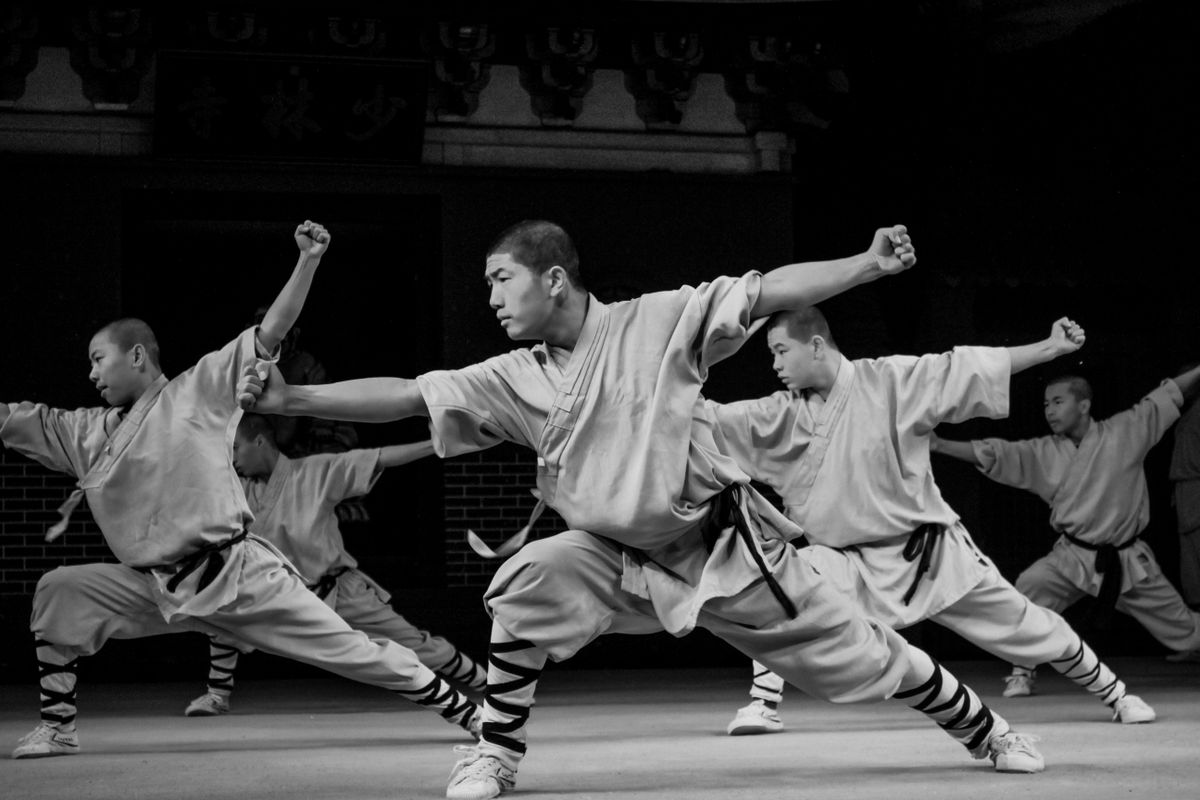
This dual nature is precisely what makes Wushu so compelling for anyone who isn’t looking for pure striking training. You can develop toward the aesthetic, body-controlled forms or step into competitive combat. Both paths train the same athletic foundation – just with a different end goal.
What Your Body Actually Gets Out of It
Wushu is one of the few training systems that demands four abilities simultaneously: strength for explosive jumps, flexibility for deep stances and high kicks, coordination for complex sequences, and balance for landings. Add endurance to that – a complete Taolu form is short but brutally intense, comparable to a maximal interval sprint. Train regularly and you develop a body that is strong, supple, and fast all at once, a combination that’s genuinely hard to achieve in a conventional gym.
At least as significant is the mental effect. Drilling long forms demands complete concentration – every movement is either clean or it isn’t. Many practitioners describe this blend of peak physical output and near-meditative focus as the real draw. Research into the effects of traditional Chinese martial arts suggests that regular practice can improve both physical fitness and mental wellbeing.
Wushu challenges your body like gymnastics and trains your mind like movement meditation – and that combination is exactly what makes it so complete.
So who is it for? Essentially anyone who wants varied, engaging training and isn’t afraid of looking awkward at the start. No prior martial arts experience required. What you do need is patience, because the movements are complex and need to be learned properly. The payoff is that progress is extremely visible – few training disciplines give you such a direct, tangible sense of what your body has suddenly become capable of.
How to get started as a beginner
The best route is through a club or school with qualified coaches. Wushu lives and dies by correct technique, and you won’t learn that from videos alone – stances in particular, and the joint stress involved in jumps, need proper guidance. Search specifically for Wushu rather than just Kung Fu if the modern, competitive side appeals to you. Many martial arts schools offer taster sessions where you can feel the difference between Taolu and Sanda for yourself.
Be prepared for the first phase to consist mostly of fundamentals: stances, footwork, mobility training. It can feel slow, but this is the foundation for everything that looks spectacular later. Any mobility work you’re already doing on the side will pay dividends – your body will thank you when the deep positions come. If you already have a background in flexibility-focused training, say from climbing or bouldering, you’re coming in with a solid base.
And don’t underestimate the mental side. Wushu rewards those who stick with it and sweat the details, not those who just show up strong. That’s precisely what makes it a sport that challenges you for years without ever getting stale. You never stop learning – and that’s the whole point.
Cool-down
Click a question to reveal the answer.
Is Wushu the same as Kung Fu?
Do I need prior experience in martial arts?
Taolu or Sanda – where should I start?
Is Wushu an Olympic sport?

Editorial IBS Publishing ››
Via Ferrata for Beginners: How to Tackle Your First Klettersteig Safely →Dead Hang: Why This Exercise Is Becoming the Calisthenics Scene’s Favourite Workout →Cold Plunge: When Ice Bathing Aids Recovery – and When It Holds You Back →Bouldering for Beginners: Technique Beats Strength →The Invisible Hits: Why Unknown Producers Shape the Music Market [InspiredByBeatz]→
Image source: AI-generated (June 2026), C2PA certificate embedded in image
Image in article: Pexels / Lan Yao (px:6724208)