






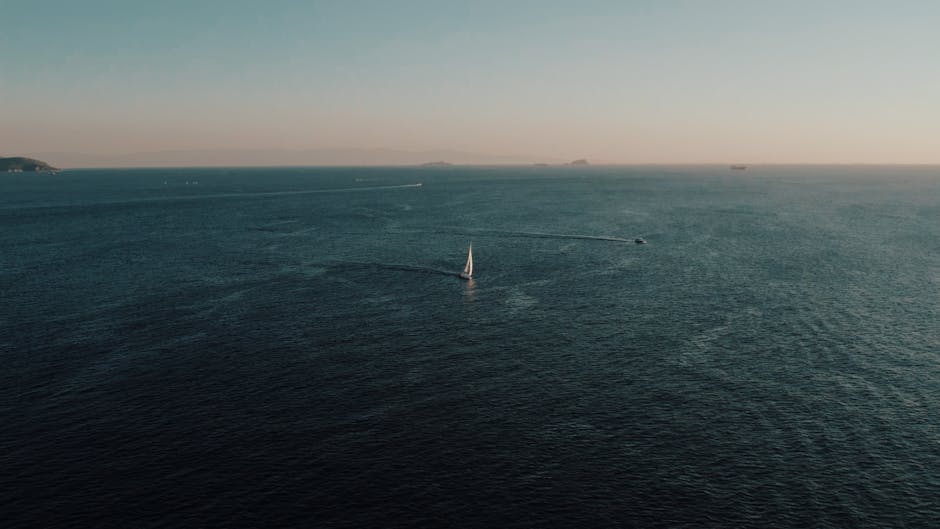
Learn to Sail: Your Boat License in 4 Weekends
7 Min. Read Time
Four weekends between you and your first hit on the Baltic Sea. No joke. The SBF See (Sportbootführerschein See) is the key to everything over 15 HP – from chartering a sailboat in Mallorca to driving a motorboat on Lake Starnberg. And the path to getting it is more manageable than you think.
27.04.2026
What the SBF See Really Demands
The theory covers 72 possible questions in four topic blocks: maritime law, navigation, meteorology, and behavior on the water. In the exam, you’ll receive a basic questionnaire with seven questions plus seven additional ones. You need to answer at least 13 out of 14 correctly. Additionally, there’s the navigation questionnaire: a sea chart of Kiel Fjord, plotting a few positions, courses, and bearings. This part can be intimidating, but it’s solid craftsmanship if you take your time with the triangle and compass.
The practical exam is surprisingly relaxed. Docking, undocking, man-overboard drill, tacking, sailing in an “Acht” (figure-eight), and knots. Six specific knots – square knot, sheet bend, clove hitch, bowline, stopper knot, and round turn with two half hitches. The bowline is the one everyone needs to master in their sleep. If you can tie it one-handed behind your back, the exam is a no-brainer.
It smells like diesel and algae when you stand in the marina at 8 am and start the boat. The deck is slippery from dew, the wind is coming from astern, and you feel the keel gently resting on the dock. Your instructor says “gas” and the engine roars to life. In that exact moment, you understand why the six hours of practical training are mandatory – not because of the maneuvers, but because of the time your body needs to read the boat’s movements.
The 4-Weekend Plan: How it Works
Weekend 1: Theory Basics (Sat 9am-5pm, Sun 9am-5pm)
Compact course with around 16 teaching hours. Maritime signs, right-of-way rules, light and sound signals, basic weather knowledge. By Sunday evening, you’ll know your buoys inside out. Invest in a practice app – Bootsschule24 or Sportbootfuehrerschein-See are the standard options. Home study time: 30 minutes daily in the following week.
Weekend 2: Navigation + Theory Exam
Saturday: intensive navigation – chart work on the Kiel Fjord, plotting courses, calculating current displacement. Sunday: the theoretical exam with the DMYV or DSV examination board. Lasts around 60 minutes. Results on the same day. Those who fail can retake after four weeks – the national failure rate is around 10 percent.
Weekend 3: Practical Part 1 (2x 2 hours)
Two practical sessions of 90 to 120 minutes, with a maximum of three students plus instructor per boat. Topics: basic maneuvers, docking at the pier, departing against the wind. Giving it some gas for the first time feels more dramatic at 40 horsepower than in a car with 300. You feel the water beneath the hull. This is the moment it becomes clear: this isn’t just a license – it’s a new way of moving.
Weekend 4: Practical Part 2 + Exam
Saturday: final practice session. Man overboard drill until it’s second nature, practicing knots, perfecting turning maneuvers. Sunday: the practical exam. Around 20 to 30 minutes on the water with an examiner. Three maneuvers, four knots on command, oral questions on maritime signs. Pass or fail – results are immediate after the ride.
Schools and Prices in the DACH Comparison
The price range is broader than you think. Affordable online courses start at around 390 Euro, but they usually only include theory. The complete package with practical training and exam fees realistically falls between 490 and 600 Euro. Those who choose a sailing school at a specific location pay a bit more but save on traveling to the coast for practical training.
| Provider | Total Price | Format | Practical Training Area |
|---|---|---|---|
| Yachtschule Meridian (Hamburg) | from 395 Euro theory | Weekend Compact | Alster, Elbe |
| Segelschule Rückenwind | 495 Euro | Weekend Course | Baltic Sea (Kiel) |
| Forggensee Yachtschule | from 490 Euro | Weekends + Evenings | Forggensee (Allgäu) |
| Sportbootfuehrerschein.de | from 238 Euro online theory | Online + Practical Partner | nationwide Germany |
What’s crucial isn’t the lowest price, but whether the practical training area offers realistic conditions. A flat Alster feels different from the Kiel fjord in windy conditions. If you want to sail on the open sea later, learn on the open sea. If getting into water sports appeals to you in general, the SBF See is a different game compared to surfing or SUP – it’s about being responsible for a heavy vehicle, not just moving with the water.
What You Should Know
You need to obtain two documents yourself: a police certificate of good conduct (document type O, requested for official purposes) and an eye test at an optometrist or doctor. The total cost is around 30 Euro. The SBF See is valid indefinitely – once passed, it’s valid for life. It’s internationally recognized through the International Certificate of Competence (ICC). For chartering in Croatia, Spain, or Greece, you’ll also need the SRC radio license; otherwise, the charter company will be strict.
If you want to sail on German inland waters in addition to the SBF See (Starnberger See, Bodensee on the German side, Müritz), you’ll need the SBF Binnen as an extension. This costs an additional 150 to 200 Euro in a package and has its own short exam. For SUP or other non-powered water sports, you don’t need a license – the dividing line is at engine power above 11.03 kW (15 PS) or sailboats over 6 square meters.
“The license is the entry ticket. The real learning begins after the exam, when you’re alone on the Baltic Sea for the first time and suddenly the echo sounder beeps differently than expected.”
– Practical experience from the sailing community (IBS Publishing, 2026)
What the plan costs you – a realistic calculation
Total budget for the SBF See 2026 including all additional costs: 550 to 700 Euro. Of this, around 490 to 600 Euro goes towards the course itself. The examination fees (59 Euro theory plus 68 Euro practical) are usually already included, but not the certificate of good conduct and eye test. Learning materials (textbook, navigation tools) add another 40 to 70 Euro – a good set square and a decent compass will last a lifetime. Cheap versions will break on you by the second day of the course.
In terms of time, you can expect 40 to 50 hours of effective effort over the four weekends, plus around 20 hours of preparation and follow-up at home. This is a clearly defined project with a fixed end date. No drawn-out process, no vague duration. You start at the end of April, have your certificate in hand by May, and take your first trip in June.
What comes after the certificate – the real learning journey
The SBF See is an entry-level certificate. It confirms that you can operate a motorboat under controlled conditions – pier, calm water, examiner by your side. What it doesn’t do: prepare you for strong winds, navigation in fog, or the situation when your engine fails on the open sea. For these things, you need driving lessons after the certificate. Every boating school offers advanced courses, usually between 80 and 120 Euro per hour, with a focus on specific regions.
The learning effect doesn’t scale linearly with the number of hours. The first 20 hours after the certificate turn you from an exam candidate into an experienced skipper. The next 50 hours bring nuances – reading currents, anticipating wind, harbor maneuvers under pressure. After that, progress slows down. Those who still want to improve after 200 to 300 hours of solo experience change their region: from the Baltic Sea to the North Sea, from the Baltic Sea to the Mediterranean, from protected coastal waters to the high seas.
A good next step is to start open-water swimming in parallel with your boating experience. Sounds far-fetched, but it’s the best insurance in case you end up in the water involuntarily. Someone who has never swum in open water reacts differently to falling overboard than someone who knows the water. The combination of SBF See and 1000-meter open-water routine is the realistic safety profile for coastal skippers.
Four weekends, a new region. The journey to your own boat doesn’t start with buying a sailboat – it begins with a course, a map, and the first turn on the fjord.
 Cool-down
Click on a question to reveal the answer.
Are four weekends really enough?
Do I need sailing experience for the SBF See?
Can I obtain the license on vacation in Croatia?
What’s next after the SBF See?

Editorial Team Evernine Media / IBS Publishing ››
Mobility Training: 15 Minutes that Change Your Training →London Marathon 2026 Today: Elite Field, Weather, and What Matters →London Marathon Post-Race Analysis: What Elite Splits and Title Defenders Show the Recreational Runner →72 Hours After the Marathon: What Regeneration Research Really Proves →
Cover Image Source: Pexels / Julien Goettelmann