






E-Bikes on the Trail: Revolution or Cheating?

7 Min. Read
You’re at the trailhead, sweaty after 800 meters of elevation. Next to you stands someone on an e-mountain bike, dry, smiling, having covered the same distance in half the time. You think: That’s not real mountain biking. And maybe you’re right. Or maybe you’re missing out on the biggest revolution in cycling since suspension.
What an E-MTB Can and Cannot Do
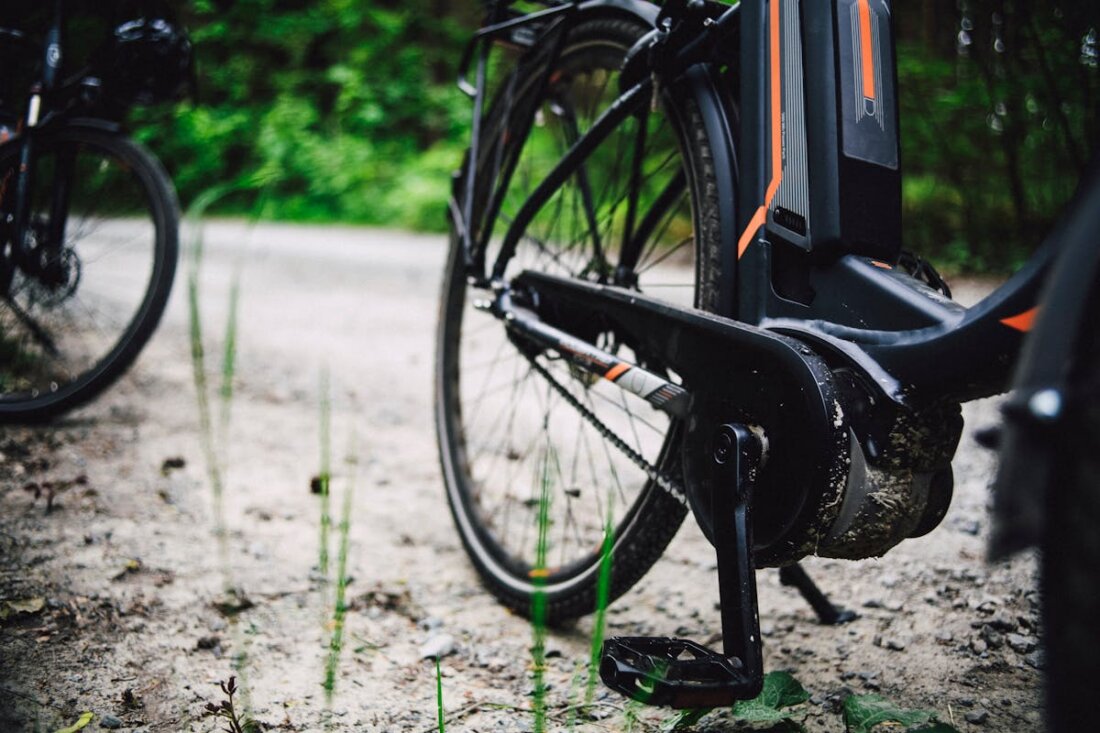
An e-mountain bike has a motor that assists up to 25 km/h. Over 25 km/h: no motor. Downhill: no motor. The motor aids in pedaling; it doesn’t ride for you. You still need to pedal, steer, and have technique. The difference: climbing costs you 50-60% less energy.
This means: more elevation gain per ride, more descents per day, less fatigue for the same distance. For many, this isn’t cheating; it’s an opportunity to ride trails that would be impossible with muscle power alone. Those who also engage in gravel biking without a motor know the difference well.
Critics’ Arguments (and What’s Valid)
Trail Erosion: E-bikes allow for more rides per day, increasing the strain on popular trails. This is a valid point, but the real erosion factors are tire width and rider weight (25-30 kg with bike vs. 12-15 kg for analog MTBs), not motor assistance.
Speed: E-bikers climb faster than analog riders. On narrow trails with oncoming traffic, this can be dangerous. The solution: Respect trail etiquette, don’t speed, yield to pedestrians and slower bikers.
Authenticity: Is it real mountain biking if a motor helps? Purists say no. Pragmatists say: If you’re having fun and getting exercise on a trail, you’re doing sport. Period.
Who an E-MTB Makes Sense For (and Who It Doesn’t)
Makes sense: Over-50s who want to hit the trails again. Couples with different fitness levels. People recovering from injuries or with joint issues. Commuters who want to arrive at work sweat-free and hit the trails on weekends.
Less sense: Young, fit riders looking to build endurance (the motor reduces the training effect). Competitive mountain bikers (E-MTBs have their own categories). Budget-conscious beginners (E-MTBs start at 3,000 Euro, analog MTBs at 1,000).
Let’s be honest: Most E-MTB critics have never ridden one. And most E-MTB riders admit they’d do more for their basic endurance without the motor.
Buying Guide: What You Need to Know
Motor: Bosch Performance CX, Shimano EP8, or Brose Drive S are the leading systems. All deliver 85 Nm of torque, enough for the steepest climbs. The differences lie in responsiveness and natural ride feel.
Battery: 625-750 Wh is the standard for 2026. That’s enough for 80-120 km of mixed-terrain riding. For alpine tours: Range Extender or spare battery (400-600 Euro extra).
Price: Under 3,000 Euro: decent, but compromises on suspension and motor. 3,000-6,000 Euro: the sweet spot with solid suspension and current drivetrain. Over 6,000 Euro: carbon, premium suspension, for those who know what they want.
“The question isn’t whether E-bikes belong on trails. The question is how we make trails accessible and safe for all users.”
DIMB (Deutsche Initiative Mountain Bike), E-MTB Position Paper 2025
 Cool-down
Click on a question to reveal the answer.
Do I need a driver’s license for an E-MTB?
How heavy is an E-Mountainbike?
How long does the battery last?
Can I maintain an E-MTB myself?
Are E-Bikes banned on trails?
Image source: Pexels / Markus Spiske
Translated from the German original using artificial intelligence. The German version is authoritative.