






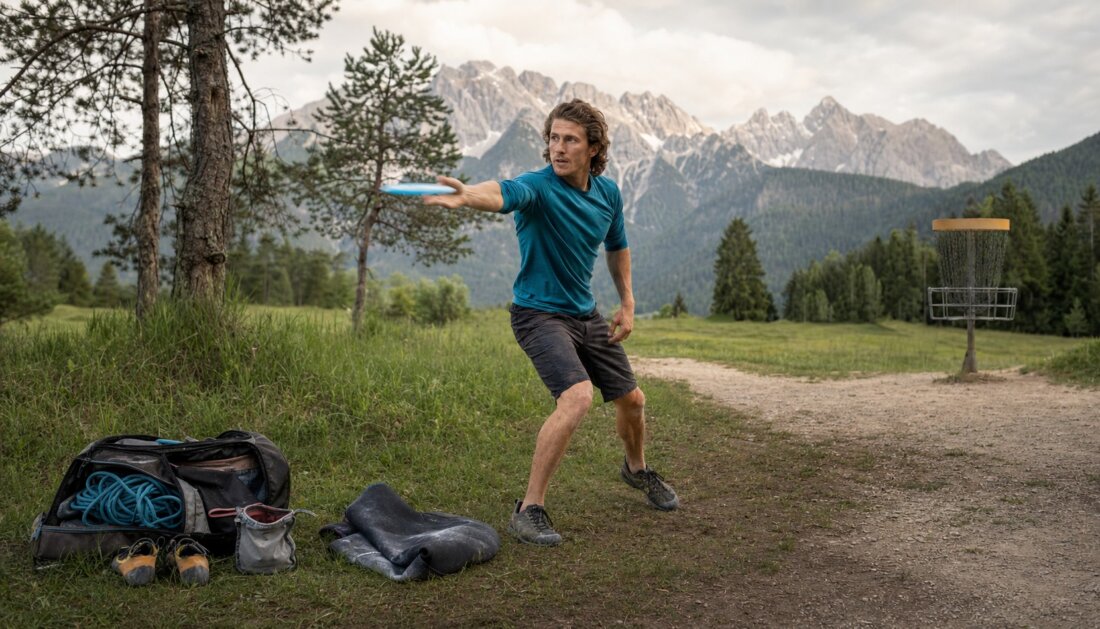
Disc Golf: The Perfect Recovery Training for Surfers and Climbers

6 min read
Twenty throws into a sport I thought was a picnic with plastic discs, and my shoulders felt like I’d just finished a long bouldering session. I hadn’t seen that coming. I’d headed to the course for a relaxed Sunday, only to return with the sensation of having done cross-training that hit the spots left drained by surfing and climbing. All you need is a disc, a meadow, a three-kilometre walk, and a throwing motion that demands more from your core than I’d bargained for.
 Quick Sprint
- ▸ A round of disc golf is three to four kilometres of easy walking plus 18 to 25 explosive throws, delivered at recovery pace rather than in competition mode.
- ▸ The throwing mechanics flow from the hips through the core into the shoulder, engaging the kinetic chain that surfers and climbers usually stress in one direction only.
- ▸ Germany boasts 140 permanent courses, most of them free to use and open to all-no membership, no green fee required.
- ▸ Three discs will get you started: a putter, a mid-range, and a driver. A single all-round disc under twelve euros will do the trick at first.
- ▸ Your heart rate stays low, yet you’re moving for almost an hour, and both rotational directions get their turn. Recovery that doesn’t feel like standing still.
How I realized this was a workout while standing in a meadow
I was only there because a friend wanted to test his new discs. A course on the outskirts of town, freely accessible, a chain basket in the distance that looked like it had stepped out of an early-Eighties sci-fi movie. My first throw landed four metres to my left in the bushes. My twentieth flew halfway straight. And somewhere in between, at basket seven, I noticed I was sweating and my side-core was waking up.
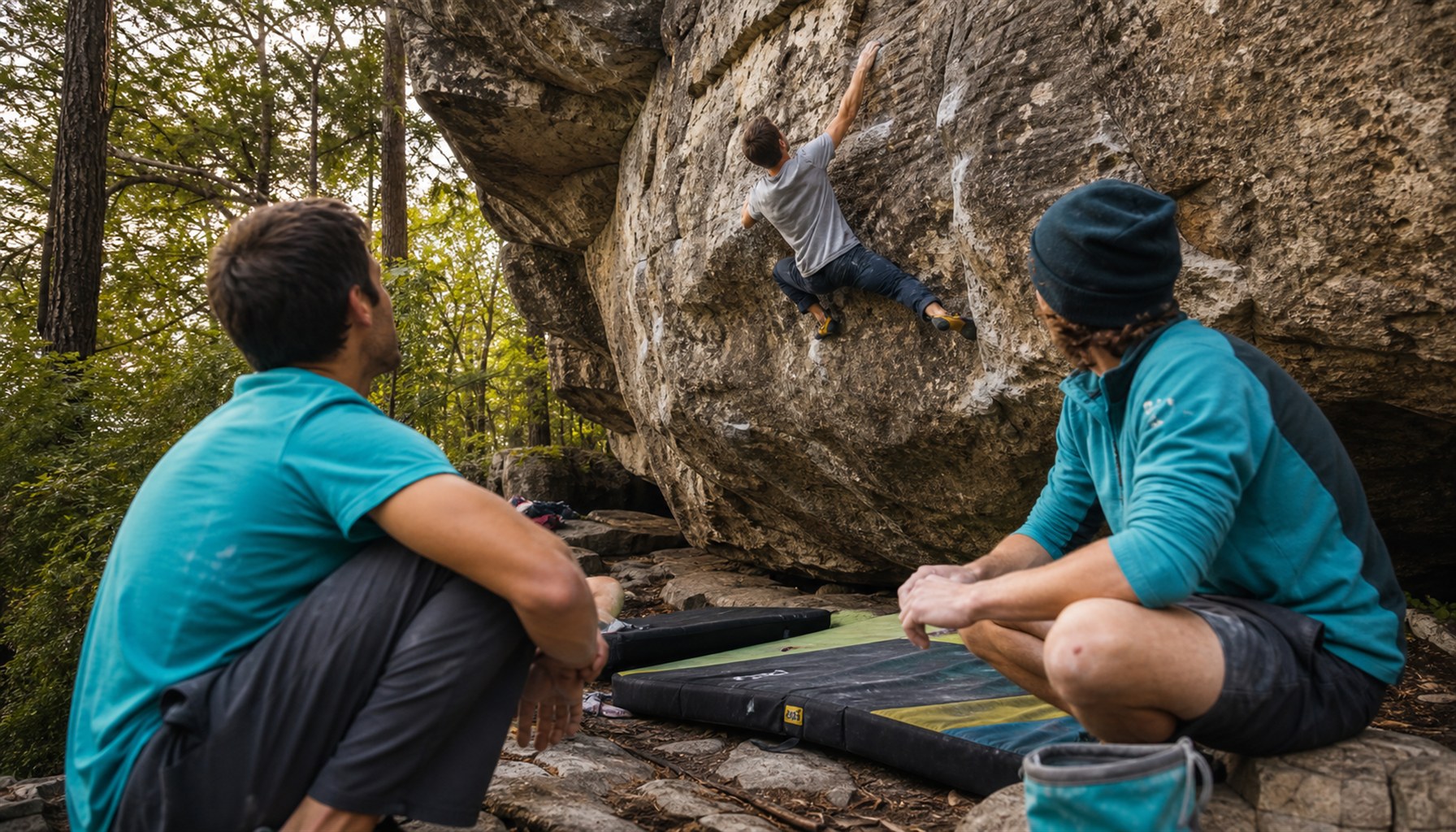
That was the moment. Two days earlier I’d finished a gruelling climbing session that had left my fingers and lats sore. Instead of stiffening up, the tissue loosened with every round. Not because I’d stretched, but because I’d repeated a full-body rotational motion at a moderate tempo for almost an hour. Later I checked: according to the German Frisbee Sports Federation, Germany has 140 permanent installations. Most people never realize they’re walking past a cross-training machine when they pass such a meadow.
What sets Disc Golf apart from a regular stroll is the alternation. You walk easily, then stop, plot a line, and then an explosive hip-driven throw. Walk, plan, throw, move on. This interval of low pulse and short load spikes is exactly what active-recovery programmes describe: keep moving without pushing the system any further.
Why the throwing motion hits exactly what surfing and climbing wear down
Surfing and climbing share a common problem: they heavily strain the upper body in the pulling direction while neglecting rotation. You paddle, you pull yourself up, you hang from your fingers. What rarely happens is a controlled twist from the core, where hips, thoracic spine, and shoulders work together as a kinetic chain. That chain is precisely the disc-golf throwing motion.
A clean backhand throw starts in the legs, loads the hips forward, and releases through a rotation of the thoracic spine into the arm pull. Repeating this for a few rounds mobilizes the thoracic rotation that’s often short-changed when hanging and paddling. And since you can practice both backhand and forehand, you train rotation and core control in both directions instead of always overloading one side.
It took me three weeks to realize why my shoulders felt looser, not more tired, after a Sunday of disc golf. It’s not the effort. It’s the direction of the movement.
The key is dosage. Active recovery only works if your heart rate stays low. If you start launching every throw at full power because your score frustrates you, the whole thing flips into a load that’s meant to regenerate but does the opposite. The rule I’ve settled on: on a recovery day, throw at seventy percent. It’s about the motion, not the distance. If you want to dig deeper into recovery science, we’ve put together an overview of what research actually shows about the 72 hours after intense exertion.
How to start without buying €200 worth of gear
The biggest beginner mistake is buying a fifteen-disc set because a forum recommended it. You only need one disc-maybe three-to begin with. A stable all-rounder under twelve euros will fly far enough for the first few weeks. If you stick with it, add a putter for short range and a driver for distance. Anything more is collecting, not playing.
The rest is common sense. Use the course map from the national association to find a nearby layout; most are free and open to the public. Go with someone who’s thrown before, or watch a basic technique video first. And treat your first round for what it is: a slow day, not a performance test. You’ll only need the international PDGA rating system once competition grabs you.
Now I head out every one or two weeks, usually the day after a long session. It’s the only recovery method where I don’t feel like I’m just sitting around. You’re outside, you’re moving, you’re tossing a disc into a chain basket-and along the way you mobilize the exact kinetic chain your main sport forgets.
Cool-down
Click on a question to reveal the answer.
Is disc golf really intense enough to make a difference?
Which disc should I buy first?
Do you have to pay to play on the courses?
Why is this better for surfers and climbers than jogging?
How often should I play to make it an effective recovery session?

Editorial Team IBS Publishing ››
Trail-running shoes 2026: the wave of releases from Hoka Mafate X to Salomon S/Lab Pulsar 3 →Learn to sail in 2026: earn your Sportbootführerschein See in four weekends + practical training →72 hours after the marathon: what recovery research really proves →London Marathon post-race analysis: what elite splits teach the recreational runner →
Image source: cover and in-article images AI-generated (May 2026), C2PA certificate embedded in image
Translated from the German original using artificial intelligence. The German version is authoritative.