






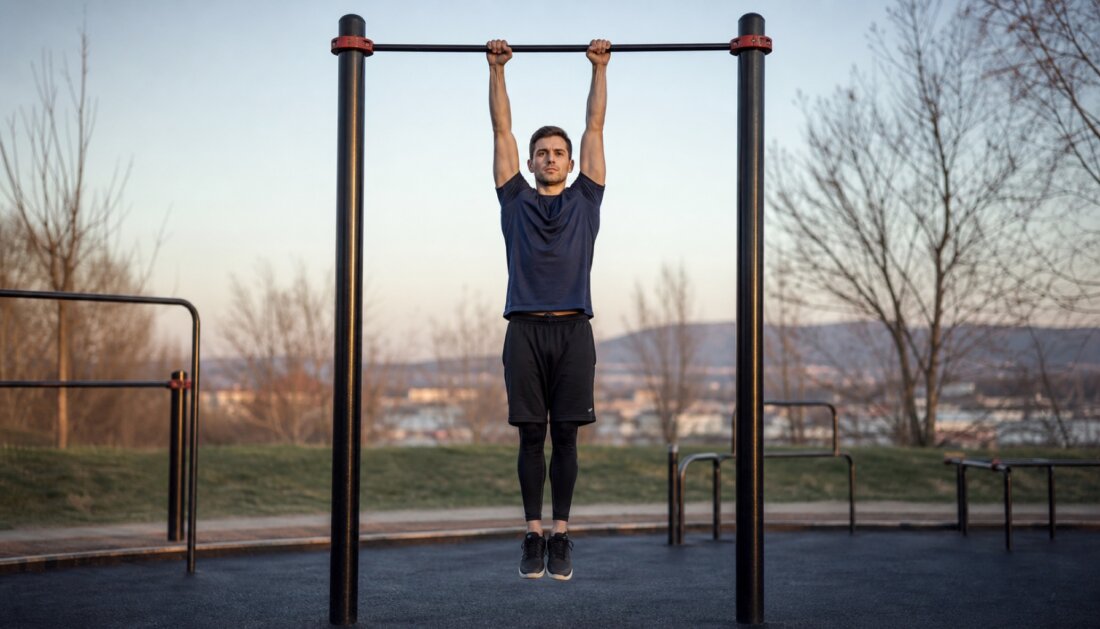
Dead Hang: The Calisthenics Scene’s New Favorite Move

5 Min. Read
Three people, one pull-up bar, not a single pull-up. They just hang. Thirty, forty seconds, shoulders long, eyes forward – and that’s exactly the point. The dead hang is the least spectacular exercise in the entire park, which is precisely why it’s getting more attention in the calisthenics scene right now than almost anything else. No equipment, no gimmicks, just you and gravity.
 Quick Sprint
- ▸ The dead hang is passive hanging from the bar – no strength required, just time under load.
- ▸ It builds grip strength and decompresses the shoulders, while simultaneously opening up the chest to counter rounded screen posture.
- ▸30 seconds is a realistic first goal, 60 a genuinely strong one.
- ▸ All you need is a sturdy bar – just tack it onto your regular training and you’re done.
Why Everyone Suddenly Just Hangs There
Walk through any calisthenics park on a Saturday morning and you’ll see it: between the muscle-up attempts and the handstand sessions, almost everyone just hangs there at some point. No swing, no pull, just hanging. What two years ago barely counted as a warm-up ritual has since evolved into a move in its own right. The reason is straightforward, which is precisely why it’s so compelling: the dead hang works immediately, costs nothing, and makes itself felt – after the very first attempt – exactly where most of us carry chronic tension.

The bouldering and climbing crowd never really abandoned hanging in the first place – grip endurance is hard currency there. What’s new is that the exercise has slipped out of its niche and into everyday life. Fitness creators showcase their 60-second hangs as mini-challenges, physiotherapists recommend passive hanging for shoulder issues, and suddenly everyone is doing it, from seasoned boulderers to people gripping a bar for the very first time.
The beauty of it: hanging is democratic. You don’t need to manage a pull-up, you don’t need any prior skill. You grab on, let go of everything else, and hold as long as you can. That low barrier to entry is exactly what makes the dead hang the perfect entry-level move for anyone curious about calisthenics but put off by muscle-ups and front levers for now.
Grip strength is one of the few everyday markers that physicians directly link to life expectancy, and no exercise trains it more incidentally than simply hanging.
What really happens to your body when you hang
At first glance, nothing seems to be happening – you’re just hanging there. In reality, several regions are working simultaneously. Your forearms support your bodyweight, shoulders and latissimus stabilise the shoulder girdle, and your deep core keeps you from dangling like a wet sack. It’s static work – tension without movement – and that’s precisely what often gets shortchanged in regular training.
The most frequently cited benefit involves the shoulders. When you hang, gravity pulls your upper body downward, creating a gentle traction on the joint. This brief decompression can relieve pressure in the shoulder area, which is why passive hanging is often recommended for impingement complaints. The emphasis on gentle matters: the dead hang is not a miracle cure, it’s mobilisation. For acute pain, the shoulder belongs in a doctor’s office, not on a bar.
Then there’s grip strength – and this is where things get interesting. Population studies have linked a strong hand to lower cardiovascular risk and better overall health for years. Grip strength is less a cause than a reflection: people who grip powerfully tend to be more robust overall. That said, it can still be trained, and few things do it as directly as hanging. Studies on sport climbers found grip endurance rising markedly after just a few weeks of regular hangs – roughly by a quarter. For an exercise that costs nothing and takes up no space, that’s a remarkable return.
And then there’s posture. Anyone who spends most of the day in front of a screen knows the result: shoulders rolled forward, chest closed, upper back rounded. Hanging visibly reverses this pattern by bringing your arms overhead and opening the ribcage. It’s no substitute for more movement throughout the day, but it’s an honest counter-movement in thirty seconds.
How to fit the dead hang into your daily routine
The best thing about hanging is that you don’t need a programme for it. All you need is a solid bar and a bit of patience. Grip shoulder-width apart, palms facing forward, and lower yourself in a controlled manner into the hang position. Keep your shoulders active rather than fully passive in the joints – this protects the tendons. Then hold for as long as it remains comfortably challenging. The first time, that might be ten seconds, and that’s perfectly fine.
The easiest way to stay consistent: attach it to something you already do. After training, after climbing, after a workout in the park. Three to four hangs spread across the day add up faster than a single long attempt ever could. If you have a bar at home, grab it in passing – first thing in the morning or before settling onto the sofa in the evening.
Build up to longer holds gradually. From ten to twenty to thirty seconds, then maintain that across multiple sets. If your grip gives out before the rest of you does, that’s normal – the forearms are often the weakest link. And that’s exactly what we want to strengthen. Once a plain hang starts feeling too easy, variations come into play: touching with one arm, gentle swinging, raising your knees. But that’s advanced territory. The simple dead hang will take you surprisingly far.
Cool-down
Click on a question to reveal the answer.
How long should I hang at the beginning?
Is the dead hang worth it if I can’t do a pull-up yet?
Can I hang every day, or will it damage my shoulders?
Do I need an expensive bar at home?

Editorial IBS Publishing ››
Bouldering for Beginners: Technique Beats Strength →Stand-Up Paddling: The Underrated Full-Body Workout →Mountain Bike Trail Technique: Vision, Braking, Cornering →Running in the Heat: Your Summer Training Guide →DJ Starter Guide: Building Your First Set with Arc and Flow [InspiredByBeatz]→
Cover image source: Pexels / Nikola Vu (px:10021277)
Images in article: AI-generated (June 2026)