






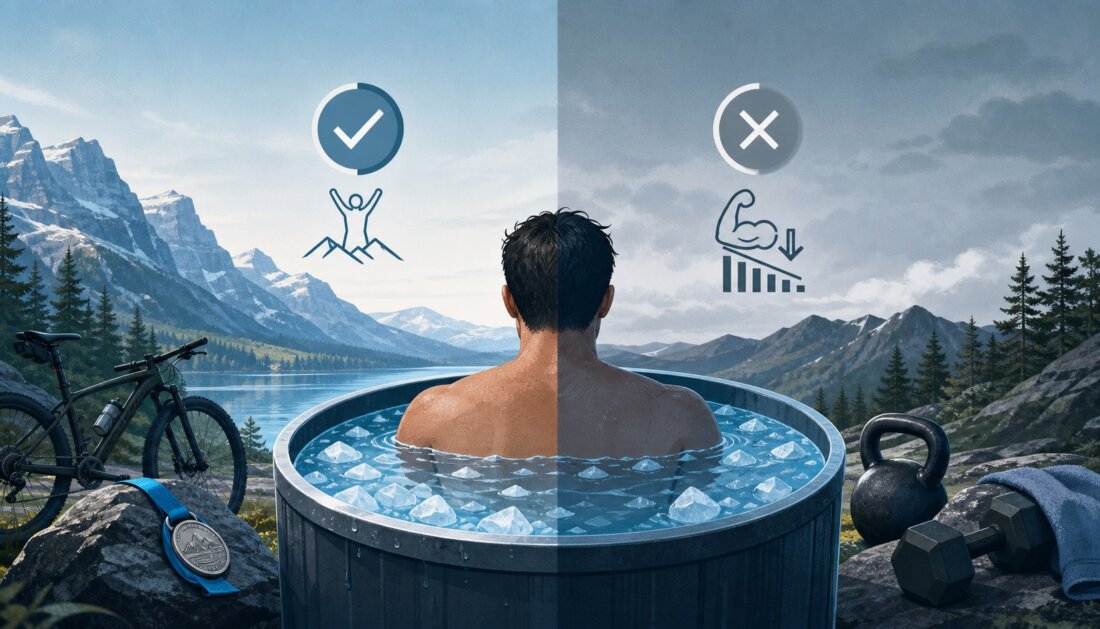
Cold Plunge: When Ice Baths Help Recovery and When They Don’t

4 Min. Read
Three degrees, two minutes, a gritted smile for the phone camera. Ice bathing has gone from a Wim Hof niche thing to a recovery ritual for everyone, and few training trends are getting quite as much hype right now. The science, though, is far less clear-cut than the reels suggest. Cold can help your recovery – or it can actively sabotage exactly what you’re training for. It all depends on when you get in the water.
 Quick Sprint
- ▸ Ice bathing helps with acute recovery – for example after a tough competition when you need to bounce back fast.
- ▸ Applied directly after strength training, cold suppresses muscle growth – current studies are fairly clear on this.
- ▸ The effective window is around 10 to 15 minutes in water between 5 and 10 degrees Celsius.
- ▸ That great feeling afterwards is real – the measurable impact on your performance is often smaller than you’d expect.
Why everyone is suddenly taking the plunge
Ice bathing has come a remarkably long way. What was once dismissed as the quirk of extreme athletes and Wim Hof disciples now sits as a tub with a thermometer in half the CrossFit boxes across the country and on every other recovery reel. The appeal is easy to explain: it looks visibly tough, it feels like self-mastery, and the adrenaline rush afterwards is real. You step out feeling alert, clear-headed, and just a little invincible.
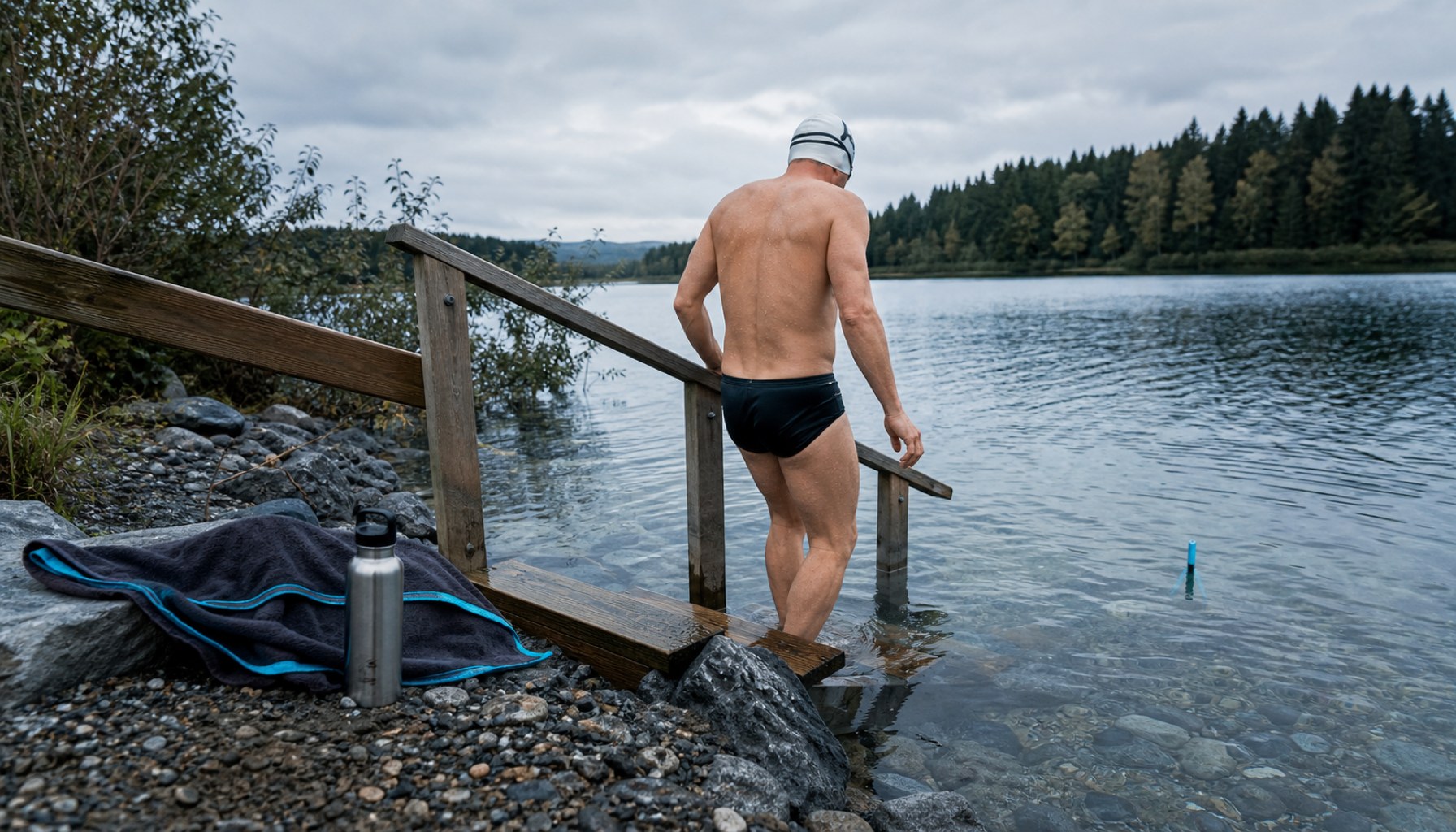
That very feeling is part of the problem, if you look honestly at what is actually happening. Because what feels like a massive training boost is largely your body’s stress response to cold. That is not a bad thing in itself, but it is not the same as evidence that ice bathing makes you fitter or stronger. And this is where it gets interesting.
Research over the past few years has pulled the topic apart thoroughly, and the picture is far more nuanced than any challenge on your feed. Cold is neither miracle cure nor nonsense. It is a tool with a fairly narrow window of genuinely useful application.
The ice bath feels like self-optimisation, but taken straight after strength training it sabotages exactly what you sweated for in the gym.
What the research actually shows
The most important finding first, because it surprises most people: anyone looking to build muscle should not be hitting the ice after strength training. A 2025 study from Maastricht University showed that cold water immediately after training significantly reduces blood flow to the muscles, blocking the uptake of the proteins they need to grow. Multiple review papers reach the same conclusion: regular ice bathing after strength sessions measurably suppresses muscle development over the course of weeks.
For pure endurance, the picture looks different, though far from spectacular. One study had athletes immerse themselves in cold water after high-intensity sessions over five weeks. The result: no effect on oxygen uptake, inflammation markers, or running performance. In plain terms, the cold neither hurt nor helped in any meaningful way. And a controlled 2025 study on women found that neither cold nor warm water noticeably accelerated recovery after muscle-damaging exercise.
Where ice bathing genuinely delivers is in acute recovery. If you have multiple starts on a tournament day, or need to perform again shortly after a gruelling competition, cold can measurably reduce the feeling of heavy legs. It is a short-term aid, not a long-term building block.
How to use cold exposure strategically
The simplest rule: separate your goals. If you want to get stronger and build muscle in the gym, skip the ice bath on strength days – or push it back by several hours. Your body needs the inflammation and increased blood flow after training to adapt. Cool down immediately, and you suppress exactly those signals.
If, on the other hand, you need to bounce back quickly after a tough competition day or a double session, cold is a legitimate tool. Ten to fifteen minutes in cool water – not ice-cold to the point of pain – is enough for the recovery effect. Warmer than you might think is often smarter than the shock of three degrees for the sake of a video.
And if you simply enjoy it because it clears your head: that’s completely fine. The mental effect – that alert, grounded feeling afterwards – is real, and for many people it’s the actual reason. You just need to know that you’re bathing for wellbeing, not for muscle growth. Keeping that distinction clear leads to better decisions, much like deliberately weaving small training blocks into your daily routine.
Cool-down
Click on a question to reveal the answer.
How cold and how long should the water be?
Why should I avoid an ice bath right after strength training?
Does ice bathing actually improve endurance performance?
Is the mental effect just imagination?

Editorial IBS Publishing ››
Dead Hang: Why This Exercise Is Becoming the Calisthenics Scene’s Favourite Workout →Running in the Heat: The Training Guide for Summer →Bouldering for Beginners: Technique Beats Strength →Stand-Up Paddling: The Underrated Full-Body Workout →Sound Machines for Everyone: How Clones Are Shaking Up the Synth Market [InspiredByBeatz]→
Image credits: Cover image and article images AI-generated (June 2026), C2PA certificate embedded in image