







Biathlon Data: Using Pulse and Shooting Quota for Hobby Athletes

6 Min. Read Time
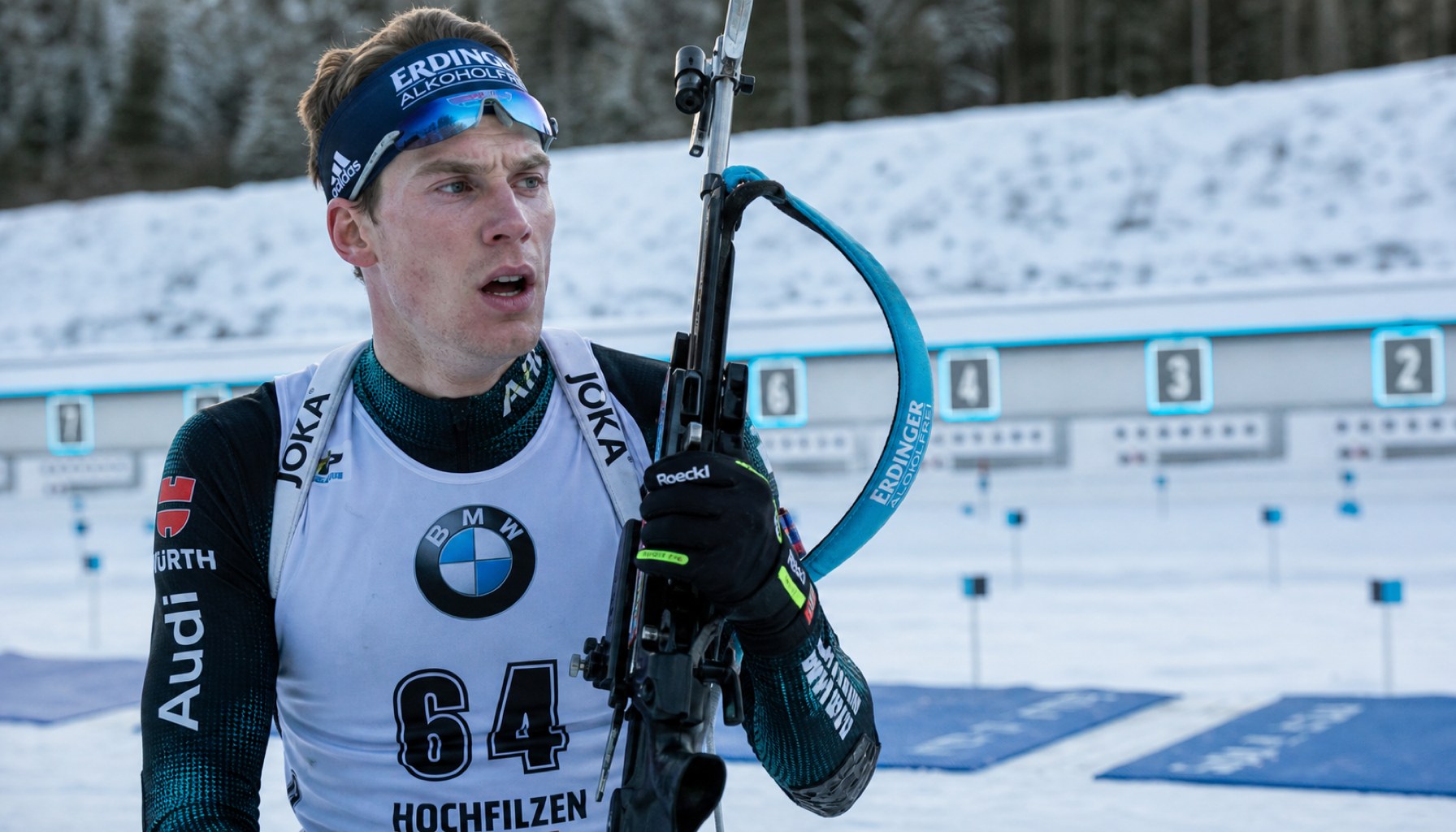
With almost 180 beats per minute, a biathlete arrives at the shooting range, then has to fire five shots, each hitting a target of 4.5 centimeters. This is the most brutal part of the entire sport: first, bursting the lungs, then keeping the finger steady. What biathletes do with their bodies in these 50 seconds has become measurable, and the data tells a story that concerns every hobby athlete who has ever tried to make a precise movement with trembling legs. It’s not about winter sports; it’s about precision under pressure.
 Short Sprint
- ▸ The core conflict is measurable: Biathletes reach the shooting range with around 90 percent of their maximum heart rate and shoot at 85 to 87 percent.
- ▸ In 50 to 60 seconds they lower their pulse by 10 to 12 beats before the first shot is fired. Active shutdown, not coincidence.
- ▸ Pros fire during diastole, i.e., during the pause between two heartbeats. Beginners shoot randomly through the rhythm.
- ▸ Precision is not linear: Studies show the highest hit rate at rest and around 70 percent of the heart rate, not at the limit.
- ▸ Three lessons for you: Control recovery instead of suffering it, use breathing as a tool, and don’t force fine motor tasks at maximum pulse.
The Moment of Truth
Imagine sprinting up a staircase and then immediately needing to thread a needle. That’s essentially biathlon, but with a rifle and under competitive pressure. Sports science has been measuring this transition for years, and the numbers are remarkably consistent: on the track, the heart rate is around 90 percent of the maximum, and upon arrival at the shooting range, it’s still between 85 and 87 percent. From this state, athletes must hit five shots.
What’s fascinating isn’t that athletes have a high heart rate – that’s expected. What’s fascinating is what they do with it in the following seconds. Instead of waiting for their body to calm down on its own, they actively bring it down. Measurements show a decrease of 10 to 12 beats in 50 to 60 seconds, precisely in the window between arrival and the first shot. Anyone who’s trained with a pulse monitor on their wrist knows how challenging it is to regulate their heart rate so quickly.
This 70 percent mark is perhaps the most surprising finding. One might assume that the calmer the athlete, the better, and thus the hit rate would be maximal in complete calmness. Research paints a more nuanced picture: accuracy is high at rest, decreases with increasing load, but has a remarkably stable range at moderate intensity. The body needs a certain level of activation to be alert and focused. Too little is just as bad as too much.
What the data reveals about precision under pressure
The most fascinating difference between professionals and beginners lies in a detail that would be invisible without measurement techniques: the timing of the trigger pull. Every heartbeat generates a tiny recoil in the body, a ballistocardiac impulse that minimally moves the rifle. Professionals almost invariably take the shot during diastole, the relaxation phase between two beats, when the body is at its calmest.
Beginners don’t do that. They shoot fairly evenly distributed over the entire cardiac cycle, sometimes in the middle of a beat, sometimes during a pause. And here’s where it gets instructive: when the same beginners deliberately shoot during diastole, their hit rate measurably increases. Timing, therefore, is not innate; it can be trained. The difference lies in the conscious handling of one’s own rhythm.
| Aspect | Professional Biathlete | Typical Beginner |
|---|---|---|
| Trigger Pull Timing | almost always during diastole | randomly distributed over the cardiac cycle |
| Pulse at Target | actively reduced to 85 percent | remains high, no targeted reduction |
| Breathing Before the Shot | conscious breathing pause, shot at the end of exhalation | shallow and rushed, no rhythm |
Breathing is the connecting link. It is the only part of the autonomic nervous system that we can consciously control, and through it, the pulse can be influenced. Biathletes use a short, controlled breathing pause and take the shot at the end of exhalation, when the chest is still. The same mechanism is known to archers, target shooters, and, incidentally, surgeons.
Three Lessons for Your Own Training
You’ll never stand at a shooting range, but the principle behind it applies constantly: performing a fine-motor or concentration-intensive task directly after physical exertion. The trail runner who needs to navigate technical terrain after a steep climb. The climber who sets a precise grip after a crux move. The lessons from biathletes can be directly applied.
Firstly, actively manage recovery instead of passively enduring it. When you do something precise after intense exertion, don’t wait for your body to calm down on its own. Use those few seconds consciously: lower your shoulders, relax your jaw, and exhale. This gives you exactly the window where fine-motor control works again.
Secondly, understand breathing as a tool. A slow, controlled exhalation lowers your pulse and calms your nervous system in seconds. The decisive moment for every precise action lies at the end of exhalation, when your body is at its calmest. This costs nothing and works immediately.
Thirdly, don’t try to force it to the maximum. The 70-percent insight is a permission: you don’t need to be completely rested for precision, but not at the limit either. When planning a technical passage, consciously reduce the intensity beforehand. This applies to the trail just as it does to training management over an entire season. Data gives you the leverage, and your feeling decides the rest.
Cool-down
Click on a question to reveal the answer.
Can amateur athletes actually train shooting during diastole?
Does the 70-percent rule apply to every sport?
Do I need a heart rate monitor to benefit from this?
Why don’t biathletes just shoot slower and steadier?

Editorial Team, IBS Publishing ››
Kitesurf Tracker Test: Fitbit Air vs Whoop vs Apple Watch →
Critérium du Dauphiné: 5 Endurance Training Lessons →
Master the Pull-Up: 8-Week Plan for Your First Rep →
Mobility Training: 15 Minutes That Will Transform Your Workout →
Image source: AI-generated (June 2026), C2PA certificate embedded in image
Translated from the German original using artificial intelligence. The German version is authoritative.