






Bouldering Psychology: How Hard Moves Rewire Your Brain
Action Sports · Bouldering

20.04.2026
The climbing move you just failed wasn’t a strength issue. It was a planning issue. A working memory problem. An inhibition control challenge. All at once. Bouldering is probably the most undercover cognitive training method in sports—and brain research is only now, in 2026, beginning to grasp how deep the impact truly goes.
Bouldering is motor learning research that makes you sweat
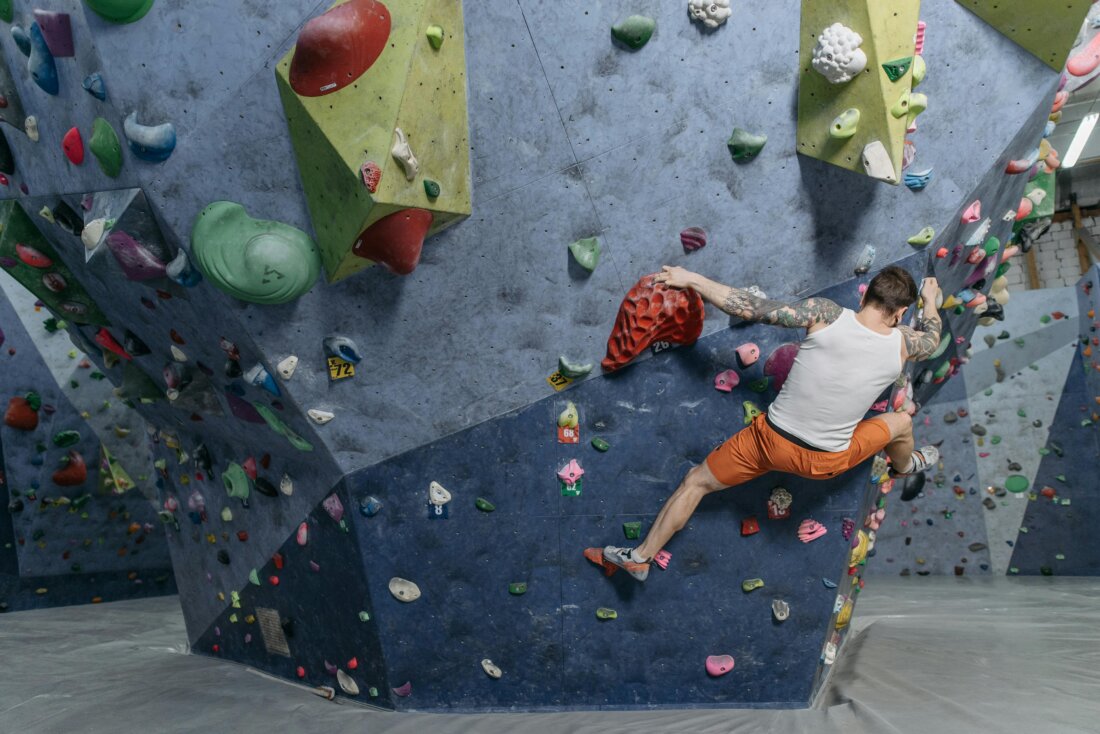
Bouldering is rope-free climbing at low heights, typically on artificial walls up to four meters high. Each route is called a “boulder” or “problem” and is graded by difficulty (Fontainebleau scale from 3 to 9a, V-scale from V0 to V17). The sport has one crucial characteristic that sets it apart from nearly every other indoor discipline: every wall is different, and each boulder presents a new cognitive pattern.
When you face a problem, more is happening in your brain than you might think. You scan the wall, break the route into discrete movement sequences, assess the friction of footholds, and evaluate three possible sequences simultaneously. Then you actively suppress the one that failed you on your last attempt. Only then do you begin the move. Neuroscientifically, this is precisely the loop running in the prefrontal and parietal cortices—responsible for working memory, spatial planning, and inhibition.
The study “Executive Functions and Domain-Specific Cognitive Skills in Climbers” (PMC8066095, 2021) measured this loop. Climbers with at least three years of experience significantly outperformed the control group in domain-specific working memory tests. The authors interpret this as evidence that repeatedly memorizing movement sequences trains a form of visuospatial working memory rarely challenged in other sports.
This is the point strength-training purists miss. Weight training rewards repetition. Bouldering rewards reinterpretation. Every move is a new decision tree. Your brain must navigate it in real time while your fingers are already gripping the edge. If you’re looking for a similar blend of physical effort and mental navigation, you’ll find it primarily in the via ferrata and sport climbing with ropes, but not in conventional gym workouts.
What 50 Percent More Working Memory Really Means
The perhaps sharpest work doesn’t come directly from the climbing scene but rather from an experiment conducted in 2015 by Ross Alloway, Tracy Alloway, and Philip Tomporowski at the University of North Florida. The participants engaged in two hours of proprioceptively demanding movement—tree climbing, balancing on beams, carrying asymmetrical loads. At its core, this was exactly what happens during bouldering. Afterward, their working-memory capacity was 50 percent higher than before the training.
Fifty percent. In two hours. That’s not an effect you’d get from an afternoon of aerobic exercise or yoga. According to the authors, the trigger is that the movement must be proprioceptively challenging. It must have a clear goal. It must demand continuous spatial orientation. Bouldering meets all three criteria simultaneously. A treadmill meets only one—and even then, quite weakly.
Expert Quote
“The effect we measured was dramatic. After just two hours of proprioceptive movement, working memory improved by 50 percent. We believe it’s the cognitive demand during the movement—constant thinking, planning, and adjusting—that drives the effect, not just the physical exertion alone.”
Tracy Packiam Alloway, University of North Florida, Perceptual and Motor Skills, 2015
Practically speaking, if you spend two hours bouldering, you’ll leave the gym not only with sore fingers but measurably sharper in your thinking than when you walked in. The only open question is how long the effect lasts—and how strongly it accumulates over weeks or even years. The study itself didn’t include any long-term follow-up measurements, but other research provides some clues.
An exploratory study in the Spanish Journal of Psychology showed in 2024 that climbing performance correlates directly with individual working-memory capacity. The higher the capacity, the better the performance on the rock. Whether this is cause or effect remains unclear—but probably both. Strong climbers have strong working memories because they train them constantly.
The Brain Anatomy of Real Boulders
Boulderers who train regularly over the years structurally rewire their brains. Di Paola and colleagues have used MRI to demonstrate enlarged Vermis volumes in the cerebellum among world-class rock climbers. Additionally, there is a slightly enlarged right medial posterior parietal area. Both structures belong to the motor learning system. The cerebellum fine-tunes movement, while the parietal area processes spatial information.
This isn’t just academically relevant. It means your brain physically responds when you consistently learn and refine new movement patterns. You’re not “just stronger” after two years of bouldering—you have an anatomically different brain. The effect is comparable to findings from the musician’s brain: professionals also show structural differences in motor and auditory areas. Brains are more plastic than most people assume, and bouldering engages multiple layers simultaneously.
The 2024 Frontiers Review on the role of neural oscillations in sport-induced brain remodeling shows that movement requiring cognitive planning strongly modulates theta and alpha oscillations in the prefrontal cortex. These are precisely the frequency ranges active in classic working-memory experiments. In other words, bouldering trains the same neural infrastructure you need when playing chess or doing strategy planning at work. No wonder many of the most productive people in tech companies now commute to climbing gyms instead of the gym.
How to Use This Effect Consciously
If this data convinces you—and you’ve been training for a while—you can shape your bouldering in two ways. The first is the classic approach: many repetitions on routes you already know, aiming to automate strength and technique. That’s valid. That’s necessary. The second, more cognitively engaging method, is consistently working on projects that challenge you mentally—new sequences, unfamiliar styles, on-sight attempts instead of redpoints.
Elite sports coaches have been preaching this for years. On-sight bouldering (attempting a problem for the first time, without beta from others or prior analysis of the solution) is a direct stress test for your working memory. You have to build the route in your mind, execute the first move, update the mental image, then adapt the second move accordingly. This is cognitive hardcore mode. Anyone who regularly climbs on-sight trains precisely the executive functions needed in real life when facing new, unplanned situations.
For beginners, less is enough. Try a new problem just slightly above your current level. Before your first attempt, create three different plans. Run through them mentally. Then start. If you fail, re-plan. Your brain notices the difference to mindless repetition immediately—and after four weeks, you’ll feel sharper even outside the gym. A similarly strong transfer effect occurs with skateboarding after 30, where constantly reassessing terrain and body posture acts as cognitive stress.
One final practical note. The motor learning field distinguishes between open and closed skills. Closed skills include weightlifting, swimming in a pool, or running on a treadmill. Open skills include tennis, soccer, parkour, and bouldering. Open skills demonstrably enhance transfer to everyday life. You don’t just become better at climbing—you become better at handling the unexpected. This explains why older amateur boulderers often seem remarkably mentally sharp, while pure strength athletes tend to become more rigid with age. It’s not a life philosophy. It’s neuroplasticity.
 Cool-down
Click a question to expand the answer.
Does the cognitive effect last for years?
Is a bouldering gym enough, or does it have to be outdoors?
Is bouldering better for the brain than running or yoga?
How often should I go for it to have cognitive benefits?
Does the effect work for older climbers too?
Header image source: Pexels / Pavel Danilyuk