






Transvulcania 2026: Sinclair Shatters the 11-Year Record

28 May 2026
⏱ 6-minute read
On 9 May 2026, David Sinclair stormed the Transvulcania in 6:32:24, slicing 20 minutes off Luis Alberto Hernando’s 2015 course record. Behind him, Andreas Reiterer from South Tyrol finished sixth, while Daniela Oemus became the top German woman in seventh place. Three weeks later, you can learn more from that single day on La Palma than from any Instagram training plan.
Why 6:32:24 is more than just a fast time
A course record that has stood for eleven years doesn’t fall because a runner has a good day. Hernando’s mark from 2015 was considered untouchable because the course has barely changed and the competition has been fierce in recent years. Sinclair set the early pace on the first half, the climb from the coast up to Roque de los Muchachos. At 2,421 metres, he ran deliberately conservatively instead of going all-out early.
That’s the lesson many trail runners miss. On a 75-kilometre course with climbing that feels like a via ferrata, you can’t win the first hour. You can, however, lose it.
Sinclair said after the race it was the best race of his life. Check the split times on iRunFar and you’ll see what he meant. He ran the second half faster than the first. A negative split over an ultra distance with more than 4,000 metres of climbing is rare-and it takes brains.
Reiterer and Oemus – what the German-speaking sixth and seventh places reveal
What often gets lost in the international recap: sixth place among the men went to Andreas Reiterer from Italy, deeply rooted in the South Tyrolean trail scene, finishing in 6:49:52. A time that would have been outright world-class ten years ago but now merely earns an honourable sixth place. That jump alone tells you how fast the trail elite has become.
In the women’s race, Germany’s Daniela Oemus crossed the line seventh in 8:44:42. That’s no fluke. Oemus has spent years bridging the gap from national contender to the international field, and Transvulcania is one of the toughest races you can pick to do it.
If you toe the line at any of the trail races between the Allgäu and Tyrol this summer, that’s the honest yardstick-not Sinclair’s sub-6:30 world, but the pacing discipline that lets Reiterer and Oemus cover such distances. The Zone-2 debate from May just got a new tone after this weekend.
What you, as a trail runner, should take from the pace profile
Transvulcania is split into three phases-and that’s exactly how you should think about your own race. Phase one is the climb to 2,421 metres. Most runners make the same mistake here: too fast, too soon. Sinclair stayed up front but conserved his nervous system for later.
Phase two is the long downhill to the coast. Two thousand metres of descent sounds like recovery, but for quads and knees it’s the most brutal section. Braking with floppy legs here means you’ll have nothing left for phase three. Running loose and letting gravity pull you forward saves seconds without burning extra energy.
Phase three is the final climb up around 350 metres above Los Llanos. After 65 kilometres it sounds like nothing-yet that’s where Sinclair built his negative split because he still had reserves left.
Translation for your next race: plan any distance over 50 kilometres in three phases with clear pace bands. The first phase should always feel 5 to 10 percent slower than what your legs are screaming for.
The Vertical Kilometer race redefines the benchmark
On the day before the Ultra, Richard Omaya Atuya completed the Vertical Kilometer in 45:01, setting a new course record. 1,000 metres of elevation in under 46 minutes-this is the work economy that recalibrates every standard in mountain running. Joyce Njeru claimed the women’s title in 55:02.
What does this mean for you? Nothing and everything. No one expects you to clock a VK time under an hour. Yet your local peak offers the same test on a smaller scale. Pick 200 metres of continuous climb, run it ten times in four weeks, and you’ll have a concrete number to measure yourself against. That’s more honest than any training plan promising watts per kilo.
If you’re eyeing the via ferrata season or your first mountain race, May is the month to lock in this routine. Whoever hasn’t started by June will be playing catch-up in August.
Sinclair’s showing reshuffles the trail season
Transvulcania has long been the spring event where the global trail elite realigns. With Sinclair in front, Sweden’s Petter Engdahl in second and Italy’s Nadir Maguet in third, it’s clear the summer slate-from UTMB to Sierre-Zinal-will look different than in 2024.
For the mountain-running scene between Garmisch and Innsbruck, two things follow: first, the bar for top-ten finishes on big stages has just been raised; second, athletes like Reiterer and Oemus are primed to chase that bar. You can watch their races unfold live over the coming months. Trail season 2026 is already firing on all cylinders.
If you’re still planning an ultra this year, use La Palma as a reminder: speed comes from mind and pacing, not legs alone. Log a few sessions at HYROX-Tempelhof as cross-training now, and by August you’ll have a solid buffer for the trail distance.
 Cool-down
Click on a question to reveal the answer.
Where did Transvulcania 2026 take place and on which date?
Who held the course record before Sinclair and what was the time?
What lessons can I take from this race for my first ultra?
Were there any German, Austrian or Swiss runners in the top field?
What does Sinclair’s season opener tell us about the summer trail races ahead?

IBS Publishing Desk ››
HYROX Doubles in Tempelhof: lessons pairs can take from the season finale before signing up again →Bikepacking 2026: why DACH outdoor athletes are switching from gravel bikes to touring setups →Roland Garros 2026 is on: lessons hobby players can take from the clay-court season →Fitbit Air launches today for €99: what Google’s Whoop-killer means for outdoor athletes →Sleep and recovery: how wearables and AI can truly optimise your training →
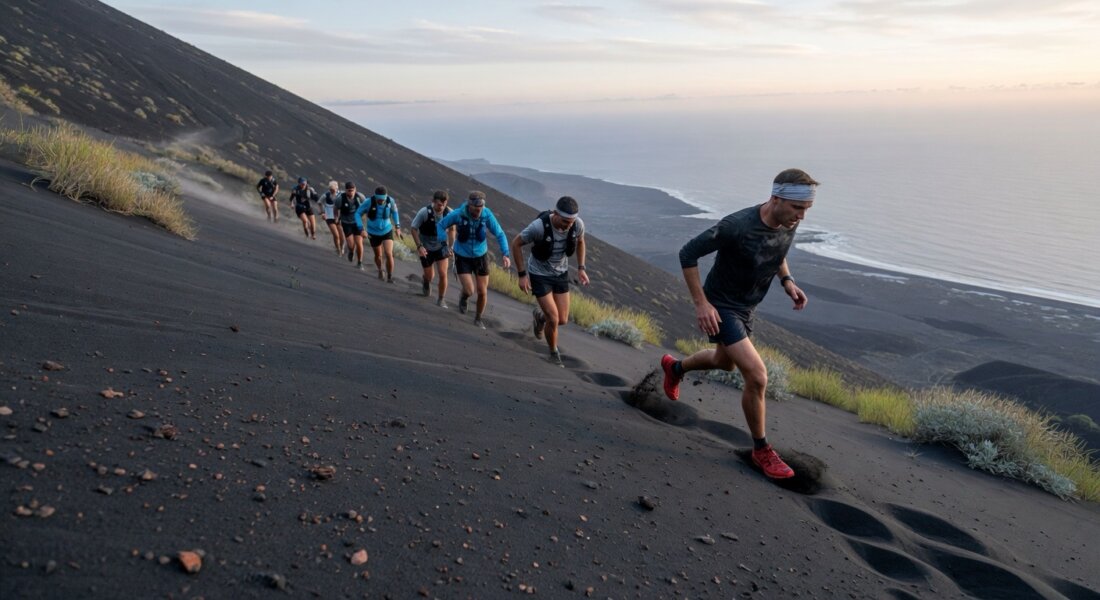
Image: AI-generated (May 2026)
Translated from the German original using artificial intelligence. The German version is authoritative.